Patrik Bjärterot, Anna Nilsson, Reza Shariatgorji, Theodosia Vallianatou, Ibrahim Kaya, Per Svenningsson, Lukas Käll, Per E. Andrén
{"title":"Met-ID: An Open-Source Software for Comprehensive Annotation of Multiple On-Tissue Chemical Modifications in MALDI-MSI","authors":"Patrik Bjärterot, Anna Nilsson, Reza Shariatgorji, Theodosia Vallianatou, Ibrahim Kaya, Per Svenningsson, Lukas Käll, Per E. Andrén","doi":"10.1021/acs.analchem.5c00633","DOIUrl":null,"url":null,"abstract":"Here, we introduce Met-ID, a graphical user interface software designed to efficiently identify metabolites from MALDI-MSI data sets. Met-ID enables annotation of <i>m</i>/<i>z</i> features from any type of MALDI-MSI experiment, involving either derivatizing or conventional matrices. It utilizes structural information for derivatizing matrices to generate a subset of targets that contain only functional groups specific to the derivatization agent. The software is able to identify multiple derivatization sites on the same molecule, facilitating identification of the derivatized compound. This ability is exemplified by FMP-10, a reactive matrix that assists the covalent charge-tagging of molecules containing phenolic hydroxyl and/or primary or secondary amine groups. Met-ID also permits users to recalibrate data with known <i>m</i>/<i>z</i> ratios, boosting confidence in mass match results. Furthermore, Met-ID includes a database featuring MS2 spectra of numerous chemical standards, consisting of neurotransmitters and metabolites derivatized with FMP-10, alongside peaks for FMP-10 itself, all accessible directly through the software. The MS2 spectral database supports user-uploaded spectra and enables comparison of these spectra with user-provided tissue MS2 spectra for similarity assessment. Although initially installed with basic data, Met-ID is designed to be customizable, encouraging users to tailor the software to their specific needs. While several MSI-oriented software solutions exist, Met-ID combines both MS1 and MS2 functionalities. Developed in alignment with the FAIR Guiding Principles for scientific software, Met-ID is freely available as an open-source tool on GitHub, ensuring wide accessibility and collaboration.","PeriodicalId":27,"journal":{"name":"Analytical Chemistry","volume":"5 1","pages":""},"PeriodicalIF":6.7000,"publicationDate":"2025-04-20","publicationTypes":"Journal Article","fieldsOfStudy":null,"isOpenAccess":false,"openAccessPdf":"","citationCount":"0","resultStr":null,"platform":"Semanticscholar","paperid":null,"PeriodicalName":"Analytical Chemistry","FirstCategoryId":"92","ListUrlMain":"https://doi.org/10.1021/acs.analchem.5c00633","RegionNum":1,"RegionCategory":"化学","ArticlePicture":[],"TitleCN":null,"AbstractTextCN":null,"PMCID":null,"EPubDate":"","PubModel":"","JCR":"Q1","JCRName":"CHEMISTRY, ANALYTICAL","Score":null,"Total":0}
引用次数: 0
Abstract
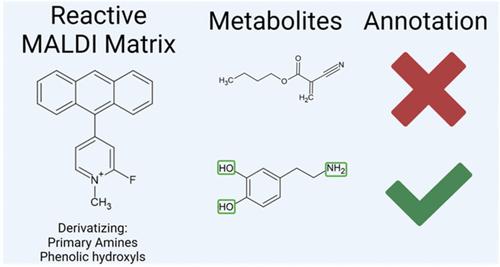
Here, we introduce Met-ID, a graphical user interface software designed to efficiently identify metabolites from MALDI-MSI data sets. Met-ID enables annotation of m/z features from any type of MALDI-MSI experiment, involving either derivatizing or conventional matrices. It utilizes structural information for derivatizing matrices to generate a subset of targets that contain only functional groups specific to the derivatization agent. The software is able to identify multiple derivatization sites on the same molecule, facilitating identification of the derivatized compound. This ability is exemplified by FMP-10, a reactive matrix that assists the covalent charge-tagging of molecules containing phenolic hydroxyl and/or primary or secondary amine groups. Met-ID also permits users to recalibrate data with known m/z ratios, boosting confidence in mass match results. Furthermore, Met-ID includes a database featuring MS2 spectra of numerous chemical standards, consisting of neurotransmitters and metabolites derivatized with FMP-10, alongside peaks for FMP-10 itself, all accessible directly through the software. The MS2 spectral database supports user-uploaded spectra and enables comparison of these spectra with user-provided tissue MS2 spectra for similarity assessment. Although initially installed with basic data, Met-ID is designed to be customizable, encouraging users to tailor the software to their specific needs. While several MSI-oriented software solutions exist, Met-ID combines both MS1 and MS2 functionalities. Developed in alignment with the FAIR Guiding Principles for scientific software, Met-ID is freely available as an open-source tool on GitHub, ensuring wide accessibility and collaboration.
期刊介绍:
Analytical Chemistry, a peer-reviewed research journal, focuses on disseminating new and original knowledge across all branches of analytical chemistry. Fundamental articles may explore general principles of chemical measurement science and need not directly address existing or potential analytical methodology. They can be entirely theoretical or report experimental results. Contributions may cover various phases of analytical operations, including sampling, bioanalysis, electrochemistry, mass spectrometry, microscale and nanoscale systems, environmental analysis, separations, spectroscopy, chemical reactions and selectivity, instrumentation, imaging, surface analysis, and data processing. Papers discussing known analytical methods should present a significant, original application of the method, a notable improvement, or results on an important analyte.



 京公网安备 11010802042870号
京ICP备2023020795号-1
京公网安备 11010802042870号
京ICP备2023020795号-1

 分享
分享
 求助内容:
求助内容: 应助结果提醒方式:
 扫码关注我们
