A Mitochondria-Targetable Europium(III) Complex-Based Probe for Time-Gated Luminescence and Lifetime Detection of Hypochlorous Acid In Vitro and In Vivo
Zhuo Wang, Yundi Huang, Bo Song, Yuanyuan Shi, Jingli Yuan
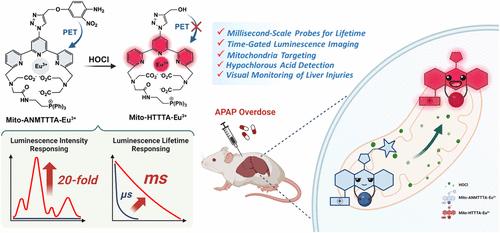
{"title":"A Mitochondria-Targetable Europium(III) Complex-Based Probe for Time-Gated Luminescence and Lifetime Detection of Hypochlorous Acid In Vitro and In Vivo","authors":"Zhuo Wang, Yundi Huang, Bo Song, Yuanyuan Shi, Jingli Yuan","doi":"10.1021/acs.inorgchem.5c00525","DOIUrl":null,"url":null,"abstract":"We proposed a strategy for developing a mitochondria-targeting lanthanide complex-based probe, Mito-ANMTTTA-Eu<sup>3+</sup>, designed for hypochlorous acid (HClO) detection using time-gated luminescence intensity and lifetime modes. The probe consists of a terpyridine polyacid-Eu<sup>3+</sup> complex as the luminophore, a 4-amino-3-nitrophenyl group for HClO recognition, and a triphenylphosphonium (TPP) group as the mitochondrial-targeting moiety. The probe initially exists in a “dark state,” characterized by a relatively short luminescence lifetime. Upon reaction with HClO, the time-gated luminescence (TGL) intensity and the average luminescence lifetime of Mito-ANMTTTA-Eu<sup>3+</sup> increased by approximately 20-fold and 15-fold, respectively. These features enable sensitive and accurate detection of HClO by utilizing TGL and luminescence lifetime as complementary detection strategies. Cell imaging studies revealed that the probe was predominantly localized in the mitochondria after coculture with live cells, and it could effectively image both endogenous and exogenous HClO in mitochondria under background-free TGL mode. Furthermore, the probe was effectively implemented for the imaging of HClO in zebrafish and the livers of drug-induced liver injury (DILI) mice, revealing a positive correlation between HClO levels and the degree of DILI. Consequently, this study paves a new way for designing lanthanide complex-based dual-made luminescent probes for biosensing and bioimaging.","PeriodicalId":40,"journal":{"name":"Inorganic Chemistry","volume":"6 1","pages":""},"PeriodicalIF":4.7000,"publicationDate":"2025-04-21","publicationTypes":"Journal Article","fieldsOfStudy":null,"isOpenAccess":false,"openAccessPdf":"","citationCount":"0","resultStr":null,"platform":"Semanticscholar","paperid":null,"PeriodicalName":"Inorganic Chemistry","FirstCategoryId":"92","ListUrlMain":"https://doi.org/10.1021/acs.inorgchem.5c00525","RegionNum":2,"RegionCategory":"化学","ArticlePicture":[],"TitleCN":null,"AbstractTextCN":null,"PMCID":null,"EPubDate":"","PubModel":"","JCR":"Q1","JCRName":"CHEMISTRY, INORGANIC & NUCLEAR","Score":null,"Total":0}
引用次数: 0
Abstract
We proposed a strategy for developing a mitochondria-targeting lanthanide complex-based probe, Mito-ANMTTTA-Eu3+, designed for hypochlorous acid (HClO) detection using time-gated luminescence intensity and lifetime modes. The probe consists of a terpyridine polyacid-Eu3+ complex as the luminophore, a 4-amino-3-nitrophenyl group for HClO recognition, and a triphenylphosphonium (TPP) group as the mitochondrial-targeting moiety. The probe initially exists in a “dark state,” characterized by a relatively short luminescence lifetime. Upon reaction with HClO, the time-gated luminescence (TGL) intensity and the average luminescence lifetime of Mito-ANMTTTA-Eu3+ increased by approximately 20-fold and 15-fold, respectively. These features enable sensitive and accurate detection of HClO by utilizing TGL and luminescence lifetime as complementary detection strategies. Cell imaging studies revealed that the probe was predominantly localized in the mitochondria after coculture with live cells, and it could effectively image both endogenous and exogenous HClO in mitochondria under background-free TGL mode. Furthermore, the probe was effectively implemented for the imaging of HClO in zebrafish and the livers of drug-induced liver injury (DILI) mice, revealing a positive correlation between HClO levels and the degree of DILI. Consequently, this study paves a new way for designing lanthanide complex-based dual-made luminescent probes for biosensing and bioimaging.
期刊介绍:
Inorganic Chemistry publishes fundamental studies in all phases of inorganic chemistry. Coverage includes experimental and theoretical reports on quantitative studies of structure and thermodynamics, kinetics, mechanisms of inorganic reactions, bioinorganic chemistry, and relevant aspects of organometallic chemistry, solid-state phenomena, and chemical bonding theory. Emphasis is placed on the synthesis, structure, thermodynamics, reactivity, spectroscopy, and bonding properties of significant new and known compounds.



 京公网安备 11010802042870号
京ICP备2023020795号-1
京公网安备 11010802042870号
京ICP备2023020795号-1

 分享
分享
 求助内容:
求助内容: 应助结果提醒方式:
 扫码关注我们
