{"title":"Indium-Based Fluoride Nanoparticles Doped with Chromium for Near-Infrared Luminescence","authors":"Emily Andreato, Nikita Panov, Álvaro Artiga, Viktoriia Osipova, Ute Resch-Genger, Erving Ximendes, Pablo Molina, Patrizia Canton, Riccardo Marin","doi":"10.1021/acs.chemmater.4c03335","DOIUrl":null,"url":null,"abstract":"Transition metal (TM) and rare earth (RE) ion-doped nanoparticles (NPs) are photoluminescent materials of technological relevance in bioimaging, sensing, and light conversion. Fluoride NPs are particularly attractive in this context, since they combine low-energy phonons, high chemical stability, optical transparency, size, and architecture tunability. Yet, nearly all reported colloidal fluoride NPs (e.g., NaYF<sub>4</sub> and LiYF<sub>4</sub>) can only be efficiently doped with RE<sup>3+</sup> and not with luminescent TM ions. Herein, we contribute to filling this gap in materials science by reporting Na<sub>3</sub>InF<sub>6</sub> NPs doped with Cr<sup>3+</sup> as a model luminescent TM ion. We unveil the heat-driven NP formation mechanism, which involves a cubic-to-monoclinic phase conversion, similarly to the cubic-to-hexagonal phase conversion in NaYF<sub>4</sub>. Reaction temperatures above 225 °C and reaction time have a limited impact on the NP morphology, while the amount of fluoride precursor and oleylamine grants control over the NP size. After verifying that Na<sub>3</sub>InF<sub>6</sub> NPs show negligible cytotoxicity toward U-87 cell line, we study the optical properties of these NPs upon Cr<sup>3+</sup> doping. Temperature-dependent photoluminescence measurements indicate that Cr<sup>3+</sup> ions experience a weak crystal field in the Na<sub>3</sub>InF<sub>6</sub> host lattice, while their photoluminescence lifetime varies linearly in the 20–50 °C range. These results set the ground for further studies of photoluminescent TM-doped fluoride NPs, toward their applications in bioimaging, sensing, and light-converting devices.","PeriodicalId":33,"journal":{"name":"Chemistry of Materials","volume":"23 1","pages":""},"PeriodicalIF":7.0000,"publicationDate":"2025-04-20","publicationTypes":"Journal Article","fieldsOfStudy":null,"isOpenAccess":false,"openAccessPdf":"","citationCount":"0","resultStr":null,"platform":"Semanticscholar","paperid":null,"PeriodicalName":"Chemistry of Materials","FirstCategoryId":"88","ListUrlMain":"https://doi.org/10.1021/acs.chemmater.4c03335","RegionNum":2,"RegionCategory":"材料科学","ArticlePicture":[],"TitleCN":null,"AbstractTextCN":null,"PMCID":null,"EPubDate":"","PubModel":"","JCR":"Q2","JCRName":"CHEMISTRY, PHYSICAL","Score":null,"Total":0}
引用次数: 0
Abstract
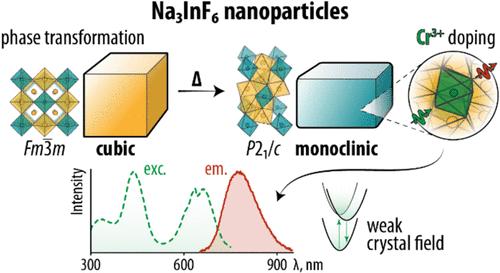
Transition metal (TM) and rare earth (RE) ion-doped nanoparticles (NPs) are photoluminescent materials of technological relevance in bioimaging, sensing, and light conversion. Fluoride NPs are particularly attractive in this context, since they combine low-energy phonons, high chemical stability, optical transparency, size, and architecture tunability. Yet, nearly all reported colloidal fluoride NPs (e.g., NaYF4 and LiYF4) can only be efficiently doped with RE3+ and not with luminescent TM ions. Herein, we contribute to filling this gap in materials science by reporting Na3InF6 NPs doped with Cr3+ as a model luminescent TM ion. We unveil the heat-driven NP formation mechanism, which involves a cubic-to-monoclinic phase conversion, similarly to the cubic-to-hexagonal phase conversion in NaYF4. Reaction temperatures above 225 °C and reaction time have a limited impact on the NP morphology, while the amount of fluoride precursor and oleylamine grants control over the NP size. After verifying that Na3InF6 NPs show negligible cytotoxicity toward U-87 cell line, we study the optical properties of these NPs upon Cr3+ doping. Temperature-dependent photoluminescence measurements indicate that Cr3+ ions experience a weak crystal field in the Na3InF6 host lattice, while their photoluminescence lifetime varies linearly in the 20–50 °C range. These results set the ground for further studies of photoluminescent TM-doped fluoride NPs, toward their applications in bioimaging, sensing, and light-converting devices.
期刊介绍:
The journal Chemistry of Materials focuses on publishing original research at the intersection of materials science and chemistry. The studies published in the journal involve chemistry as a prominent component and explore topics such as the design, synthesis, characterization, processing, understanding, and application of functional or potentially functional materials. The journal covers various areas of interest, including inorganic and organic solid-state chemistry, nanomaterials, biomaterials, thin films and polymers, and composite/hybrid materials. The journal particularly seeks papers that highlight the creation or development of innovative materials with novel optical, electrical, magnetic, catalytic, or mechanical properties. It is essential that manuscripts on these topics have a primary focus on the chemistry of materials and represent a significant advancement compared to prior research. Before external reviews are sought, submitted manuscripts undergo a review process by a minimum of two editors to ensure their appropriateness for the journal and the presence of sufficient evidence of a significant advance that will be of broad interest to the materials chemistry community.



 京公网安备 11010802042870号
京ICP备2023020795号-1
京公网安备 11010802042870号
京ICP备2023020795号-1

 分享
分享
 求助内容:
求助内容: 应助结果提醒方式:
 扫码关注我们
