Yohannes Getahun, Ana C. Martinez, Mario Rodriguez, Alexis Maurel, Daisy Lopez, Eunja Kim, Graham King, Harikrishnan S. Nair
{"title":"Electrochemical Performance of Layered Honeycomb Na2(Ni2–xCox)TeO6 (x = 0, 0.10, 0.25) Oxides as Sodium-Ion Battery Cathodes","authors":"Yohannes Getahun, Ana C. Martinez, Mario Rodriguez, Alexis Maurel, Daisy Lopez, Eunja Kim, Graham King, Harikrishnan S. Nair","doi":"10.1021/acs.inorgchem.4c05017","DOIUrl":null,"url":null,"abstract":"To develop economically and environmentally viable sodium-based solid-state batteries, we investigated Na<sub>2</sub>(Ni<sub>2–<i>x</i></sub>Co<sub><i>x</i></sub>)TeO<sub>6</sub> (<i>x</i> = 0, 0.10, 0.25). After synthesizing phase-pure compositions, we confirmed <i>P</i>6<sub>3</sub>/<i>mcm</i> space group and P2 coordination through high-resolution synchrotron diffraction data, where Na<sup>+</sup> occupies three different crystallographic positions in the unit cell: Na1, Na2, and Na3. With the incorporation of cobalt into the nickel lattice, an increase in the cell volume is seen. Bond parameters show that the average Ni–Ni distance increases as a result, but the local structure and coordination do not show marked differences. Our density functional theory calculations revealed that sodium at the Na1 site is energetically more favorable and that Co doping increased the lattice constants, supported by our X-ray diffraction data. Electrochemical measurements performed on half-cells versus sodium metal using CR2032-type coin cells revealed exceptionally high specific capacity matching the theoretical value and retained around 120 mAhg<sup>–1</sup> at the smallest but optimum concentration of cobalt. The kinetics of storage mechanisms in these compositions reflect pseudo-capacitive behavior. Our results indicate that substitution pathways in the layered oxide family of Na<sub>2</sub>Ni<sub>2</sub>TeO<sub>6</sub> offer the potential for the development of Na-based cathodes with enhanced cycling stability and ionic conductivity.","PeriodicalId":40,"journal":{"name":"Inorganic Chemistry","volume":"3 1","pages":""},"PeriodicalIF":4.7000,"publicationDate":"2025-04-20","publicationTypes":"Journal Article","fieldsOfStudy":null,"isOpenAccess":false,"openAccessPdf":"","citationCount":"0","resultStr":null,"platform":"Semanticscholar","paperid":null,"PeriodicalName":"Inorganic Chemistry","FirstCategoryId":"92","ListUrlMain":"https://doi.org/10.1021/acs.inorgchem.4c05017","RegionNum":2,"RegionCategory":"化学","ArticlePicture":[],"TitleCN":null,"AbstractTextCN":null,"PMCID":null,"EPubDate":"","PubModel":"","JCR":"Q1","JCRName":"CHEMISTRY, INORGANIC & NUCLEAR","Score":null,"Total":0}
引用次数: 0
Abstract
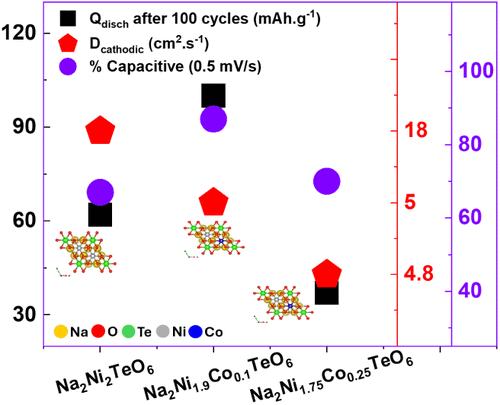
To develop economically and environmentally viable sodium-based solid-state batteries, we investigated Na2(Ni2–xCox)TeO6 (x = 0, 0.10, 0.25). After synthesizing phase-pure compositions, we confirmed P63/mcm space group and P2 coordination through high-resolution synchrotron diffraction data, where Na+ occupies three different crystallographic positions in the unit cell: Na1, Na2, and Na3. With the incorporation of cobalt into the nickel lattice, an increase in the cell volume is seen. Bond parameters show that the average Ni–Ni distance increases as a result, but the local structure and coordination do not show marked differences. Our density functional theory calculations revealed that sodium at the Na1 site is energetically more favorable and that Co doping increased the lattice constants, supported by our X-ray diffraction data. Electrochemical measurements performed on half-cells versus sodium metal using CR2032-type coin cells revealed exceptionally high specific capacity matching the theoretical value and retained around 120 mAhg–1 at the smallest but optimum concentration of cobalt. The kinetics of storage mechanisms in these compositions reflect pseudo-capacitive behavior. Our results indicate that substitution pathways in the layered oxide family of Na2Ni2TeO6 offer the potential for the development of Na-based cathodes with enhanced cycling stability and ionic conductivity.
期刊介绍:
Inorganic Chemistry publishes fundamental studies in all phases of inorganic chemistry. Coverage includes experimental and theoretical reports on quantitative studies of structure and thermodynamics, kinetics, mechanisms of inorganic reactions, bioinorganic chemistry, and relevant aspects of organometallic chemistry, solid-state phenomena, and chemical bonding theory. Emphasis is placed on the synthesis, structure, thermodynamics, reactivity, spectroscopy, and bonding properties of significant new and known compounds.



 京公网安备 11010802042870号
京ICP备2023020795号-1
京公网安备 11010802042870号
京ICP备2023020795号-1

 分享
分享
 求助内容:
求助内容: 应助结果提醒方式:
 扫码关注我们
