{"title":"CuCo2S4/g-C3N4–x S-Scheme Heterojunction for Photothermal-Assisted Photocatalytic CO2 Reduction","authors":"Fangde Liu, Yanjie Song, Renzhi Xiong, Dongchen Duan, Xiao Xiao, Yanhe Xiao, Baochang Cheng, Shuijin Lei","doi":"10.1021/acs.inorgchem.5c00779","DOIUrl":null,"url":null,"abstract":"Photocatalytic conversion of CO<sub>2</sub> into chemical fuels has emerged as a research hotspot, aiming to mitigate the rapid depletion of fossil fuels and alleviate global warming. However, the inherent low carrier separation efficiency and limited solar light utilization of photocatalysts lead to unsatisfactory CO<sub>2</sub> conversion efficiency. In this study, an appealing CuCo<sub>2</sub>S<sub>4</sub>/g-C<sub>3</sub>N<sub>4–<i>x</i></sub> S-scheme heterostructure is successfully fabricated by a simple polyol reflux method. Notably, nitrogen vacancies enhance the Fermi level difference between CuCo<sub>2</sub>S<sub>4</sub> and g-C<sub>3</sub>N<sub>4–<i>x</i></sub>, resulting in a stronger interfacial built-in electric field. The full-spectrum strong optical absorption capability endows the synthesized catalysts with superior light-harvesting property. The photothermal effect-induced temperature increase accelerates the cyclic process of CO<sub>2</sub> adsorption and CO desorption on the catalyst surface. Most importantly, the S-scheme charge transfer pathway ensures the efficient separation of photogenerated carriers. Thanks to these synergistic benefits, CuCo<sub>2</sub>S<sub>4</sub>/g-C<sub>3</sub>N<sub>4–<i>x</i></sub> exhibits exceptional photothermal-assisted photocatalytic CO<sub>2</sub> reduction performance. Under simulated sunlight, the average CO production rate of CuCo<sub>2</sub>S<sub>4</sub>/g-C<sub>3</sub>N<sub>4–<i>x</i></sub> reaches 24.64 μmol g<sup>–1</sup> h<sup>–1</sup>, which is 12.1 and 27.1 times higher than that of g-C<sub>3</sub>N<sub>4</sub> and CuCo<sub>2</sub>S<sub>4</sub>, respectively. This study offers a novel strategy for designing photocatalysts with outstanding CO<sub>2</sub> conversion performance.","PeriodicalId":40,"journal":{"name":"Inorganic Chemistry","volume":"24 1","pages":""},"PeriodicalIF":4.7000,"publicationDate":"2025-04-20","publicationTypes":"Journal Article","fieldsOfStudy":null,"isOpenAccess":false,"openAccessPdf":"","citationCount":"0","resultStr":null,"platform":"Semanticscholar","paperid":null,"PeriodicalName":"Inorganic Chemistry","FirstCategoryId":"92","ListUrlMain":"https://doi.org/10.1021/acs.inorgchem.5c00779","RegionNum":2,"RegionCategory":"化学","ArticlePicture":[],"TitleCN":null,"AbstractTextCN":null,"PMCID":null,"EPubDate":"","PubModel":"","JCR":"Q1","JCRName":"CHEMISTRY, INORGANIC & NUCLEAR","Score":null,"Total":0}
引用次数: 0
Abstract
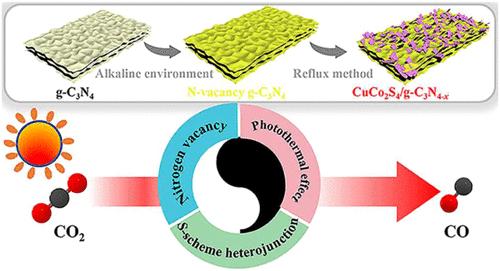
Photocatalytic conversion of CO2 into chemical fuels has emerged as a research hotspot, aiming to mitigate the rapid depletion of fossil fuels and alleviate global warming. However, the inherent low carrier separation efficiency and limited solar light utilization of photocatalysts lead to unsatisfactory CO2 conversion efficiency. In this study, an appealing CuCo2S4/g-C3N4–x S-scheme heterostructure is successfully fabricated by a simple polyol reflux method. Notably, nitrogen vacancies enhance the Fermi level difference between CuCo2S4 and g-C3N4–x, resulting in a stronger interfacial built-in electric field. The full-spectrum strong optical absorption capability endows the synthesized catalysts with superior light-harvesting property. The photothermal effect-induced temperature increase accelerates the cyclic process of CO2 adsorption and CO desorption on the catalyst surface. Most importantly, the S-scheme charge transfer pathway ensures the efficient separation of photogenerated carriers. Thanks to these synergistic benefits, CuCo2S4/g-C3N4–x exhibits exceptional photothermal-assisted photocatalytic CO2 reduction performance. Under simulated sunlight, the average CO production rate of CuCo2S4/g-C3N4–x reaches 24.64 μmol g–1 h–1, which is 12.1 and 27.1 times higher than that of g-C3N4 and CuCo2S4, respectively. This study offers a novel strategy for designing photocatalysts with outstanding CO2 conversion performance.
期刊介绍:
Inorganic Chemistry publishes fundamental studies in all phases of inorganic chemistry. Coverage includes experimental and theoretical reports on quantitative studies of structure and thermodynamics, kinetics, mechanisms of inorganic reactions, bioinorganic chemistry, and relevant aspects of organometallic chemistry, solid-state phenomena, and chemical bonding theory. Emphasis is placed on the synthesis, structure, thermodynamics, reactivity, spectroscopy, and bonding properties of significant new and known compounds.



 京公网安备 11010802042870号
京ICP备2023020795号-1
京公网安备 11010802042870号
京ICP备2023020795号-1

 分享
分享
 求助内容:
求助内容: 应助结果提醒方式:
 扫码关注我们
