Bikash Mishra, Mahesh Bachu, Ruoxi Yuan, Claire Wingert, Vidyanath Chaudhary, Caroline Brauner, Richard Bell, Lionel B. Ivashkiv
{"title":"IL-10 targets IRF transcription factors to suppress IFN and inflammatory response genes by epigenetic mechanisms","authors":"Bikash Mishra, Mahesh Bachu, Ruoxi Yuan, Claire Wingert, Vidyanath Chaudhary, Caroline Brauner, Richard Bell, Lionel B. Ivashkiv","doi":"10.1038/s41590-025-02137-3","DOIUrl":null,"url":null,"abstract":"Interleukin-10 (IL-10) is pivotal in suppressing innate immune activation, in large part by suppressing induction of inflammatory genes. Despite decades of research, the molecular mechanisms underlying this inhibition have not been resolved. Here we utilized an integrated epigenomic analysis to investigate IL-10-mediated suppression of LPS and TNF responses in primary human monocytes. Instead of inhibiting core TLR4-activated pathways such as NF-κB, MAPK–AP-1 and TBK1–IRF3 signaling, IL-10 targeted IRF transcription factor activity and DNA binding, particularly IRF5 and an IRF1-mediated amplification loop. This resulted in suppression of inflammatory NF-κB target genes and near-complete suppression of interferon-stimulated genes. Mechanisms of gene inhibition included downregulation of chromatin accessibility, de novo enhancer formation and IRF1-associated H3K27ac activating histone marks. These results provide a mechanism by which IL-10 suppresses inflammatory NF-κB target genes, highlight the role of IRF1 in inflammatory gene expression and describe the suppression of IFN responses by epigenetic mechanisms. Ivashkiv and colleagues show that IL-10 inhibits the expression and DNA binding of IRF1 and IRF5, two transcription factors that have an amplifying role in the induction of inflammatory NF-κB target genes and directly induce the expression of ISGs.","PeriodicalId":19032,"journal":{"name":"Nature Immunology","volume":"26 5","pages":"748-759"},"PeriodicalIF":27.6000,"publicationDate":"2025-04-22","publicationTypes":"Journal Article","fieldsOfStudy":null,"isOpenAccess":false,"openAccessPdf":"","citationCount":"0","resultStr":null,"platform":"Semanticscholar","paperid":null,"PeriodicalName":"Nature Immunology","FirstCategoryId":"3","ListUrlMain":"https://www.nature.com/articles/s41590-025-02137-3","RegionNum":1,"RegionCategory":"医学","ArticlePicture":[],"TitleCN":null,"AbstractTextCN":null,"PMCID":null,"EPubDate":"","PubModel":"","JCR":"Q1","JCRName":"IMMUNOLOGY","Score":null,"Total":0}
引用次数: 0
Abstract
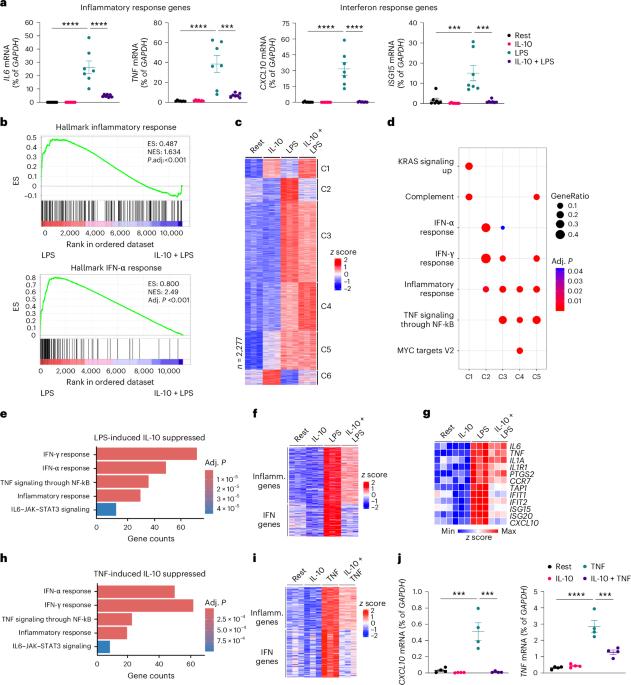
Interleukin-10 (IL-10) is pivotal in suppressing innate immune activation, in large part by suppressing induction of inflammatory genes. Despite decades of research, the molecular mechanisms underlying this inhibition have not been resolved. Here we utilized an integrated epigenomic analysis to investigate IL-10-mediated suppression of LPS and TNF responses in primary human monocytes. Instead of inhibiting core TLR4-activated pathways such as NF-κB, MAPK–AP-1 and TBK1–IRF3 signaling, IL-10 targeted IRF transcription factor activity and DNA binding, particularly IRF5 and an IRF1-mediated amplification loop. This resulted in suppression of inflammatory NF-κB target genes and near-complete suppression of interferon-stimulated genes. Mechanisms of gene inhibition included downregulation of chromatin accessibility, de novo enhancer formation and IRF1-associated H3K27ac activating histone marks. These results provide a mechanism by which IL-10 suppresses inflammatory NF-κB target genes, highlight the role of IRF1 in inflammatory gene expression and describe the suppression of IFN responses by epigenetic mechanisms. Ivashkiv and colleagues show that IL-10 inhibits the expression and DNA binding of IRF1 and IRF5, two transcription factors that have an amplifying role in the induction of inflammatory NF-κB target genes and directly induce the expression of ISGs.
期刊介绍:
Nature Immunology is a monthly journal that publishes the highest quality research in all areas of immunology. The editorial decisions are made by a team of full-time professional editors. The journal prioritizes work that provides translational and/or fundamental insight into the workings of the immune system. It covers a wide range of topics including innate immunity and inflammation, development, immune receptors, signaling and apoptosis, antigen presentation, gene regulation and recombination, cellular and systemic immunity, vaccines, immune tolerance, autoimmunity, tumor immunology, and microbial immunopathology. In addition to publishing significant original research, Nature Immunology also includes comments, News and Views, research highlights, matters arising from readers, and reviews of the literature. The journal serves as a major conduit of top-quality information for the immunology community.




 京公网安备 11010802042870号
京ICP备2023020795号-1
京公网安备 11010802042870号
京ICP备2023020795号-1

 分享
分享
 求助内容:
求助内容: 应助结果提醒方式:
 扫码关注我们
