Jinhua Wu, Zhang Liang, Hao Sun, Ying Cui and Cun-Zheng Ning
{"title":"Determination of the rate equations for erbium nanoparticles at arbitrary concentrations and drastically enhanced non-radiative transitions†","authors":"Jinhua Wu, Zhang Liang, Hao Sun, Ying Cui and Cun-Zheng Ning","doi":"10.1039/D4NR04815F","DOIUrl":null,"url":null,"abstract":"<p >Erbium (Er)-based NaYF<small><sub>4</sub></small> nanoparticles (ENPs) are important for many applications including imaging, communications, and biosensing, particularly at high Er concentrations. The rate equations (REs) are fundamental for understanding various transitions in ENPs. However, the REs and their various coefficients are determined only at the classical composition of ∼2% Er and ∼20% ytterbium (Yb) while focusing only on up-conversion processes. This paper aims to determine the coefficients of the REs through systematic characterization across the full range of Er levels (5%, 50%, 75%, and 100%), where both up- and down-conversions are important and careful calibration of visible and near-infrared emission bands is required. The parameter values of the REs were then obtained through curve fitting for arbitrary Er concentrations. We found that non-radiative transitions and energy-transfer processes increase quadratically with Er concentration. We discovered that the non-radiative transition from <small><sup>4</sup></small>I<small><sub>11/2</sub></small> to <small><sup>4</sup></small>I<small><sub>13/2</sub></small> increases with Er concentration and is orders of magnitude faster than other decay processes, exhibiting the highest down-conversion at 100% Er. Our study explains why high Er concentration nanoparticles typically exhibit weak up-conversion emission. Our results establish the REs for arbitrary Er concentrations for the first time, which can be used more generally for designing ENPs and understanding complex nonlinear processes.</p>","PeriodicalId":92,"journal":{"name":"Nanoscale","volume":" 24","pages":" 14837-14847"},"PeriodicalIF":5.1000,"publicationDate":"2025-04-22","publicationTypes":"Journal Article","fieldsOfStudy":null,"isOpenAccess":false,"openAccessPdf":"","citationCount":"0","resultStr":null,"platform":"Semanticscholar","paperid":null,"PeriodicalName":"Nanoscale","FirstCategoryId":"88","ListUrlMain":"https://pubs.rsc.org/en/content/articlelanding/2025/nr/d4nr04815f","RegionNum":3,"RegionCategory":"材料科学","ArticlePicture":[],"TitleCN":null,"AbstractTextCN":null,"PMCID":null,"EPubDate":"","PubModel":"","JCR":"Q1","JCRName":"CHEMISTRY, MULTIDISCIPLINARY","Score":null,"Total":0}
引用次数: 0
Abstract
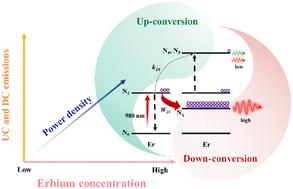
Erbium (Er)-based NaYF4 nanoparticles (ENPs) are important for many applications including imaging, communications, and biosensing, particularly at high Er concentrations. The rate equations (REs) are fundamental for understanding various transitions in ENPs. However, the REs and their various coefficients are determined only at the classical composition of ∼2% Er and ∼20% ytterbium (Yb) while focusing only on up-conversion processes. This paper aims to determine the coefficients of the REs through systematic characterization across the full range of Er levels (5%, 50%, 75%, and 100%), where both up- and down-conversions are important and careful calibration of visible and near-infrared emission bands is required. The parameter values of the REs were then obtained through curve fitting for arbitrary Er concentrations. We found that non-radiative transitions and energy-transfer processes increase quadratically with Er concentration. We discovered that the non-radiative transition from 4I11/2 to 4I13/2 increases with Er concentration and is orders of magnitude faster than other decay processes, exhibiting the highest down-conversion at 100% Er. Our study explains why high Er concentration nanoparticles typically exhibit weak up-conversion emission. Our results establish the REs for arbitrary Er concentrations for the first time, which can be used more generally for designing ENPs and understanding complex nonlinear processes.
基于铒(Er)的 NaYF4 纳米粒子(ENPs)在成像、通信和生物传感等许多应用中都非常重要,尤其是在高浓度铒的情况下。速率方程(REs)是理解 ENPs 中各种转变的基础。然而,REs 和各种系数仅在经典的铒浓度约为 2% 和镱浓度约为 20% 时确定,其中仅包括上转换过程。本文旨在通过对全部铒含量范围(5%、50%、75% 和 100%)的系统表征来确定 REs 的系数,其中上转换和下转换都很重要,并且需要对可见光和近红外发射波段进行仔细校准。然后对 RE 的参数值进行曲线拟合,以获得任意 Er 浓度下的参数值。我们发现,非辐射跃迁和能量转移过程随 Er 浓度的增加而呈二次方增加。我们发现,从 4I11/2 到 4I13/2 的非辐射跃迁随 Er 浓度的增加而增加,其速度比其他衰变过程快几个数量级,在 Er 浓度为 100% 时表现出最高的下转换率。我们的研究解释了为什么高 Er 纳米粒子通常表现出微弱的上转换发射。我们的研究结果首次建立了任意 Er 浓度的 REs,可更广泛地用于设计 ENPs 和理解复杂的非线性过程。
期刊介绍:
Nanoscale is a high-impact international journal, publishing high-quality research across nanoscience and nanotechnology. Nanoscale publishes a full mix of research articles on experimental and theoretical work, including reviews, communications, and full papers.Highly interdisciplinary, this journal appeals to scientists, researchers and professionals interested in nanoscience and nanotechnology, quantum materials and quantum technology, including the areas of physics, chemistry, biology, medicine, materials, energy/environment, information technology, detection science, healthcare and drug discovery, and electronics.




 京公网安备 11010802042870号
京ICP备2023020795号-1
京公网安备 11010802042870号
京ICP备2023020795号-1

 分享
分享
 求助内容:
求助内容: 应助结果提醒方式:
 扫码关注我们
