Yue Liu, Yunping Wu, Yi Liu, Qiang Zhang, Hong Yuan, Shen Li, Zhi Li, Bo Wang, Yangyang Chang, Meng Liu
{"title":"Arrest of CRISPR-Cas12a by Nonspecific Single-Stranded DNA for Biosensing","authors":"Yue Liu, Yunping Wu, Yi Liu, Qiang Zhang, Hong Yuan, Shen Li, Zhi Li, Bo Wang, Yangyang Chang, Meng Liu","doi":"10.1021/acs.analchem.4c07081","DOIUrl":null,"url":null,"abstract":"CRISPR-Cas technologies have emerged as powerful biosensing tools for the sensitive and specific detection of non-nucleic acid targets. However, existing biosensing strategies suffer from poor compatibility across diverse targets due to the complicated engineering of crRNA and DNA activator required for the CRISPR-Cas activity regulation. Herein, we report a novel and straightforward strategy for designing CRISPR-Cas12a-based biosensors that function by switching structures from single-stranded (ss)DNA/CRISPR-Cas12a assembly to DNA activator/CRISPR-Cas12a complex in the presence of target bacterium. The strategy begins with a ssDNA assembly made of a trans-acting RNA-cleaving DNAzyme (tRCD) and an RNA/DNA chimeric substrate (RCS). The ssDNA assembly has the ability to bind Cas12a nonspecifically, thus indeed blocking the CRISPR-Cas12a activity. By exploiting the specific recognition and cleavage capacities of tRCD for RCS in the presence of a target, the target-bound tRCD and the cleaved RCS are released from Cas12a, thus restoring the CRISPR-Cas12a activity. This method has been successfully applied for the sensitive (detection limit: 10<sup>2</sup> CFU/mL) detection of <i>Escherichia coli</i> (<i>E. coli</i>, EC) and <i>Burkholderia gladioli</i> (<i>B. gladioli</i>, BG). For the blind testing of 30 clinical urine samples, it exhibited 100% sensitivity and 100% specificity in identifying <i>E. coli</i>-associated urinary tract infections (UTIs).","PeriodicalId":27,"journal":{"name":"Analytical Chemistry","volume":"17 1","pages":""},"PeriodicalIF":6.7000,"publicationDate":"2025-04-22","publicationTypes":"Journal Article","fieldsOfStudy":null,"isOpenAccess":false,"openAccessPdf":"","citationCount":"0","resultStr":null,"platform":"Semanticscholar","paperid":null,"PeriodicalName":"Analytical Chemistry","FirstCategoryId":"92","ListUrlMain":"https://doi.org/10.1021/acs.analchem.4c07081","RegionNum":1,"RegionCategory":"化学","ArticlePicture":[],"TitleCN":null,"AbstractTextCN":null,"PMCID":null,"EPubDate":"","PubModel":"","JCR":"Q1","JCRName":"CHEMISTRY, ANALYTICAL","Score":null,"Total":0}
引用次数: 0
Abstract
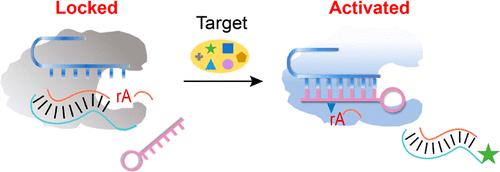
CRISPR-Cas technologies have emerged as powerful biosensing tools for the sensitive and specific detection of non-nucleic acid targets. However, existing biosensing strategies suffer from poor compatibility across diverse targets due to the complicated engineering of crRNA and DNA activator required for the CRISPR-Cas activity regulation. Herein, we report a novel and straightforward strategy for designing CRISPR-Cas12a-based biosensors that function by switching structures from single-stranded (ss)DNA/CRISPR-Cas12a assembly to DNA activator/CRISPR-Cas12a complex in the presence of target bacterium. The strategy begins with a ssDNA assembly made of a trans-acting RNA-cleaving DNAzyme (tRCD) and an RNA/DNA chimeric substrate (RCS). The ssDNA assembly has the ability to bind Cas12a nonspecifically, thus indeed blocking the CRISPR-Cas12a activity. By exploiting the specific recognition and cleavage capacities of tRCD for RCS in the presence of a target, the target-bound tRCD and the cleaved RCS are released from Cas12a, thus restoring the CRISPR-Cas12a activity. This method has been successfully applied for the sensitive (detection limit: 102 CFU/mL) detection of Escherichia coli (E. coli, EC) and Burkholderia gladioli (B. gladioli, BG). For the blind testing of 30 clinical urine samples, it exhibited 100% sensitivity and 100% specificity in identifying E. coli-associated urinary tract infections (UTIs).
期刊介绍:
Analytical Chemistry, a peer-reviewed research journal, focuses on disseminating new and original knowledge across all branches of analytical chemistry. Fundamental articles may explore general principles of chemical measurement science and need not directly address existing or potential analytical methodology. They can be entirely theoretical or report experimental results. Contributions may cover various phases of analytical operations, including sampling, bioanalysis, electrochemistry, mass spectrometry, microscale and nanoscale systems, environmental analysis, separations, spectroscopy, chemical reactions and selectivity, instrumentation, imaging, surface analysis, and data processing. Papers discussing known analytical methods should present a significant, original application of the method, a notable improvement, or results on an important analyte.



 京公网安备 11010802042870号
京ICP备2023020795号-1
京公网安备 11010802042870号
京ICP备2023020795号-1

 分享
分享
 求助内容:
求助内容: 应助结果提醒方式:
 扫码关注我们
