{"title":"Increasing Aptamer Affinity from Millimolar to Nanomolar by Forming a Covalent Adduct for Detecting Acrylamide","authors":"Jin Wang, Xiangmei Li, Hongtao Lei, Juewen Liu","doi":"10.1021/acs.analchem.5c00783","DOIUrl":null,"url":null,"abstract":"Being a neurotoxin and carcinogen, acrylamide has been an important target for developing biosensors. DNA aptamers are attractive for making biosensors due to their programmable structure, low cost, and ease of modification. However, DNA aptamers have poor affinities to low-binding epitope target molecules such as acrylamide. In this work, an aptamer for acrylamide was isolated with an apparent <i>K</i><sub>d</sub> of 10.5 mM using a thioflavin T fluorescence assay and 4.7 mM using the fluorescence strand-displacement assay. To improve binding affinity, acrylamide was reacted with xanthydrol to form a covalent adduct, and a new aptamer selected for this adduct achieved a <i>K</i><sub>d</sub> of 20 nM using the strand-displacement assay, representing an improvement of 235,000-fold. Using the strand-displacement biosensor, a limit of detection of 4.2 nM was achieved for the adduct. This work demonstrates a practical route to convert low epitope targets to high-affinity targets for aptamer binding and bioanalytical applications.","PeriodicalId":27,"journal":{"name":"Analytical Chemistry","volume":"20 1","pages":""},"PeriodicalIF":6.7000,"publicationDate":"2025-04-22","publicationTypes":"Journal Article","fieldsOfStudy":null,"isOpenAccess":false,"openAccessPdf":"","citationCount":"0","resultStr":null,"platform":"Semanticscholar","paperid":null,"PeriodicalName":"Analytical Chemistry","FirstCategoryId":"92","ListUrlMain":"https://doi.org/10.1021/acs.analchem.5c00783","RegionNum":1,"RegionCategory":"化学","ArticlePicture":[],"TitleCN":null,"AbstractTextCN":null,"PMCID":null,"EPubDate":"","PubModel":"","JCR":"Q1","JCRName":"CHEMISTRY, ANALYTICAL","Score":null,"Total":0}
引用次数: 0
Abstract
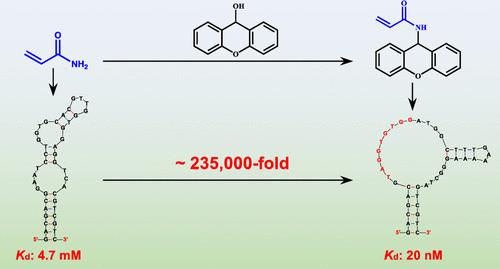
Being a neurotoxin and carcinogen, acrylamide has been an important target for developing biosensors. DNA aptamers are attractive for making biosensors due to their programmable structure, low cost, and ease of modification. However, DNA aptamers have poor affinities to low-binding epitope target molecules such as acrylamide. In this work, an aptamer for acrylamide was isolated with an apparent Kd of 10.5 mM using a thioflavin T fluorescence assay and 4.7 mM using the fluorescence strand-displacement assay. To improve binding affinity, acrylamide was reacted with xanthydrol to form a covalent adduct, and a new aptamer selected for this adduct achieved a Kd of 20 nM using the strand-displacement assay, representing an improvement of 235,000-fold. Using the strand-displacement biosensor, a limit of detection of 4.2 nM was achieved for the adduct. This work demonstrates a practical route to convert low epitope targets to high-affinity targets for aptamer binding and bioanalytical applications.
期刊介绍:
Analytical Chemistry, a peer-reviewed research journal, focuses on disseminating new and original knowledge across all branches of analytical chemistry. Fundamental articles may explore general principles of chemical measurement science and need not directly address existing or potential analytical methodology. They can be entirely theoretical or report experimental results. Contributions may cover various phases of analytical operations, including sampling, bioanalysis, electrochemistry, mass spectrometry, microscale and nanoscale systems, environmental analysis, separations, spectroscopy, chemical reactions and selectivity, instrumentation, imaging, surface analysis, and data processing. Papers discussing known analytical methods should present a significant, original application of the method, a notable improvement, or results on an important analyte.





 京公网安备 11010802042870号
京ICP备2023020795号-1
京公网安备 11010802042870号
京ICP备2023020795号-1

 分享
分享
 求助内容:
求助内容: 应助结果提醒方式:
 扫码关注我们
