{"title":"Simple In-Cell Processing Enables Deep Proteome Analysis of Low-Input Caenorhabditis elegans","authors":"Malek Elsayyid, Jessica E. Tanis, Yanbao Yu","doi":"10.1021/acs.analchem.4c05003","DOIUrl":null,"url":null,"abstract":"<i>Caenorhabditis elegans</i> is a widely used genetic model organism; however, the worm cuticle complicates extraction of intracellular proteins, a prerequisite for typical bottom-up proteomics. Conventional physical disruption procedures are not only time-consuming but can also cause significant sample loss, making it difficult to perform proteomics with low-input samples. Here, for the first time, we present an on-filter in-cell (OFIC) processing approach that can digest <i>C. elegans</i> proteins directly in the cells of the organism after methanol fixation. With OFIC processing and single-shot LC-MS analysis, we identified over 9400 proteins from a sample of only 200 worms, the largest <i>C. elegans</i> proteome reported to date that did not require fractionation or enrichment. We systematically evaluated the performance of the OFIC approach by comparing it to conventional lysis-based methods. Our data suggest superior performance of OFIC processing for <i>C. elegans</i> proteome identification and quantitation. We further evaluated the OFIC approach with even lower-input samples, including single worms. Then, we used this method to determine how the proteome is impacted by loss of superoxide dismutase <i>sod-1</i>, the ortholog of human <i>SOD1</i>, a gene associated with amyotrophic lateral sclerosis. Analysis of 8800 proteins from only 50 worms as the initial input showed that loss of <i>sod-1</i> affects the abundance of proteins required for stress response, ribosome biogenesis, and metabolism. In conclusion, our streamlined OFIC approach, which can be broadly applied to other systems, minimizes sample loss while offering the simplest workflow reported to date for <i>C. elegans</i> proteomics.","PeriodicalId":27,"journal":{"name":"Analytical Chemistry","volume":"64 1","pages":""},"PeriodicalIF":6.7000,"publicationDate":"2025-04-21","publicationTypes":"Journal Article","fieldsOfStudy":null,"isOpenAccess":false,"openAccessPdf":"","citationCount":"0","resultStr":null,"platform":"Semanticscholar","paperid":null,"PeriodicalName":"Analytical Chemistry","FirstCategoryId":"92","ListUrlMain":"https://doi.org/10.1021/acs.analchem.4c05003","RegionNum":1,"RegionCategory":"化学","ArticlePicture":[],"TitleCN":null,"AbstractTextCN":null,"PMCID":null,"EPubDate":"","PubModel":"","JCR":"Q1","JCRName":"CHEMISTRY, ANALYTICAL","Score":null,"Total":0}
引用次数: 0
Abstract
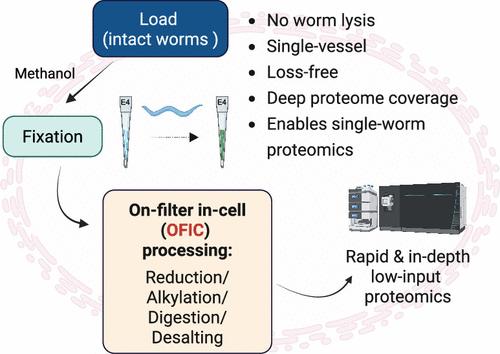
Caenorhabditis elegans is a widely used genetic model organism; however, the worm cuticle complicates extraction of intracellular proteins, a prerequisite for typical bottom-up proteomics. Conventional physical disruption procedures are not only time-consuming but can also cause significant sample loss, making it difficult to perform proteomics with low-input samples. Here, for the first time, we present an on-filter in-cell (OFIC) processing approach that can digest C. elegans proteins directly in the cells of the organism after methanol fixation. With OFIC processing and single-shot LC-MS analysis, we identified over 9400 proteins from a sample of only 200 worms, the largest C. elegans proteome reported to date that did not require fractionation or enrichment. We systematically evaluated the performance of the OFIC approach by comparing it to conventional lysis-based methods. Our data suggest superior performance of OFIC processing for C. elegans proteome identification and quantitation. We further evaluated the OFIC approach with even lower-input samples, including single worms. Then, we used this method to determine how the proteome is impacted by loss of superoxide dismutase sod-1, the ortholog of human SOD1, a gene associated with amyotrophic lateral sclerosis. Analysis of 8800 proteins from only 50 worms as the initial input showed that loss of sod-1 affects the abundance of proteins required for stress response, ribosome biogenesis, and metabolism. In conclusion, our streamlined OFIC approach, which can be broadly applied to other systems, minimizes sample loss while offering the simplest workflow reported to date for C. elegans proteomics.
期刊介绍:
Analytical Chemistry, a peer-reviewed research journal, focuses on disseminating new and original knowledge across all branches of analytical chemistry. Fundamental articles may explore general principles of chemical measurement science and need not directly address existing or potential analytical methodology. They can be entirely theoretical or report experimental results. Contributions may cover various phases of analytical operations, including sampling, bioanalysis, electrochemistry, mass spectrometry, microscale and nanoscale systems, environmental analysis, separations, spectroscopy, chemical reactions and selectivity, instrumentation, imaging, surface analysis, and data processing. Papers discussing known analytical methods should present a significant, original application of the method, a notable improvement, or results on an important analyte.



 京公网安备 11010802042870号
京ICP备2023020795号-1
京公网安备 11010802042870号
京ICP备2023020795号-1

 分享
分享
 求助内容:
求助内容: 应助结果提醒方式:
 扫码关注我们
