{"title":"Sources and Transformation of Methylmercury in Paddy Water: Insights from Mercury Isotopes Collected by Diffusive Gradients in Thin Films","authors":"Hongqian Yin, Heng Yao, Bo Meng, Che-Jen Lin, Wei Yuan, Runsheng Yin, Ping Li, Chaoyue Chen, Qiang Pu, Kun Zhang, Guangyi Sun, Hua Zhang, Xinbin Feng","doi":"10.1021/acs.analchem.4c06132","DOIUrl":null,"url":null,"abstract":"Despite concerns about methylmercury (MeHg) contamination in rice, the sources and transformation mechanisms of MeHg within paddy field water, the primary source of MeHg in rice, remain unclear. Determination of the isotopic composition of MeHg in paddy water is crucial to clarify these processes. However, there is a lack of sampling and analytical methods for quantifying MeHg isotopes in water samples. In this study, we use diffusive gradients in thin films (DGT) <i>in situ</i> to collect MeHg from paddy water to determine the concentration of MeHg and the associated isotopic composition. This technique enables high collection efficiency of aqueous MeHg with limited Hg isotope mass-dependent fractionation (∼− 0.2‰ δ<sup>202</sup>Hg) and mass-independent fractionation (<0.1‰ Δ<sup>199</sup>Hg). Field applications using the developed DGT method suggest that <i>in situ</i> methylation of soluble Hg(II) drives the generation of MeHg in paddy water. MeHg in overlying water exhibits a Δ<sup>199</sup>Hg/Δ<sup>201</sup>Hg ratio of 1.07 ± 0.09, indicating significant photoreduction of aqueous Hg(II) before methylation. The absence of photodemethylation Δ<sup>199</sup>Hg/Δ<sup>201</sup>Hg ratio (∼1.36) suggests limited MeHg demethylation in the overlying water. This study provides insights into the sources and transformation of MeHg in rice paddies and helps develop mitigation strategies to reduce MeHg exposure through rice consumption.","PeriodicalId":27,"journal":{"name":"Analytical Chemistry","volume":"1 1","pages":""},"PeriodicalIF":6.7000,"publicationDate":"2025-04-21","publicationTypes":"Journal Article","fieldsOfStudy":null,"isOpenAccess":false,"openAccessPdf":"","citationCount":"0","resultStr":null,"platform":"Semanticscholar","paperid":null,"PeriodicalName":"Analytical Chemistry","FirstCategoryId":"92","ListUrlMain":"https://doi.org/10.1021/acs.analchem.4c06132","RegionNum":1,"RegionCategory":"化学","ArticlePicture":[],"TitleCN":null,"AbstractTextCN":null,"PMCID":null,"EPubDate":"","PubModel":"","JCR":"Q1","JCRName":"CHEMISTRY, ANALYTICAL","Score":null,"Total":0}
引用次数: 0
Abstract
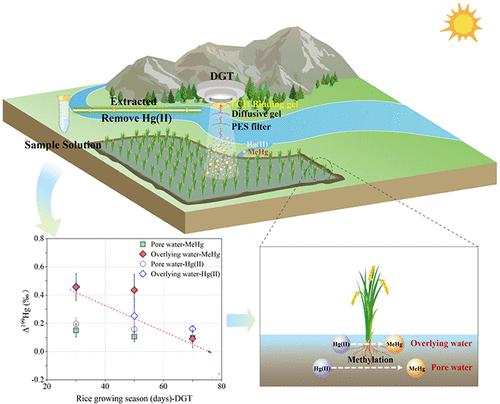
Despite concerns about methylmercury (MeHg) contamination in rice, the sources and transformation mechanisms of MeHg within paddy field water, the primary source of MeHg in rice, remain unclear. Determination of the isotopic composition of MeHg in paddy water is crucial to clarify these processes. However, there is a lack of sampling and analytical methods for quantifying MeHg isotopes in water samples. In this study, we use diffusive gradients in thin films (DGT) in situ to collect MeHg from paddy water to determine the concentration of MeHg and the associated isotopic composition. This technique enables high collection efficiency of aqueous MeHg with limited Hg isotope mass-dependent fractionation (∼− 0.2‰ δ202Hg) and mass-independent fractionation (<0.1‰ Δ199Hg). Field applications using the developed DGT method suggest that in situ methylation of soluble Hg(II) drives the generation of MeHg in paddy water. MeHg in overlying water exhibits a Δ199Hg/Δ201Hg ratio of 1.07 ± 0.09, indicating significant photoreduction of aqueous Hg(II) before methylation. The absence of photodemethylation Δ199Hg/Δ201Hg ratio (∼1.36) suggests limited MeHg demethylation in the overlying water. This study provides insights into the sources and transformation of MeHg in rice paddies and helps develop mitigation strategies to reduce MeHg exposure through rice consumption.
期刊介绍:
Analytical Chemistry, a peer-reviewed research journal, focuses on disseminating new and original knowledge across all branches of analytical chemistry. Fundamental articles may explore general principles of chemical measurement science and need not directly address existing or potential analytical methodology. They can be entirely theoretical or report experimental results. Contributions may cover various phases of analytical operations, including sampling, bioanalysis, electrochemistry, mass spectrometry, microscale and nanoscale systems, environmental analysis, separations, spectroscopy, chemical reactions and selectivity, instrumentation, imaging, surface analysis, and data processing. Papers discussing known analytical methods should present a significant, original application of the method, a notable improvement, or results on an important analyte.



 京公网安备 11010802042870号
京ICP备2023020795号-1
京公网安备 11010802042870号
京ICP备2023020795号-1

 分享
分享
 求助内容:
求助内容: 应助结果提醒方式:
 扫码关注我们
