Onni Veteläinen, Morsal Babayan, Lassi Pihlava, Abdul Rahman Abid, Antti Kivimäki, Edwin Kukk, Noelle Walsh, Samuli Urpelainen, Olle Björneholm, Marko Huttula, Matti Alatalo, Minna Patanen and Sergio Díaz-Tendero
{"title":"Hydrogen migration reactions via low internal energy pathways in aminobenzoic acid dications†","authors":"Onni Veteläinen, Morsal Babayan, Lassi Pihlava, Abdul Rahman Abid, Antti Kivimäki, Edwin Kukk, Noelle Walsh, Samuli Urpelainen, Olle Björneholm, Marko Huttula, Matti Alatalo, Minna Patanen and Sergio Díaz-Tendero","doi":"10.1039/D5CP00415B","DOIUrl":null,"url":null,"abstract":"<p >Hydrogen migration is a ubiquitous phenomenon upon dissociation of organic molecules. Here we investigate the formation of a H<small><sub>3</sub></small>O<small><sup>+</sup></small> fragment after core-level photoionization and Auger decay in aminobenzoic acid molecules – a process that requires the migration of at least two hydrogen atoms. Using photoelectron–photoion coincidence spectroscopy, the formation of a H<small><sub>3</sub></small>O<small><sup>+</sup></small> fragment is observed to be more probable in <em>ortho</em>-aminobenzoic acid than in <em>meta</em>- and <em>para</em>-aminobenzoic acid. Energy-resolved Auger electron–photoion coincidences are measured for the <em>ortho</em>-isomer to investigate the internal energy dependence of the fragmentation channels, most notably of those producing H<small><sub>3</sub></small>O<small><sup>+</sup></small>. The corresponding fragmentation channels and their mechanisms are investigated by exploring the potential energy surface with <em>ab initio</em> quantum chemistry methods and molecular dynamics simulations. Excited-state modeling of dicationic <em>ortho</em>-aminobenzoic acid is used to interpret features in the Auger spectra and identify the electronic states contributing to the signals in the Auger electron photoion coincidence map. We show that populating low-energy excited states of the dication is sufficient to trigger hydrogen migration and produce H<small><sub>3</sub></small>O<small><sup>+</sup></small> efficiently.</p>","PeriodicalId":99,"journal":{"name":"Physical Chemistry Chemical Physics","volume":" 18","pages":" 9884-9894"},"PeriodicalIF":2.9000,"publicationDate":"2025-04-22","publicationTypes":"Journal Article","fieldsOfStudy":null,"isOpenAccess":false,"openAccessPdf":"https://pubs.rsc.org/en/content/articlepdf/2025/cp/d5cp00415b?page=search","citationCount":"0","resultStr":null,"platform":"Semanticscholar","paperid":null,"PeriodicalName":"Physical Chemistry Chemical Physics","FirstCategoryId":"92","ListUrlMain":"https://pubs.rsc.org/en/content/articlelanding/2025/cp/d5cp00415b","RegionNum":3,"RegionCategory":"化学","ArticlePicture":[],"TitleCN":null,"AbstractTextCN":null,"PMCID":null,"EPubDate":"","PubModel":"","JCR":"Q3","JCRName":"CHEMISTRY, PHYSICAL","Score":null,"Total":0}
引用次数: 0
Abstract
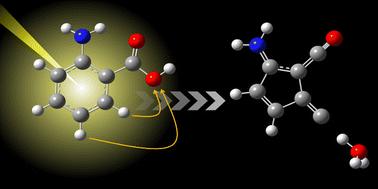
Hydrogen migration is a ubiquitous phenomenon upon dissociation of organic molecules. Here we investigate the formation of a H3O+ fragment after core-level photoionization and Auger decay in aminobenzoic acid molecules – a process that requires the migration of at least two hydrogen atoms. Using photoelectron–photoion coincidence spectroscopy, the formation of a H3O+ fragment is observed to be more probable in ortho-aminobenzoic acid than in meta- and para-aminobenzoic acid. Energy-resolved Auger electron–photoion coincidences are measured for the ortho-isomer to investigate the internal energy dependence of the fragmentation channels, most notably of those producing H3O+. The corresponding fragmentation channels and their mechanisms are investigated by exploring the potential energy surface with ab initio quantum chemistry methods and molecular dynamics simulations. Excited-state modeling of dicationic ortho-aminobenzoic acid is used to interpret features in the Auger spectra and identify the electronic states contributing to the signals in the Auger electron photoion coincidence map. We show that populating low-energy excited states of the dication is sufficient to trigger hydrogen migration and produce H3O+ efficiently.
期刊介绍:
Physical Chemistry Chemical Physics (PCCP) is an international journal co-owned by 19 physical chemistry and physics societies from around the world. This journal publishes original, cutting-edge research in physical chemistry, chemical physics and biophysical chemistry. To be suitable for publication in PCCP, articles must include significant innovation and/or insight into physical chemistry; this is the most important criterion that reviewers and Editors will judge against when evaluating submissions.
The journal has a broad scope and welcomes contributions spanning experiment, theory, computation and data science. Topical coverage includes spectroscopy, dynamics, kinetics, statistical mechanics, thermodynamics, electrochemistry, catalysis, surface science, quantum mechanics, quantum computing and machine learning. Interdisciplinary research areas such as polymers and soft matter, materials, nanoscience, energy, surfaces/interfaces, and biophysical chemistry are welcomed if they demonstrate significant innovation and/or insight into physical chemistry. Joined experimental/theoretical studies are particularly appreciated when complementary and based on up-to-date approaches.




 京公网安备 11010802042870号
京ICP备2023020795号-1
京公网安备 11010802042870号
京ICP备2023020795号-1

 分享
分享
 求助内容:
求助内容: 应助结果提醒方式:
 扫码关注我们
