Yu Chen, Xueqing Zhang, Chenyang Wang, Zhuojia Shi, Xihou Wang, Jiayi Dong, Yanlong Wang and Minghui Feng
{"title":"Green recovery of solid electrolytes from all-solid-state lithium-ion batteries using low-melting mixture solvents with tunable physical properties†","authors":"Yu Chen, Xueqing Zhang, Chenyang Wang, Zhuojia Shi, Xihou Wang, Jiayi Dong, Yanlong Wang and Minghui Feng","doi":"10.1039/D4CP04684F","DOIUrl":null,"url":null,"abstract":"<p >All-solid-state lithium-ion batteries (ASSLIBs) are anticipated to be the next generation of high-performance lithium batteries due to their enhanced safety and high energy density. However, the promising widespread application of ASSLIBs will lead to a significant increase in spent batteries, resulting in environmental pollution and resource depletion. Therefore, the development of environmentally friendly recycling methods for ASSLIBs is both urgent and critical. Low-melting mixture solvents (LoMMSs) were proposed by Professor Yu's research group at Tsinghua University in 2023 to facilitate the advancement of green solvents and green chemistry. Here, we utilize LoMMSs to leach metals from solid-state electrolytes (SSEs) of ASSLIBs and apply anti-solvents method to recover metal ions from leachate. Results show that the leaching efficiency of Li is up to 92.5% at a mild temperature of 80 °C within 24 h. The high Li leaching efficiency is ascribed to the coordination interaction. Furthermore, the Li leaching efficiency in large-scale applications shows minimal deviation from the optimal efficiency. This research provides valuable insights into the development of efficient, green, and mild recycling methods for SSEs in ASSLIBs.</p>","PeriodicalId":99,"journal":{"name":"Physical Chemistry Chemical Physics","volume":" 22","pages":" 12004-12015"},"PeriodicalIF":2.9000,"publicationDate":"2025-04-22","publicationTypes":"Journal Article","fieldsOfStudy":null,"isOpenAccess":false,"openAccessPdf":"","citationCount":"0","resultStr":null,"platform":"Semanticscholar","paperid":null,"PeriodicalName":"Physical Chemistry Chemical Physics","FirstCategoryId":"92","ListUrlMain":"https://pubs.rsc.org/en/content/articlelanding/2025/cp/d4cp04684f","RegionNum":3,"RegionCategory":"化学","ArticlePicture":[],"TitleCN":null,"AbstractTextCN":null,"PMCID":null,"EPubDate":"","PubModel":"","JCR":"Q3","JCRName":"CHEMISTRY, PHYSICAL","Score":null,"Total":0}
引用次数: 0
Abstract
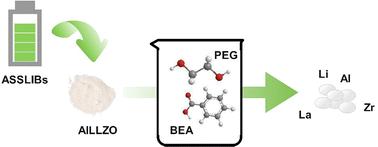
All-solid-state lithium-ion batteries (ASSLIBs) are anticipated to be the next generation of high-performance lithium batteries due to their enhanced safety and high energy density. However, the promising widespread application of ASSLIBs will lead to a significant increase in spent batteries, resulting in environmental pollution and resource depletion. Therefore, the development of environmentally friendly recycling methods for ASSLIBs is both urgent and critical. Low-melting mixture solvents (LoMMSs) were proposed by Professor Yu's research group at Tsinghua University in 2023 to facilitate the advancement of green solvents and green chemistry. Here, we utilize LoMMSs to leach metals from solid-state electrolytes (SSEs) of ASSLIBs and apply anti-solvents method to recover metal ions from leachate. Results show that the leaching efficiency of Li is up to 92.5% at a mild temperature of 80 °C within 24 h. The high Li leaching efficiency is ascribed to the coordination interaction. Furthermore, the Li leaching efficiency in large-scale applications shows minimal deviation from the optimal efficiency. This research provides valuable insights into the development of efficient, green, and mild recycling methods for SSEs in ASSLIBs.
期刊介绍:
Physical Chemistry Chemical Physics (PCCP) is an international journal co-owned by 19 physical chemistry and physics societies from around the world. This journal publishes original, cutting-edge research in physical chemistry, chemical physics and biophysical chemistry. To be suitable for publication in PCCP, articles must include significant innovation and/or insight into physical chemistry; this is the most important criterion that reviewers and Editors will judge against when evaluating submissions.
The journal has a broad scope and welcomes contributions spanning experiment, theory, computation and data science. Topical coverage includes spectroscopy, dynamics, kinetics, statistical mechanics, thermodynamics, electrochemistry, catalysis, surface science, quantum mechanics, quantum computing and machine learning. Interdisciplinary research areas such as polymers and soft matter, materials, nanoscience, energy, surfaces/interfaces, and biophysical chemistry are welcomed if they demonstrate significant innovation and/or insight into physical chemistry. Joined experimental/theoretical studies are particularly appreciated when complementary and based on up-to-date approaches.





 京公网安备 11010802042870号
京ICP备2023020795号-1
京公网安备 11010802042870号
京ICP备2023020795号-1

 分享
分享
 求助内容:
求助内容: 应助结果提醒方式:
 扫码关注我们
