Liangyu Chen, Zhihao Wang, En Fang, Zhiqiang Fan, Shaofei Song
{"title":"Probing the Catalytic Degradation of Unsaturated Polyolefin Materials via Fe-Based Lewis Acids-Initiated Carbonyl–Olefin Metathesis","authors":"Liangyu Chen, Zhihao Wang, En Fang, Zhiqiang Fan, Shaofei Song","doi":"10.1002/anie.202503408","DOIUrl":null,"url":null,"abstract":"<p>Degradation and recyclability of polymeric materials, including extensively used polyolefins, are becoming increasingly necessary. Chemically stable saturated polyolefin backbones make their degradation frustratingly challenging. The current effective strategy is to create cleavable defects, e.g., C═C double bonds along the backbone, and subsequently depolymerize them via cross-metathesis reaction with olefins. High-value chemicals or reusable polymeric segments are obtained. This two-step protocol provides operable means for alleviating plastics problems. There are several approaches to introduce unsaturation into a polymer backbone, like dehydrogenation or copolymerization of olefins and conjugated dienes. However, for the second step, to conduct a cross-metathesis reaction, only noble metal catalysts can be used most of the time. Regardless of their limited availability, the fact that these organometallics are unfavorably sensitive to impurities would raise barriers in industrial practices. Herein we employed earth-abundant and inexpensive iron-based Lewis acids to initiate carbonyl–olefin metathesis reactions between ketone/aldehyde reagents and unsaturated polyolefins. After explorations in poly(diene)s and industrial thermoplastic elastomers, we extended this protocol to degrade low-density polyethylene (LDPE). Low-molecular weight PE wax-like products were obtained as useful chemicals. This catalytic degradation system is expected to enable the development of more efficient metathesis strategies to promote degradation of polyolefins and pave sustainable ways for reuse of polymeric materials.</p>","PeriodicalId":125,"journal":{"name":"Angewandte Chemie International Edition","volume":"64 26","pages":""},"PeriodicalIF":16.9000,"publicationDate":"2025-04-21","publicationTypes":"Journal Article","fieldsOfStudy":null,"isOpenAccess":false,"openAccessPdf":"","citationCount":"0","resultStr":null,"platform":"Semanticscholar","paperid":null,"PeriodicalName":"Angewandte Chemie International Edition","FirstCategoryId":"92","ListUrlMain":"https://onlinelibrary.wiley.com/doi/10.1002/anie.202503408","RegionNum":1,"RegionCategory":"化学","ArticlePicture":[],"TitleCN":null,"AbstractTextCN":null,"PMCID":null,"EPubDate":"","PubModel":"","JCR":"Q1","JCRName":"CHEMISTRY, MULTIDISCIPLINARY","Score":null,"Total":0}
引用次数: 0
Abstract
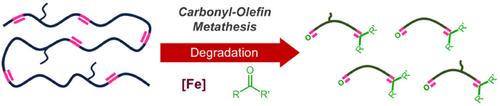
Degradation and recyclability of polymeric materials, including extensively used polyolefins, are becoming increasingly necessary. Chemically stable saturated polyolefin backbones make their degradation frustratingly challenging. The current effective strategy is to create cleavable defects, e.g., C═C double bonds along the backbone, and subsequently depolymerize them via cross-metathesis reaction with olefins. High-value chemicals or reusable polymeric segments are obtained. This two-step protocol provides operable means for alleviating plastics problems. There are several approaches to introduce unsaturation into a polymer backbone, like dehydrogenation or copolymerization of olefins and conjugated dienes. However, for the second step, to conduct a cross-metathesis reaction, only noble metal catalysts can be used most of the time. Regardless of their limited availability, the fact that these organometallics are unfavorably sensitive to impurities would raise barriers in industrial practices. Herein we employed earth-abundant and inexpensive iron-based Lewis acids to initiate carbonyl–olefin metathesis reactions between ketone/aldehyde reagents and unsaturated polyolefins. After explorations in poly(diene)s and industrial thermoplastic elastomers, we extended this protocol to degrade low-density polyethylene (LDPE). Low-molecular weight PE wax-like products were obtained as useful chemicals. This catalytic degradation system is expected to enable the development of more efficient metathesis strategies to promote degradation of polyolefins and pave sustainable ways for reuse of polymeric materials.
期刊介绍:
Angewandte Chemie, a journal of the German Chemical Society (GDCh), maintains a leading position among scholarly journals in general chemistry with an impressive Impact Factor of 16.6 (2022 Journal Citation Reports, Clarivate, 2023). Published weekly in a reader-friendly format, it features new articles almost every day. Established in 1887, Angewandte Chemie is a prominent chemistry journal, offering a dynamic blend of Review-type articles, Highlights, Communications, and Research Articles on a weekly basis, making it unique in the field.



 京公网安备 11010802042870号
京ICP备2023020795号-1
京公网安备 11010802042870号
京ICP备2023020795号-1

 分享
分享
 求助内容:
求助内容: 应助结果提醒方式:
 扫码关注我们
