{"title":"Life Cycle Assessment of Liquid Transportation Fuel Produced by the Intensified Biogas to Liquid (IBGTL) Process","authors":"Rarosue J. Amaraibi, Babu Joseph, John N. Kuhn","doi":"10.1021/acssuschemeng.4c08815","DOIUrl":null,"url":null,"abstract":"This paper conducts a comprehensive life cycle assessment (LCA) of the intensified biogas to liquids (IBGTL) process, focusing on its global warming potential (GWP) and comparing it to alternative biogas utilization pathways. Landfill gas (LFG), derived from municipal solid waste (MSW) decomposition, contributes significantly to methane emissions and poses environmental risks. Regulatory initiatives promote LFG capture and utilization for renewable energy production. The IBGTL process, integrating bi-reforming and Fischer–Tropsch synthesis into a compact reactor design, offers advantages in reduced capital and operating costs. This study quantifies the life cycle impacts of IBGTL diesel production and benchmarks it against other LFG utilization routes, including TriFTS diesel, LFG to electricity, and LFG to compressed renewable natural gas. Using a “well-to-wheel” boundary, the study evaluates emissions from production to usage. Findings indicate substantial reductions in greenhouse gas (GHG) emissions across all LFG-to-energy pathways compared to fossil alternatives, with the most significant savings achieved by IBGTL diesel with electricity cogeneration (Scenario 4, 221 gCO<sub>2</sub>eq/MJ reduction), followed by LFG to electricity (159 gCO<sub>2</sub>eq/MJ reduction), TriFTS diesel (107 gCO<sub>2</sub>eq/MJ reduction), and IBGTL diesel with material recycling (Scenario 2, 91.6 gCO<sub>2</sub>eq/MJ reduction). Sensitivity analyses reveal nuances in emissions impacts. The results highlight the importance of process optimization and grid characteristics in shaping the environmental performance. This research contributes insights for decision-makers, informing sustainable waste management strategies and guiding future LFG-to-energy technologies.","PeriodicalId":25,"journal":{"name":"ACS Sustainable Chemistry & Engineering","volume":"23 1","pages":""},"PeriodicalIF":7.3000,"publicationDate":"2025-04-21","publicationTypes":"Journal Article","fieldsOfStudy":null,"isOpenAccess":false,"openAccessPdf":"","citationCount":"0","resultStr":null,"platform":"Semanticscholar","paperid":null,"PeriodicalName":"ACS Sustainable Chemistry & Engineering","FirstCategoryId":"92","ListUrlMain":"https://doi.org/10.1021/acssuschemeng.4c08815","RegionNum":1,"RegionCategory":"化学","ArticlePicture":[],"TitleCN":null,"AbstractTextCN":null,"PMCID":null,"EPubDate":"","PubModel":"","JCR":"Q1","JCRName":"CHEMISTRY, MULTIDISCIPLINARY","Score":null,"Total":0}
引用次数: 0
Abstract
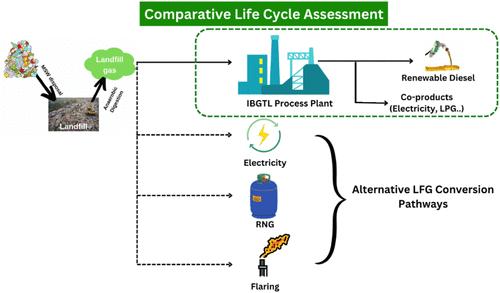
This paper conducts a comprehensive life cycle assessment (LCA) of the intensified biogas to liquids (IBGTL) process, focusing on its global warming potential (GWP) and comparing it to alternative biogas utilization pathways. Landfill gas (LFG), derived from municipal solid waste (MSW) decomposition, contributes significantly to methane emissions and poses environmental risks. Regulatory initiatives promote LFG capture and utilization for renewable energy production. The IBGTL process, integrating bi-reforming and Fischer–Tropsch synthesis into a compact reactor design, offers advantages in reduced capital and operating costs. This study quantifies the life cycle impacts of IBGTL diesel production and benchmarks it against other LFG utilization routes, including TriFTS diesel, LFG to electricity, and LFG to compressed renewable natural gas. Using a “well-to-wheel” boundary, the study evaluates emissions from production to usage. Findings indicate substantial reductions in greenhouse gas (GHG) emissions across all LFG-to-energy pathways compared to fossil alternatives, with the most significant savings achieved by IBGTL diesel with electricity cogeneration (Scenario 4, 221 gCO2eq/MJ reduction), followed by LFG to electricity (159 gCO2eq/MJ reduction), TriFTS diesel (107 gCO2eq/MJ reduction), and IBGTL diesel with material recycling (Scenario 2, 91.6 gCO2eq/MJ reduction). Sensitivity analyses reveal nuances in emissions impacts. The results highlight the importance of process optimization and grid characteristics in shaping the environmental performance. This research contributes insights for decision-makers, informing sustainable waste management strategies and guiding future LFG-to-energy technologies.
期刊介绍:
ACS Sustainable Chemistry & Engineering is a prestigious weekly peer-reviewed scientific journal published by the American Chemical Society. Dedicated to advancing the principles of green chemistry and green engineering, it covers a wide array of research topics including green chemistry, green engineering, biomass, alternative energy, and life cycle assessment.
The journal welcomes submissions in various formats, including Letters, Articles, Features, and Perspectives (Reviews), that address the challenges of sustainability in the chemical enterprise and contribute to the advancement of sustainable practices. Join us in shaping the future of sustainable chemistry and engineering.



 京公网安备 11010802042870号
京ICP备2023020795号-1
京公网安备 11010802042870号
京ICP备2023020795号-1

 分享
分享
 求助内容:
求助内容: 应助结果提醒方式:
 扫码关注我们
