Chun-Shuai Cao, Wenjie Liu, Aijing Ma, Xuan Jiao, Yuanyuan Yang, Jiahao Li, Feiyan Fu
{"title":"Single-Atom Pt-Decorated TiO2 Nanotubes for Boosted Photocatalytic Degradation of Chemical Warfare Agents","authors":"Chun-Shuai Cao, Wenjie Liu, Aijing Ma, Xuan Jiao, Yuanyuan Yang, Jiahao Li, Feiyan Fu","doi":"10.1021/acssuschemeng.5c01403","DOIUrl":null,"url":null,"abstract":"The organophosphorus compounds, as nerve agents and more broadly used as chemical warfare agents (CWAs), are difficult to remove through traditional water treatment due to their low concentrations. Single-atom (SA) catalysts, owing to their spatial atomic isolation, unsaturated coordination centers, and distinct electronic structures, can realize a maximum atom-utilization efficiency of up to 100%, thus offering outstanding catalytic performance. A highly efficient photocatalyst was synthesized by assembling single-atom Pt on TiO<sub>2</sub> nanotubes as support, and its physicochemical properties were confirmed through X-ray diffraction, X-ray photoelectron spectroscopy, high-resolution transmission electron microscopy, high-angle annular dark-field scanning transmission electron microscopy, and high-resolution transmission electron microscopy. This unique structure of SA-Pt/TiO<sub>2</sub> exhibited significantly high performance in photocatalytic degradation of dimethyl methylphosphonate (DMMP) in water, achieving a removal efficiency of 95% at an initial concentration of 80 ppm under xenon lamp irradiation. Introducing single-atom Pt led to a photocatalytic degradation rate that was 6.3 times that of the blank TiO<sub>2</sub> sample, which can be explained by the fact that single-atom Pt effectively promoted the transfer of photogenerated electrons from TiO<sub>2</sub> sites to Pt, thereby facilitating the separation of charge carriers. Additionally, density functional theory (DFT) calculations indicated that Pt doping on the TiO<sub>2</sub>(101) surface enhanced the adsorption capacity for DMMP and improved the redox capability, leading to a high photocatalytic activity. The study provides a strategy for developing highly efficient single-metal-atom-based photocatalysts, which is of great significance for efficiently removing trace amounts of chemical warfare agents from water.","PeriodicalId":25,"journal":{"name":"ACS Sustainable Chemistry & Engineering","volume":"1 1","pages":""},"PeriodicalIF":7.3000,"publicationDate":"2025-04-21","publicationTypes":"Journal Article","fieldsOfStudy":null,"isOpenAccess":false,"openAccessPdf":"","citationCount":"0","resultStr":null,"platform":"Semanticscholar","paperid":null,"PeriodicalName":"ACS Sustainable Chemistry & Engineering","FirstCategoryId":"92","ListUrlMain":"https://doi.org/10.1021/acssuschemeng.5c01403","RegionNum":1,"RegionCategory":"化学","ArticlePicture":[],"TitleCN":null,"AbstractTextCN":null,"PMCID":null,"EPubDate":"","PubModel":"","JCR":"Q1","JCRName":"CHEMISTRY, MULTIDISCIPLINARY","Score":null,"Total":0}
引用次数: 0
Abstract
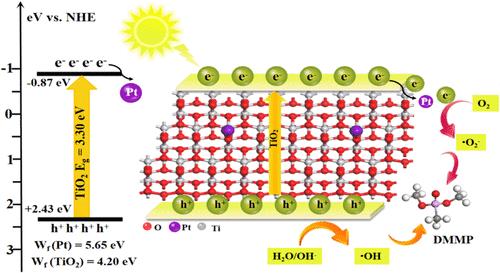
The organophosphorus compounds, as nerve agents and more broadly used as chemical warfare agents (CWAs), are difficult to remove through traditional water treatment due to their low concentrations. Single-atom (SA) catalysts, owing to their spatial atomic isolation, unsaturated coordination centers, and distinct electronic structures, can realize a maximum atom-utilization efficiency of up to 100%, thus offering outstanding catalytic performance. A highly efficient photocatalyst was synthesized by assembling single-atom Pt on TiO2 nanotubes as support, and its physicochemical properties were confirmed through X-ray diffraction, X-ray photoelectron spectroscopy, high-resolution transmission electron microscopy, high-angle annular dark-field scanning transmission electron microscopy, and high-resolution transmission electron microscopy. This unique structure of SA-Pt/TiO2 exhibited significantly high performance in photocatalytic degradation of dimethyl methylphosphonate (DMMP) in water, achieving a removal efficiency of 95% at an initial concentration of 80 ppm under xenon lamp irradiation. Introducing single-atom Pt led to a photocatalytic degradation rate that was 6.3 times that of the blank TiO2 sample, which can be explained by the fact that single-atom Pt effectively promoted the transfer of photogenerated electrons from TiO2 sites to Pt, thereby facilitating the separation of charge carriers. Additionally, density functional theory (DFT) calculations indicated that Pt doping on the TiO2(101) surface enhanced the adsorption capacity for DMMP and improved the redox capability, leading to a high photocatalytic activity. The study provides a strategy for developing highly efficient single-metal-atom-based photocatalysts, which is of great significance for efficiently removing trace amounts of chemical warfare agents from water.
期刊介绍:
ACS Sustainable Chemistry & Engineering is a prestigious weekly peer-reviewed scientific journal published by the American Chemical Society. Dedicated to advancing the principles of green chemistry and green engineering, it covers a wide array of research topics including green chemistry, green engineering, biomass, alternative energy, and life cycle assessment.
The journal welcomes submissions in various formats, including Letters, Articles, Features, and Perspectives (Reviews), that address the challenges of sustainability in the chemical enterprise and contribute to the advancement of sustainable practices. Join us in shaping the future of sustainable chemistry and engineering.



 京公网安备 11010802042870号
京ICP备2023020795号-1
京公网安备 11010802042870号
京ICP备2023020795号-1

 分享
分享
 求助内容:
求助内容: 应助结果提醒方式:
 扫码关注我们
