Multi-modal energy harvesting for efficient piezoelectric photocatalytic pollutant degradation using CaBi4Ti4O15/BiOI heterojunctions with excellent piezoelectric properties
ZhanMing Yin , Tong Liu , Yu Yang , Rongli Sang , Zhanshen Zheng , Jixiang Duan , Yuanliang Li
{"title":"Multi-modal energy harvesting for efficient piezoelectric photocatalytic pollutant degradation using CaBi4Ti4O15/BiOI heterojunctions with excellent piezoelectric properties","authors":"ZhanMing Yin , Tong Liu , Yu Yang , Rongli Sang , Zhanshen Zheng , Jixiang Duan , Yuanliang Li","doi":"10.1016/j.jallcom.2025.180566","DOIUrl":null,"url":null,"abstract":"<div><div>Bismuth-based materials, known for their unique layered structure, have emerged as promising candidates for semiconductor photocatalysts. However, their practical application is often hindered by wide band gaps and limited visible light absorption, leading to low photocatalytic efficiency. To address these challenges, we developed a novel CaBi<sub>4</sub>Ti<sub>4</sub>O<sub>15</sub>/BiOI (CBTO/BOI) heterojunction catalyst, leveraging the synergistic effects of piezoelectricity and photocatalysis. The heterogeneous structure of CBTO/BOI, combined with the intrinsic polarization effect of CBTO, significantly enhances the separation of electron-hole pairs, providing a robust driving force for catalytic degradation. This multi-modal catalytic process efficiently harnesses both solar and mechanical energy, enabling rapid carrier separation and migration. Under simultaneous light and ultrasonic irradiation, the CBTO/BOI catalyst achieved an exceptional 98.36 % degradation of Rhodamine B (RhB) within 16 min, with a remarkable rate constant of <em>k</em> = 0.2298 min<sup>−1</sup>, surpassing most reported piezoelectric photocatalysts. This study not only presents a highly efficient and environmentally friendly approach for pollutant degradation through multi-modal energy harvesting but also opens new avenues for the design of advanced photocatalysts for sustainable environmental remediation.</div></div>","PeriodicalId":344,"journal":{"name":"Journal of Alloys and Compounds","volume":"1027 ","pages":"Article 180566"},"PeriodicalIF":6.3000,"publicationDate":"2025-05-10","publicationTypes":"Journal Article","fieldsOfStudy":null,"isOpenAccess":false,"openAccessPdf":"","citationCount":"0","resultStr":null,"platform":"Semanticscholar","paperid":null,"PeriodicalName":"Journal of Alloys and Compounds","FirstCategoryId":"88","ListUrlMain":"https://www.sciencedirect.com/science/article/pii/S0925838825021279","RegionNum":2,"RegionCategory":"材料科学","ArticlePicture":[],"TitleCN":null,"AbstractTextCN":null,"PMCID":null,"EPubDate":"2025/4/22 0:00:00","PubModel":"Epub","JCR":"Q2","JCRName":"CHEMISTRY, PHYSICAL","Score":null,"Total":0}
引用次数: 0
Abstract
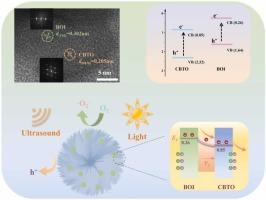
Bismuth-based materials, known for their unique layered structure, have emerged as promising candidates for semiconductor photocatalysts. However, their practical application is often hindered by wide band gaps and limited visible light absorption, leading to low photocatalytic efficiency. To address these challenges, we developed a novel CaBi4Ti4O15/BiOI (CBTO/BOI) heterojunction catalyst, leveraging the synergistic effects of piezoelectricity and photocatalysis. The heterogeneous structure of CBTO/BOI, combined with the intrinsic polarization effect of CBTO, significantly enhances the separation of electron-hole pairs, providing a robust driving force for catalytic degradation. This multi-modal catalytic process efficiently harnesses both solar and mechanical energy, enabling rapid carrier separation and migration. Under simultaneous light and ultrasonic irradiation, the CBTO/BOI catalyst achieved an exceptional 98.36 % degradation of Rhodamine B (RhB) within 16 min, with a remarkable rate constant of k = 0.2298 min−1, surpassing most reported piezoelectric photocatalysts. This study not only presents a highly efficient and environmentally friendly approach for pollutant degradation through multi-modal energy harvesting but also opens new avenues for the design of advanced photocatalysts for sustainable environmental remediation.
期刊介绍:
The Journal of Alloys and Compounds is intended to serve as an international medium for the publication of work on solid materials comprising compounds as well as alloys. Its great strength lies in the diversity of discipline which it encompasses, drawing together results from materials science, solid-state chemistry and physics.



 京公网安备 11010802042870号
京ICP备2023020795号-1
京公网安备 11010802042870号
京ICP备2023020795号-1

 分享
分享
 求助内容:
求助内容: 应助结果提醒方式:
 扫码关注我们
