Katrin Beuthert, Nils Spang, Diana Carolina Alzate Millan, Lukas Guggolz, Stefanie Dehnen
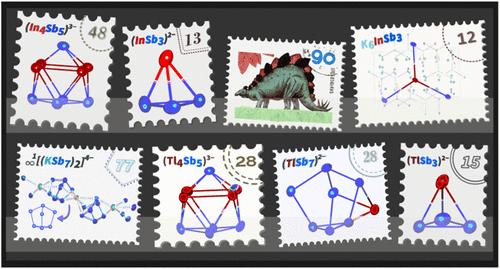
{"title":"Expanding the Toolbox: Synthesis of Zintl Salts Containing Anions of the In/Sb and Tl/Sb Elemental Combinations","authors":"Katrin Beuthert, Nils Spang, Diana Carolina Alzate Millan, Lukas Guggolz, Stefanie Dehnen","doi":"10.1021/acs.inorgchem.5c00724","DOIUrl":null,"url":null,"abstract":"Binary Zintl anions comprising atoms of two p-block elements, and ternary Zintl clusters, in which the latter are combined with d-/f-block metal ions, are being studied with great activity. However, although an impressive variety of elemental compositions have been realized, some combinations of the p-block (semi)metals are lacking in corresponding substructures. The In/Sb combination is extremely rare, and Tl/Sb has not yet been realized at all, although the existence of <i>pseudo</i>-tetrahedral species, for instance, was predicted by quantum chemical studies. Extraction of the novel ternary phase K<sub>6</sub>InSb<sub>3</sub> and of K<sub>6</sub>Tl<sub>2</sub>Sb<sub>3</sub> with ethane-1,2-diamine (en) yielded binary Zintl anions of these elemental combinations as salts comprising <i>pseudo</i>-tetrahedral anions (InSb<sub>3</sub>)<sup>2–</sup> and (TlSb<sub>3</sub>)<sup>2–</sup> or nine-vertex cages (In<sub>4</sub>Sb<sub>5</sub>)<sup>3–</sup> and (Tl<sub>4</sub>Sb<sub>5</sub>)<sup>3–</sup>, respectively. To establish efficient synthesis routes, the extractions were monitored using electrospray-ionization mass spectrometry and fractionated crystallization. We thereby isolated salts of two further anions that might represent intermediates on the way to larger species, namely, a novel salt of the Sb<sub>7</sub><sup>3–</sup> anion, and a salt of the new binary anion (TlSb<sub>7</sub>)<sup>2–</sup>. We describe the experimental approach, the process of its optimization, the geometric structures of the new compounds as well as their electronic structures that were established by DFT calculations.","PeriodicalId":40,"journal":{"name":"Inorganic Chemistry","volume":"33 1","pages":""},"PeriodicalIF":4.7000,"publicationDate":"2025-04-21","publicationTypes":"Journal Article","fieldsOfStudy":null,"isOpenAccess":false,"openAccessPdf":"","citationCount":"0","resultStr":null,"platform":"Semanticscholar","paperid":null,"PeriodicalName":"Inorganic Chemistry","FirstCategoryId":"92","ListUrlMain":"https://doi.org/10.1021/acs.inorgchem.5c00724","RegionNum":2,"RegionCategory":"化学","ArticlePicture":[],"TitleCN":null,"AbstractTextCN":null,"PMCID":null,"EPubDate":"","PubModel":"","JCR":"Q1","JCRName":"CHEMISTRY, INORGANIC & NUCLEAR","Score":null,"Total":0}
引用次数: 0
Abstract
Binary Zintl anions comprising atoms of two p-block elements, and ternary Zintl clusters, in which the latter are combined with d-/f-block metal ions, are being studied with great activity. However, although an impressive variety of elemental compositions have been realized, some combinations of the p-block (semi)metals are lacking in corresponding substructures. The In/Sb combination is extremely rare, and Tl/Sb has not yet been realized at all, although the existence of pseudo-tetrahedral species, for instance, was predicted by quantum chemical studies. Extraction of the novel ternary phase K6InSb3 and of K6Tl2Sb3 with ethane-1,2-diamine (en) yielded binary Zintl anions of these elemental combinations as salts comprising pseudo-tetrahedral anions (InSb3)2– and (TlSb3)2– or nine-vertex cages (In4Sb5)3– and (Tl4Sb5)3–, respectively. To establish efficient synthesis routes, the extractions were monitored using electrospray-ionization mass spectrometry and fractionated crystallization. We thereby isolated salts of two further anions that might represent intermediates on the way to larger species, namely, a novel salt of the Sb73– anion, and a salt of the new binary anion (TlSb7)2–. We describe the experimental approach, the process of its optimization, the geometric structures of the new compounds as well as their electronic structures that were established by DFT calculations.
期刊介绍:
Inorganic Chemistry publishes fundamental studies in all phases of inorganic chemistry. Coverage includes experimental and theoretical reports on quantitative studies of structure and thermodynamics, kinetics, mechanisms of inorganic reactions, bioinorganic chemistry, and relevant aspects of organometallic chemistry, solid-state phenomena, and chemical bonding theory. Emphasis is placed on the synthesis, structure, thermodynamics, reactivity, spectroscopy, and bonding properties of significant new and known compounds.



 京公网安备 11010802042870号
京ICP备2023020795号-1
京公网安备 11010802042870号
京ICP备2023020795号-1

 分享
分享
 求助内容:
求助内容: 应助结果提醒方式:
 扫码关注我们
