Xian-Yu Shen, Ya-Nan Wang, Ya-Ting Zheng, Ye Wang, Wen-Wen Dong, Jun Zhao, Dong-Sheng Li
{"title":"Core–Shell MIL-125-NH2@FeOOH Nanocomposites for Highly Selective Photocatalytic Oxidation of Methane to Formaldehyde in Water Vapor","authors":"Xian-Yu Shen, Ya-Nan Wang, Ya-Ting Zheng, Ye Wang, Wen-Wen Dong, Jun Zhao, Dong-Sheng Li","doi":"10.1021/acs.inorgchem.5c00883","DOIUrl":null,"url":null,"abstract":"Formaldehyde (HCHO), a crucial industrial chemical, finds extensive applications across diverse sectors, including household products, commercial materials, aviation, and medical supplies. Methane (CH<sub>4</sub>), as an abundant C1 resource, presents a promising feedstock for HCHO synthesis. However, the direct conversion of CH<sub>4</sub> to HCHO remains challenging due to its inherent chemical inertness, characterized by low polarizability and high C–H bond dissociation energy (439 kJ mol<sup>–1</sup>), coupled with the high reactivity of intermediate products. The development of efficient strategies for selective CH<sub>4</sub> oxidation to high-value HCHO under mild conditions is therefore of significant practical importance. In this study, we developed a series of MIL-125-NH<sub>2</sub>@FeOOH-<i>x</i> heterostructured photocatalysts (FM-<i>x</i>) through the controlled deposition of FeOOH nanoparticles on MIL-125-NH<sub>2</sub> surfaces. Comprehensive characterization and photocatalytic evaluations reveal that the optimized FM-1 catalyst facilitates in situ H<sub>2</sub>O<sub>2</sub> generation and subsequent decomposition into hydroxyl radicals (<sup>•</sup>OH), enabling efficient CH<sub>4</sub> photooxidation. Remarkably, the FM-1 catalyst achieves an exceptional HCHO production rate of 197.79 μmol·g<sub>cat</sub><sup>–1</sup> with >99.99% selectivity in water vapor, significantly outperforming both pristine FeOOH and MIL-125-NH<sub>2</sub> components. This work presents a promising photocatalytic system for selective CH<sub>4</sub> conversion, offering new insights into the design of efficient catalysts for C1 chemistry.","PeriodicalId":40,"journal":{"name":"Inorganic Chemistry","volume":"23 1","pages":""},"PeriodicalIF":4.7000,"publicationDate":"2025-04-21","publicationTypes":"Journal Article","fieldsOfStudy":null,"isOpenAccess":false,"openAccessPdf":"","citationCount":"0","resultStr":null,"platform":"Semanticscholar","paperid":null,"PeriodicalName":"Inorganic Chemistry","FirstCategoryId":"92","ListUrlMain":"https://doi.org/10.1021/acs.inorgchem.5c00883","RegionNum":2,"RegionCategory":"化学","ArticlePicture":[],"TitleCN":null,"AbstractTextCN":null,"PMCID":null,"EPubDate":"","PubModel":"","JCR":"Q1","JCRName":"CHEMISTRY, INORGANIC & NUCLEAR","Score":null,"Total":0}
引用次数: 0
Abstract
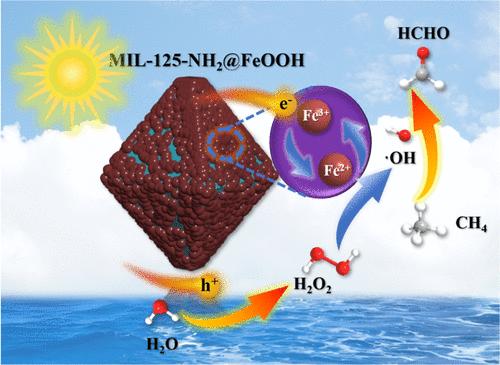
Formaldehyde (HCHO), a crucial industrial chemical, finds extensive applications across diverse sectors, including household products, commercial materials, aviation, and medical supplies. Methane (CH4), as an abundant C1 resource, presents a promising feedstock for HCHO synthesis. However, the direct conversion of CH4 to HCHO remains challenging due to its inherent chemical inertness, characterized by low polarizability and high C–H bond dissociation energy (439 kJ mol–1), coupled with the high reactivity of intermediate products. The development of efficient strategies for selective CH4 oxidation to high-value HCHO under mild conditions is therefore of significant practical importance. In this study, we developed a series of MIL-125-NH2@FeOOH-x heterostructured photocatalysts (FM-x) through the controlled deposition of FeOOH nanoparticles on MIL-125-NH2 surfaces. Comprehensive characterization and photocatalytic evaluations reveal that the optimized FM-1 catalyst facilitates in situ H2O2 generation and subsequent decomposition into hydroxyl radicals (•OH), enabling efficient CH4 photooxidation. Remarkably, the FM-1 catalyst achieves an exceptional HCHO production rate of 197.79 μmol·gcat–1 with >99.99% selectivity in water vapor, significantly outperforming both pristine FeOOH and MIL-125-NH2 components. This work presents a promising photocatalytic system for selective CH4 conversion, offering new insights into the design of efficient catalysts for C1 chemistry.
期刊介绍:
Inorganic Chemistry publishes fundamental studies in all phases of inorganic chemistry. Coverage includes experimental and theoretical reports on quantitative studies of structure and thermodynamics, kinetics, mechanisms of inorganic reactions, bioinorganic chemistry, and relevant aspects of organometallic chemistry, solid-state phenomena, and chemical bonding theory. Emphasis is placed on the synthesis, structure, thermodynamics, reactivity, spectroscopy, and bonding properties of significant new and known compounds.



 京公网安备 11010802042870号
京ICP备2023020795号-1
京公网安备 11010802042870号
京ICP备2023020795号-1

 分享
分享
 求助内容:
求助内容: 应助结果提醒方式:
 扫码关注我们
