{"title":"Intramolecular Hydrogen Bond Modulated the Formation of Exciplex for Highly Efficient Organic Light-Emitting Diodes","authors":"Shaogang Shen, Zhi Pang, Honglei Gao, Xin Xie, Xinyi Lv, Jianjun Liu, Ying Wang","doi":"10.1021/acs.jpclett.5c00876","DOIUrl":null,"url":null,"abstract":"Although exciplexes with thermally activated delayed fluorescence (TADF) properties have been applied in high-efficiency organic electroluminescent devices, the development of exciplexes has been hindered due to the limited material systems and unclear formation mechanisms. Inspired by the unusual exciplex emission discovered in the pyridine solution of 2,12-di-<i>tert</i>-butyl-5,9-dithia-13b-boranaphtho[3,2,1-de]anthracene (TSBA) in this work, the formation mechanism of exciplexes based on two groups of pyridine-based derivative isomeric acceptors 26DCzPPy, 35DCzPPy and B2PyPB, B3PyPB and B4PyPB was explored accordingly. The difference in the position of the substituted pyridine in the isomeric acceptors can effectively regulate the formation of intramolecular N···H hydrogen bonds, which further affects their interaction with the electron-donating unit in TSBA through a conformational locking effect-induced topological rigidification of the molecule, ultimately determining the formation of the exciplex. Based on this mechanism, 35DCzPPy, B3PyPB and B4PyPB acceptors, combined with the TSBA donor, display TADF exciplex emission as expected. Among these, 35DCzPPy:TSBA shows the excellent TADF property with a high photoluminescent quantum yield reaching 78%, and the corresponding device achieves a high external quantum efficiency of 18.72% along with a small efficiency roll-off. An in-depth investigation into the influence mechanisms of intramolecular interactions on exciplex construction in this work will provide crucial theoretical guidance and design strategies for developing novel, highly efficient exciplex materials.","PeriodicalId":62,"journal":{"name":"The Journal of Physical Chemistry Letters","volume":"108 1","pages":""},"PeriodicalIF":4.6000,"publicationDate":"2025-04-22","publicationTypes":"Journal Article","fieldsOfStudy":null,"isOpenAccess":false,"openAccessPdf":"","citationCount":"0","resultStr":null,"platform":"Semanticscholar","paperid":null,"PeriodicalName":"The Journal of Physical Chemistry Letters","FirstCategoryId":"1","ListUrlMain":"https://doi.org/10.1021/acs.jpclett.5c00876","RegionNum":2,"RegionCategory":"化学","ArticlePicture":[],"TitleCN":null,"AbstractTextCN":null,"PMCID":null,"EPubDate":"","PubModel":"","JCR":"Q2","JCRName":"CHEMISTRY, PHYSICAL","Score":null,"Total":0}
引用次数: 0
Abstract
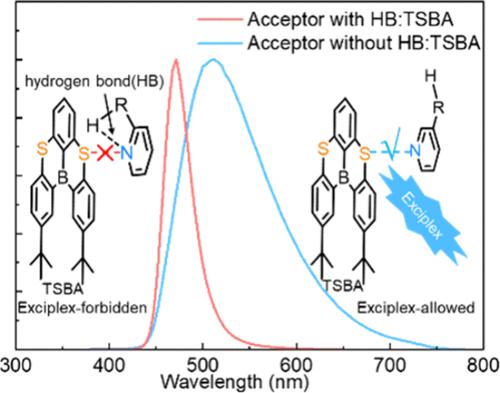
Although exciplexes with thermally activated delayed fluorescence (TADF) properties have been applied in high-efficiency organic electroluminescent devices, the development of exciplexes has been hindered due to the limited material systems and unclear formation mechanisms. Inspired by the unusual exciplex emission discovered in the pyridine solution of 2,12-di-tert-butyl-5,9-dithia-13b-boranaphtho[3,2,1-de]anthracene (TSBA) in this work, the formation mechanism of exciplexes based on two groups of pyridine-based derivative isomeric acceptors 26DCzPPy, 35DCzPPy and B2PyPB, B3PyPB and B4PyPB was explored accordingly. The difference in the position of the substituted pyridine in the isomeric acceptors can effectively regulate the formation of intramolecular N···H hydrogen bonds, which further affects their interaction with the electron-donating unit in TSBA through a conformational locking effect-induced topological rigidification of the molecule, ultimately determining the formation of the exciplex. Based on this mechanism, 35DCzPPy, B3PyPB and B4PyPB acceptors, combined with the TSBA donor, display TADF exciplex emission as expected. Among these, 35DCzPPy:TSBA shows the excellent TADF property with a high photoluminescent quantum yield reaching 78%, and the corresponding device achieves a high external quantum efficiency of 18.72% along with a small efficiency roll-off. An in-depth investigation into the influence mechanisms of intramolecular interactions on exciplex construction in this work will provide crucial theoretical guidance and design strategies for developing novel, highly efficient exciplex materials.
期刊介绍:
The Journal of Physical Chemistry (JPC) Letters is devoted to reporting new and original experimental and theoretical basic research of interest to physical chemists, biophysical chemists, chemical physicists, physicists, material scientists, and engineers. An important criterion for acceptance is that the paper reports a significant scientific advance and/or physical insight such that rapid publication is essential. Two issues of JPC Letters are published each month.



 京公网安备 11010802042870号
京ICP备2023020795号-1
京公网安备 11010802042870号
京ICP备2023020795号-1

 分享
分享
 求助内容:
求助内容: 应助结果提醒方式:
 扫码关注我们
