{"title":"Fast-Track to Catalyst Stability: Machine Learning Optimized Predictions for M1/M2-N6-Gra Catalysts","authors":"Pengxin Pu, Xin Song, Hu Ding, Yuan Deng, Haisong Feng, Xin Zhang","doi":"10.1021/acs.jpclett.5c00097","DOIUrl":null,"url":null,"abstract":"Graphene-based dual-atom catalysts M1/M2-N<sub>6</sub>-Gra have shown significant potential in various reactions, although their stabilities are debated. Therefore, developing an efficient and accurate approach to screen thermodynamically stable M1/M2-N<sub>6</sub>-Gra is significant. Herein, we designed a rational machine learning (ML) scheme based on 143 DFT calculated samples to predict the formation energies (<i>E</i><sub><i>f</i></sub>) of 1134 possible M1/M2-N<sub>6</sub>-Gra. A well performing multilayer perceptron model with test set <i>R</i><sup>2</sup> <i>=</i> 0.98 was obtained after feature engineering, model training, data supplementation, and transfer learning. This model successfully screened 604 thermodynamic stable M1/M2-N<sub>6</sub>-Gra with <i>E</i><sub><i>f</i></sub> < 0 eV. Feature importance, predictions distribution, and energy decomposition revealed that the coordination number significantly influences <i>E</i><sub><i>f</i></sub>, with cohesive energy dominating low-coordination catalysts and binding energy between metal and substrate being more critical in higher-coordination catalysts. This work highlights the potential of ML and developed effective approaches to screen thermodynamically stable catalysts and reveals the laws of stability for various materials.","PeriodicalId":62,"journal":{"name":"The Journal of Physical Chemistry Letters","volume":"33 1","pages":""},"PeriodicalIF":4.6000,"publicationDate":"2025-04-21","publicationTypes":"Journal Article","fieldsOfStudy":null,"isOpenAccess":false,"openAccessPdf":"","citationCount":"0","resultStr":null,"platform":"Semanticscholar","paperid":null,"PeriodicalName":"The Journal of Physical Chemistry Letters","FirstCategoryId":"1","ListUrlMain":"https://doi.org/10.1021/acs.jpclett.5c00097","RegionNum":2,"RegionCategory":"化学","ArticlePicture":[],"TitleCN":null,"AbstractTextCN":null,"PMCID":null,"EPubDate":"","PubModel":"","JCR":"Q2","JCRName":"CHEMISTRY, PHYSICAL","Score":null,"Total":0}
引用次数: 0
Abstract
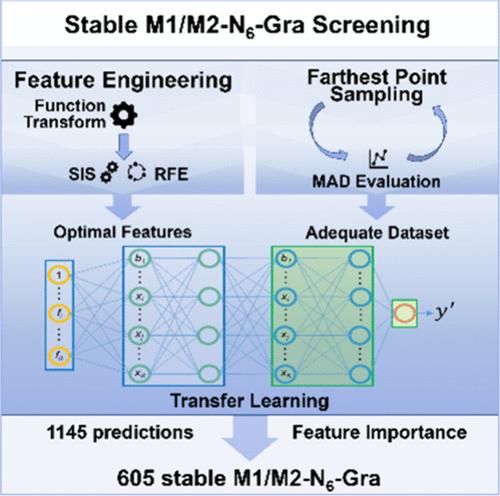
Graphene-based dual-atom catalysts M1/M2-N6-Gra have shown significant potential in various reactions, although their stabilities are debated. Therefore, developing an efficient and accurate approach to screen thermodynamically stable M1/M2-N6-Gra is significant. Herein, we designed a rational machine learning (ML) scheme based on 143 DFT calculated samples to predict the formation energies (Ef) of 1134 possible M1/M2-N6-Gra. A well performing multilayer perceptron model with test set R2= 0.98 was obtained after feature engineering, model training, data supplementation, and transfer learning. This model successfully screened 604 thermodynamic stable M1/M2-N6-Gra with Ef < 0 eV. Feature importance, predictions distribution, and energy decomposition revealed that the coordination number significantly influences Ef, with cohesive energy dominating low-coordination catalysts and binding energy between metal and substrate being more critical in higher-coordination catalysts. This work highlights the potential of ML and developed effective approaches to screen thermodynamically stable catalysts and reveals the laws of stability for various materials.
期刊介绍:
The Journal of Physical Chemistry (JPC) Letters is devoted to reporting new and original experimental and theoretical basic research of interest to physical chemists, biophysical chemists, chemical physicists, physicists, material scientists, and engineers. An important criterion for acceptance is that the paper reports a significant scientific advance and/or physical insight such that rapid publication is essential. Two issues of JPC Letters are published each month.



 京公网安备 11010802042870号
京ICP备2023020795号-1
京公网安备 11010802042870号
京ICP备2023020795号-1

 分享
分享
 求助内容:
求助内容: 应助结果提醒方式:
 扫码关注我们
