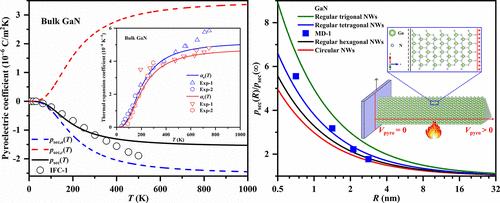
{"title":"Bond Relaxation Insight into Secondary Pyroelectric Coefficient from One- to Three-Dimensional Materials: Temperature-, Size-, and Shape Effects","authors":"Jin Liu, Xuexian Yang, Liwen Yang, Jianwen Ding","doi":"10.1021/acs.jpcc.4c08088","DOIUrl":null,"url":null,"abstract":"The physical origins of the secondary pyroelectric coefficient in response to temperature, size, and shape have long been a puzzle. Based on the local bond average approach, an analytical equation for the temperature effect of the secondary pyroelectric coefficient of bulk GaN, ZnO, ZrO<sub>2</sub>, and HfO<sub>2</sub>, and Janus monolayer MoSSe and CrSeBr is established. It is found that the secondary pyroelectric coefficient is inversely proportional to both cohesive energy and the cube of the Debye temperature. Combining the bond-order-length-strength theory and core–shell structural model, the analytical expressions for the size- and shape-dependent secondary pyroelectric coefficients for GaN nanostructures are derived. The results unveil that the crystal size-induced secondary pyroelectric coefficient rising results from the synergetic effect of the increase in piezoelectric coefficient and the decrease in both Debye temperature and cohesive energy caused by bond order deficiency at the surface layer. The secondary pyroelectric coefficient increases with the decrease in the number of sides for polyhedral nanoparticles and polygonal nanowires or nanotubes due to the rise in surface-to-volume ratio. The size effect of the secondary pyroelectric coefficient for nanotubes is characterized by the wall thickness and does not depend on the radius. The secondary pyroelectric coefficient for nanotubes is always higher than their nanowire counterparts because of their larger surface-to-volume ratios. The current study is anticipated to have implications in the field of nanoscale thermal energy harvesting.","PeriodicalId":61,"journal":{"name":"The Journal of Physical Chemistry C","volume":"7 1","pages":""},"PeriodicalIF":3.2000,"publicationDate":"2025-04-22","publicationTypes":"Journal Article","fieldsOfStudy":null,"isOpenAccess":false,"openAccessPdf":"","citationCount":"0","resultStr":null,"platform":"Semanticscholar","paperid":null,"PeriodicalName":"The Journal of Physical Chemistry C","FirstCategoryId":"1","ListUrlMain":"https://doi.org/10.1021/acs.jpcc.4c08088","RegionNum":3,"RegionCategory":"化学","ArticlePicture":[],"TitleCN":null,"AbstractTextCN":null,"PMCID":null,"EPubDate":"","PubModel":"","JCR":"Q2","JCRName":"CHEMISTRY, PHYSICAL","Score":null,"Total":0}
引用次数: 0
Abstract
The physical origins of the secondary pyroelectric coefficient in response to temperature, size, and shape have long been a puzzle. Based on the local bond average approach, an analytical equation for the temperature effect of the secondary pyroelectric coefficient of bulk GaN, ZnO, ZrO2, and HfO2, and Janus monolayer MoSSe and CrSeBr is established. It is found that the secondary pyroelectric coefficient is inversely proportional to both cohesive energy and the cube of the Debye temperature. Combining the bond-order-length-strength theory and core–shell structural model, the analytical expressions for the size- and shape-dependent secondary pyroelectric coefficients for GaN nanostructures are derived. The results unveil that the crystal size-induced secondary pyroelectric coefficient rising results from the synergetic effect of the increase in piezoelectric coefficient and the decrease in both Debye temperature and cohesive energy caused by bond order deficiency at the surface layer. The secondary pyroelectric coefficient increases with the decrease in the number of sides for polyhedral nanoparticles and polygonal nanowires or nanotubes due to the rise in surface-to-volume ratio. The size effect of the secondary pyroelectric coefficient for nanotubes is characterized by the wall thickness and does not depend on the radius. The secondary pyroelectric coefficient for nanotubes is always higher than their nanowire counterparts because of their larger surface-to-volume ratios. The current study is anticipated to have implications in the field of nanoscale thermal energy harvesting.
期刊介绍:
The Journal of Physical Chemistry A/B/C is devoted to reporting new and original experimental and theoretical basic research of interest to physical chemists, biophysical chemists, and chemical physicists.



 京公网安备 11010802042870号
京ICP备2023020795号-1
京公网安备 11010802042870号
京ICP备2023020795号-1

 分享
分享
 求助内容:
求助内容: 应助结果提醒方式:
 扫码关注我们
