Ju-Hyoung Park , Young-Hoon Noh , Jin Sung Kim , Gyu-Seob Song , Se-Joon Park , Jong Won Choi , Young-Chan Choi , Young-Joo Lee
{"title":"Biomass–formic acid–hydrogen conversion process: sustainable production of formic acid from biomass using greenhouse gas†","authors":"Ju-Hyoung Park , Young-Hoon Noh , Jin Sung Kim , Gyu-Seob Song , Se-Joon Park , Jong Won Choi , Young-Chan Choi , Young-Joo Lee","doi":"10.1039/d4gc06611a","DOIUrl":null,"url":null,"abstract":"<div><div>Sustainable green hydrogen production processes and efficient hydrogen storage methods are highly sought after to advance the hydrogen economy. Recently, a biomass–formic acid–hydrogen conversion process, which combines the formic acid production process from biomass with a formic acid dehydrogenation process, has been developed to address the two critical issues in the hydrogen field. Traditionally, inorganic acid reactants have been used to increase formic acid production during biomass treatment. In this study, we utilized a greenhouse gas as a heterogeneous acid reactant to replace toxic strong acid reactants. A formic acid yield of 36.18% was achieved using lignocellulose biomass under 30 bar CO<sub>2</sub> pressure, with 11 wt% H<sub>2</sub>O<sub>2</sub> at 170 °C for 3 h, which is comparable to the yields reported in biomass conversion studies employing sulfuric acid, highlighting the competitiveness of this greener approach. We used a carbonic acid reactant instead of inorganic acid reactants, advancing the development of a sustainable formic acid production process. Various herbaceous biomass types (corn and wheat stover) were tested in the hydrolysis–oxidation system using CO<sub>2</sub> gas and H<sub>2</sub>O<sub>2</sub>. Formic acid yields (17.43 and 20.45%) were lower when herbaceous biomass was used than when red pine was used. Finally, formic acid derived from biomass was converted to hydrogen gas in a dehydrogenation system using a Pd heterogeneous catalyst at room temperature. This process eliminates the use of harmful inorganic acids while contributing to significant carbon reduction. Carbon emission analysis results show that this process can achieve a net carbon reduction of 5.83 tons of CO<sub>2</sub> per ton of hydrogen produced. This approach not only supports carbon-neutral hydrogen production but also demonstrates high scalability potential, making it a viable solution for meeting global sustainability targets at an industrial scale.</div></div>","PeriodicalId":78,"journal":{"name":"Green Chemistry","volume":"27 17","pages":"Pages 4750-4765"},"PeriodicalIF":9.2000,"publicationDate":"2025-03-20","publicationTypes":"Journal Article","fieldsOfStudy":null,"isOpenAccess":false,"openAccessPdf":"","citationCount":"0","resultStr":null,"platform":"Semanticscholar","paperid":null,"PeriodicalName":"Green Chemistry","FirstCategoryId":"92","ListUrlMain":"https://www.sciencedirect.com/org/science/article/pii/S1463926225002468","RegionNum":1,"RegionCategory":"化学","ArticlePicture":[],"TitleCN":null,"AbstractTextCN":null,"PMCID":null,"EPubDate":"2025/5/7 0:00:00","PubModel":"Epub","JCR":"Q1","JCRName":"CHEMISTRY, MULTIDISCIPLINARY","Score":null,"Total":0}
引用次数: 0
Abstract
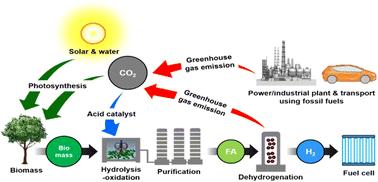
Sustainable green hydrogen production processes and efficient hydrogen storage methods are highly sought after to advance the hydrogen economy. Recently, a biomass–formic acid–hydrogen conversion process, which combines the formic acid production process from biomass with a formic acid dehydrogenation process, has been developed to address the two critical issues in the hydrogen field. Traditionally, inorganic acid reactants have been used to increase formic acid production during biomass treatment. In this study, we utilized a greenhouse gas as a heterogeneous acid reactant to replace toxic strong acid reactants. A formic acid yield of 36.18% was achieved using lignocellulose biomass under 30 bar CO2 pressure, with 11 wt% H2O2 at 170 °C for 3 h, which is comparable to the yields reported in biomass conversion studies employing sulfuric acid, highlighting the competitiveness of this greener approach. We used a carbonic acid reactant instead of inorganic acid reactants, advancing the development of a sustainable formic acid production process. Various herbaceous biomass types (corn and wheat stover) were tested in the hydrolysis–oxidation system using CO2 gas and H2O2. Formic acid yields (17.43 and 20.45%) were lower when herbaceous biomass was used than when red pine was used. Finally, formic acid derived from biomass was converted to hydrogen gas in a dehydrogenation system using a Pd heterogeneous catalyst at room temperature. This process eliminates the use of harmful inorganic acids while contributing to significant carbon reduction. Carbon emission analysis results show that this process can achieve a net carbon reduction of 5.83 tons of CO2 per ton of hydrogen produced. This approach not only supports carbon-neutral hydrogen production but also demonstrates high scalability potential, making it a viable solution for meeting global sustainability targets at an industrial scale.
可持续的绿色制氢工艺和高效的储氢方法是推动氢经济发展的迫切需要。最近,一种生物质-甲酸-氢转化工艺,将生物质制甲酸过程与甲酸脱氢过程相结合,解决了氢领域的两个关键问题。传统上,无机酸反应物已被用于提高生物质处理过程中甲酸的产量。在本研究中,我们利用温室气体作为非均相酸性反应物来取代有毒的强酸反应物。使用木质纤维素生物质,在30 bar CO2压力下,在170°C下,11wt % H2O2条件下,3小时的甲酸产率达到36.18%,这与使用硫酸的生物质转化研究报告的产率相当,突出了这种更环保方法的竞争力。我们用碳酸原料代替无机酸原料,推进了可持续甲酸生产工艺的发展。不同类型的草本生物质(玉米和小麦秸秆)在CO2气体和H2O2的水解氧化系统中进行了测试。使用草本生物量时,甲酸产率(17.43%和20.45%)低于使用红松生物量时。最后,利用Pd非均相催化剂在脱氢系统中将生物质中提取的甲酸在室温下转化为氢气。这一过程消除了有害无机酸的使用,同时有助于显著减少碳排放。碳排放分析结果表明,该工艺每生产一吨氢气可实现净减碳5.83吨CO2。这种方法不仅支持碳中和制氢,而且具有很高的可扩展性潜力,使其成为实现工业规模全球可持续发展目标的可行解决方案。
期刊介绍:
Green Chemistry is a journal that provides a unique forum for the publication of innovative research on the development of alternative green and sustainable technologies. The scope of Green Chemistry is based on the definition proposed by Anastas and Warner (Green Chemistry: Theory and Practice, P T Anastas and J C Warner, Oxford University Press, Oxford, 1998), which defines green chemistry as the utilisation of a set of principles that reduces or eliminates the use or generation of hazardous substances in the design, manufacture and application of chemical products. Green Chemistry aims to reduce the environmental impact of the chemical enterprise by developing a technology base that is inherently non-toxic to living things and the environment. The journal welcomes submissions on all aspects of research relating to this endeavor and publishes original and significant cutting-edge research that is likely to be of wide general appeal. For a work to be published, it must present a significant advance in green chemistry, including a comparison with existing methods and a demonstration of advantages over those methods.



 京公网安备 11010802042870号
京ICP备2023020795号-1
京公网安备 11010802042870号
京ICP备2023020795号-1

 分享
分享
 求助内容:
求助内容: 应助结果提醒方式:
 扫码关注我们
