{"title":"Sustainable approach towards development of a bioinspired polymer reinforced composite hydrogel: rheological and biological aspects†","authors":"Shokat Hussain and Shrikant S. Maktedar","doi":"10.1039/D4NJ05128A","DOIUrl":null,"url":null,"abstract":"<p >The present study explores the properties of a chitosan-decorated graphene oxide–silver (chitosan@GO–Ag) composite hydrogel, with a focus on its improved rheological characteristics and notable biological activity. The antimicrobial performance of chitosan@GO–Ag was assessed against <em>Streptococcus mutans</em>, <em>Staphylococcus aureus</em>, <em>Escherichia coli</em>, and <em>Pseudomonas aeruginosa</em>, revealing substantial inhibition zones, underscoring its potential as an effective antimicrobial agent. To evaluate the safety profile of the composite, genotoxicity assays were conducted using zebrafish embryos, providing insights into its toxicity levels. Comprehensive rheological tests were also performed to examine the hydrogel's viscoelastic properties, such as storage and loss moduli, as well as its flow behavior under various stress conditions. These rheological assessments shed light on the mechanical stability and gelation properties of chitosan@GO–Ag, which are closely related to its antimicrobial effectiveness and cytotoxicity, especially through their impact on the structural robustness of the composite. The synthesized chitosan@GO–Ag hydrogels demonstrated significant mechanical strength, with a linear viscoelastic region (LVER) ranging approximately from 0.01 to 014%, shear thinning behavior and well fitted to the Herschel–Bulkley model. Additionally, they exhibited strong antimicrobial activity against both Gram-positive and Gram-negative bacteria, with zones of inhibition (ZOIs) measured between 31 and 40 mm. Key rheological parameters such as critical strain, yield strain and crossover points were also determined, providing a comprehensive view of the material's stability and performance. In addition to mechanical stability, swelling behavior was evaluated over 15 hours at definite time intervals to understand the hydrogel's ability to absorb and retain water. This assessment revealed the hydrogel's high swelling capacity, indicative of its potential applications in the biomedical field. Furthermore, stability studies were performed under varying conditions to determine the long-term usability of the hydrogel in physiological environments. These investigations confirmed the structural integrity and sustained performance of the hydrogel, reinforcing its suitability for biomedical and antimicrobial applications.</p>","PeriodicalId":95,"journal":{"name":"New Journal of Chemistry","volume":" 17","pages":" 6975-6998"},"PeriodicalIF":2.5000,"publicationDate":"2025-03-24","publicationTypes":"Journal Article","fieldsOfStudy":null,"isOpenAccess":false,"openAccessPdf":"","citationCount":"0","resultStr":null,"platform":"Semanticscholar","paperid":null,"PeriodicalName":"New Journal of Chemistry","FirstCategoryId":"92","ListUrlMain":"https://pubs.rsc.org/en/content/articlelanding/2025/nj/d4nj05128a","RegionNum":3,"RegionCategory":"化学","ArticlePicture":[],"TitleCN":null,"AbstractTextCN":null,"PMCID":null,"EPubDate":"","PubModel":"","JCR":"Q2","JCRName":"CHEMISTRY, MULTIDISCIPLINARY","Score":null,"Total":0}
引用次数: 0
Abstract
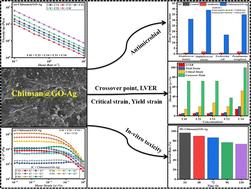
The present study explores the properties of a chitosan-decorated graphene oxide–silver (chitosan@GO–Ag) composite hydrogel, with a focus on its improved rheological characteristics and notable biological activity. The antimicrobial performance of chitosan@GO–Ag was assessed against Streptococcus mutans, Staphylococcus aureus, Escherichia coli, and Pseudomonas aeruginosa, revealing substantial inhibition zones, underscoring its potential as an effective antimicrobial agent. To evaluate the safety profile of the composite, genotoxicity assays were conducted using zebrafish embryos, providing insights into its toxicity levels. Comprehensive rheological tests were also performed to examine the hydrogel's viscoelastic properties, such as storage and loss moduli, as well as its flow behavior under various stress conditions. These rheological assessments shed light on the mechanical stability and gelation properties of chitosan@GO–Ag, which are closely related to its antimicrobial effectiveness and cytotoxicity, especially through their impact on the structural robustness of the composite. The synthesized chitosan@GO–Ag hydrogels demonstrated significant mechanical strength, with a linear viscoelastic region (LVER) ranging approximately from 0.01 to 014%, shear thinning behavior and well fitted to the Herschel–Bulkley model. Additionally, they exhibited strong antimicrobial activity against both Gram-positive and Gram-negative bacteria, with zones of inhibition (ZOIs) measured between 31 and 40 mm. Key rheological parameters such as critical strain, yield strain and crossover points were also determined, providing a comprehensive view of the material's stability and performance. In addition to mechanical stability, swelling behavior was evaluated over 15 hours at definite time intervals to understand the hydrogel's ability to absorb and retain water. This assessment revealed the hydrogel's high swelling capacity, indicative of its potential applications in the biomedical field. Furthermore, stability studies were performed under varying conditions to determine the long-term usability of the hydrogel in physiological environments. These investigations confirmed the structural integrity and sustained performance of the hydrogel, reinforcing its suitability for biomedical and antimicrobial applications.



 京公网安备 11010802042870号
京ICP备2023020795号-1
京公网安备 11010802042870号
京ICP备2023020795号-1

 分享
分享
 求助内容:
求助内容: 应助结果提醒方式:
 扫码关注我们
