Ling-Qi Li, Xiao-Hui Wang, Ze-Nong Zhang, Si-Mian Liu, Xiao Wang and Shu-Ni Li
{"title":"CuO nanorods for high-efficiency nitrate electroreduction to ammonia†","authors":"Ling-Qi Li, Xiao-Hui Wang, Ze-Nong Zhang, Si-Mian Liu, Xiao Wang and Shu-Ni Li","doi":"10.1039/D5NJ00500K","DOIUrl":null,"url":null,"abstract":"<p >Electrocatalytic nitrate reduction (NO<small><sub>3</sub></small><small><sup>−</sup></small>RR) provides an environmentally friendly alternative to the traditional Haber–Bosch technology for ammonia (NH<small><sub>3</sub></small>) production. Herein, cupric oxide (CuO) nanorods (NRs) were synthesized by a simple one-pot method and applied as NO<small><sub>3</sub></small><small><sup>−</sup></small>RR electrocatalysts. Due to the nanorod-like structure and large specific surface area, the CuO NR electrocatalyst exhibited excellent NO<small><sub>3</sub></small><small><sup>−</sup></small>RR performance. The electrocatalyst experienced <em>in situ</em> reconstruction and its phase partly changed from CuO to Cu/Cu<small><sub>2</sub></small>O in the process of the NO<small><sub>3</sub></small><small><sup>−</sup></small>RR. The formed Cu/Cu<small><sub>2</sub></small>O/CuO mixed valence state promoted its catalytic activity for the NO<small><sub>3</sub></small><small><sup>−</sup></small>RR. At −0.7 V potential, the faradaic efficiency and NH<small><sub>3</sub></small> yield could reach 94% and 28.76 mg h<small><sup>−1</sup></small> mg<small><sub>cat</sub></small><small><sup>−1</sup></small>, respectively, along with excellent durability for 10 h.</p>","PeriodicalId":95,"journal":{"name":"New Journal of Chemistry","volume":" 17","pages":" 6999-7004"},"PeriodicalIF":2.5000,"publicationDate":"2025-03-24","publicationTypes":"Journal Article","fieldsOfStudy":null,"isOpenAccess":false,"openAccessPdf":"","citationCount":"0","resultStr":null,"platform":"Semanticscholar","paperid":null,"PeriodicalName":"New Journal of Chemistry","FirstCategoryId":"92","ListUrlMain":"https://pubs.rsc.org/en/content/articlelanding/2025/nj/d5nj00500k","RegionNum":3,"RegionCategory":"化学","ArticlePicture":[],"TitleCN":null,"AbstractTextCN":null,"PMCID":null,"EPubDate":"","PubModel":"","JCR":"Q2","JCRName":"CHEMISTRY, MULTIDISCIPLINARY","Score":null,"Total":0}
引用次数: 0
Abstract
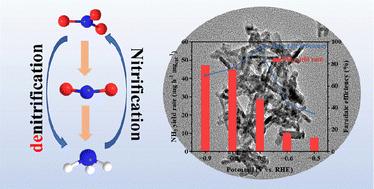
Electrocatalytic nitrate reduction (NO3−RR) provides an environmentally friendly alternative to the traditional Haber–Bosch technology for ammonia (NH3) production. Herein, cupric oxide (CuO) nanorods (NRs) were synthesized by a simple one-pot method and applied as NO3−RR electrocatalysts. Due to the nanorod-like structure and large specific surface area, the CuO NR electrocatalyst exhibited excellent NO3−RR performance. The electrocatalyst experienced in situ reconstruction and its phase partly changed from CuO to Cu/Cu2O in the process of the NO3−RR. The formed Cu/Cu2O/CuO mixed valence state promoted its catalytic activity for the NO3−RR. At −0.7 V potential, the faradaic efficiency and NH3 yield could reach 94% and 28.76 mg h−1 mgcat−1, respectively, along with excellent durability for 10 h.



 京公网安备 11010802042870号
京ICP备2023020795号-1
京公网安备 11010802042870号
京ICP备2023020795号-1

 分享
分享
 求助内容:
求助内容: 应助结果提醒方式:
 扫码关注我们
