{"title":"Lowering the calcination temperature and boosting the electrocatalytic activity of air electrodes for solid oxide cells by the glucose–urea method†","authors":"Fei Chen , Jiahui Yang , Tianyu Zhu , Peng Qiu , Chunyan Xiong","doi":"10.1039/d4gc06160h","DOIUrl":null,"url":null,"abstract":"<div><div>Efficient, cost-effective, and environmentally sustainable synthesis processes are critical for the development of high-performance air electrodes in solid oxide cells (SOCs). Traditional synthesis routes often fail to meet the dual demands of high efficiency and environmental sustainability. In this study, an eco-friendly glucose–urea method is first proposed for synthesizing the La<sub>0.6</sub>Sr<sub>0.4</sub>Co<sub>0.2</sub>Fe<sub>0.8</sub>O<sub>3−<em>δ</em></sub> (LSCF) air electrode. Compared with the conventional sol–gel method, this method can not only significantly reduce sintering temperatures, but also minimize the environmental impact by utilizing non-toxic, affordable and readily available precursors, thereby significantly lowering the carbon footprint of material production. What's more, LSCF powders with smaller and more uniform particle sizes could be obtained by using this approach, which exhibit superior electrocatalytic activity and enhanced structural stability. At 750 °C, SOCs equipped with this LSCF air electrode show a maximum power density of 1.64 W cm<sup>−2</sup> in fuel cell mode and a current density of 1.16 A cm<sup>−2</sup> (1.3 V) in electrolysis mode. A comprehensive understanding of the underlying mechanisms also facilitated the optimization of the synthesis process. This study provides a meaningful technology toward greener energy solutions and sustainable manufacturing practices by offering a cleaner, more efficient route to synthesize critical materials.</div></div>","PeriodicalId":78,"journal":{"name":"Green Chemistry","volume":"27 17","pages":"Pages 4644-4654"},"PeriodicalIF":9.2000,"publicationDate":"2025-03-20","publicationTypes":"Journal Article","fieldsOfStudy":null,"isOpenAccess":false,"openAccessPdf":"","citationCount":"0","resultStr":null,"platform":"Semanticscholar","paperid":null,"PeriodicalName":"Green Chemistry","FirstCategoryId":"92","ListUrlMain":"https://www.sciencedirect.com/org/science/article/pii/S146392622500250X","RegionNum":1,"RegionCategory":"化学","ArticlePicture":[],"TitleCN":null,"AbstractTextCN":null,"PMCID":null,"EPubDate":"2025/4/3 0:00:00","PubModel":"Epub","JCR":"Q1","JCRName":"CHEMISTRY, MULTIDISCIPLINARY","Score":null,"Total":0}
引用次数: 0
Abstract
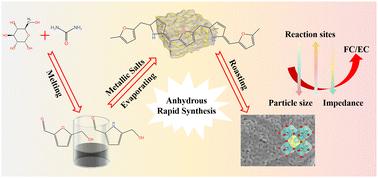
Efficient, cost-effective, and environmentally sustainable synthesis processes are critical for the development of high-performance air electrodes in solid oxide cells (SOCs). Traditional synthesis routes often fail to meet the dual demands of high efficiency and environmental sustainability. In this study, an eco-friendly glucose–urea method is first proposed for synthesizing the La0.6Sr0.4Co0.2Fe0.8O3−δ (LSCF) air electrode. Compared with the conventional sol–gel method, this method can not only significantly reduce sintering temperatures, but also minimize the environmental impact by utilizing non-toxic, affordable and readily available precursors, thereby significantly lowering the carbon footprint of material production. What's more, LSCF powders with smaller and more uniform particle sizes could be obtained by using this approach, which exhibit superior electrocatalytic activity and enhanced structural stability. At 750 °C, SOCs equipped with this LSCF air electrode show a maximum power density of 1.64 W cm−2 in fuel cell mode and a current density of 1.16 A cm−2 (1.3 V) in electrolysis mode. A comprehensive understanding of the underlying mechanisms also facilitated the optimization of the synthesis process. This study provides a meaningful technology toward greener energy solutions and sustainable manufacturing practices by offering a cleaner, more efficient route to synthesize critical materials.
高效、经济、环保的合成工艺对于固体氧化物电池(soc)中高性能空气电极的发展至关重要。传统的合成路线往往不能满足高效和环境可持续性的双重要求。本研究首次提出了一种环保的葡萄糖-尿素法制备La0.6Sr0.4Co0.2Fe0.8O3−δ (LSCF)空气电极的方法。与传统的溶胶-凝胶法相比,该方法不仅可以显著降低烧结温度,而且通过使用无毒、经济、易得的前驱体,将对环境的影响降到最低,从而显著降低材料生产的碳足迹。该方法制备的LSCF粉末粒径更小、更均匀,具有更好的电催化活性和结构稳定性。在750°C时,配备该LSCF空气电极的soc在燃料电池模式下的最大功率密度为1.64 W cm−2,在电解模式下的电流密度为1.16 a cm−2 (1.3 V)。对潜在机制的全面了解也有助于优化合成过程。这项研究为绿色能源解决方案和可持续制造实践提供了一种有意义的技术,提供了一种更清洁、更有效的合成关键材料的途径。
期刊介绍:
Green Chemistry is a journal that provides a unique forum for the publication of innovative research on the development of alternative green and sustainable technologies. The scope of Green Chemistry is based on the definition proposed by Anastas and Warner (Green Chemistry: Theory and Practice, P T Anastas and J C Warner, Oxford University Press, Oxford, 1998), which defines green chemistry as the utilisation of a set of principles that reduces or eliminates the use or generation of hazardous substances in the design, manufacture and application of chemical products. Green Chemistry aims to reduce the environmental impact of the chemical enterprise by developing a technology base that is inherently non-toxic to living things and the environment. The journal welcomes submissions on all aspects of research relating to this endeavor and publishes original and significant cutting-edge research that is likely to be of wide general appeal. For a work to be published, it must present a significant advance in green chemistry, including a comparison with existing methods and a demonstration of advantages over those methods.



 京公网安备 11010802042870号
京ICP备2023020795号-1
京公网安备 11010802042870号
京ICP备2023020795号-1

 分享
分享
 求助内容:
求助内容: 应助结果提醒方式:
 扫码关注我们
