Yuqi Yang , Xiaofang Liu , Haozhi Zhou , Junjun Chen , Yuli Lai , Shunan Zhang , Hu Luo , Hui Wang , Yuhan Sun
{"title":"Ni-catalyzed reductive carbonylation of ethylene with CO2 and methanol: potential for in situ CO2 capture and conversion†","authors":"Yuqi Yang , Xiaofang Liu , Haozhi Zhou , Junjun Chen , Yuli Lai , Shunan Zhang , Hu Luo , Hui Wang , Yuhan Sun","doi":"10.1039/d4gc06460g","DOIUrl":null,"url":null,"abstract":"<div><div>Reductive transformation of CO<sub>2</sub> using green hydrogen or methanol enables the production of industrially significant chemicals such as carboxylic acid esters, which, however, is hindered by the dependence on noble metal catalysts and the use of halide additives. Here we report a robust non-noble metal-based, halide-free catalytic system for the reductive methoxycarbonylation of ethylene with CO<sub>2</sub>/MeOH. This system achieves a turnover number of up to 110 for methyl propionate, a key precursor in polymethyl methacrylate production, showing a better performance than conventional noble-metal-based systems. Remarkably, the present system exhibits moderate performance under simulated flue gas containing NO<sub><em>x</em></sub> and SO<sub><em>x</em></sub>, demonstrating the potential for <em>in situ</em> CO<sub>2</sub> capture and conversion into value-added chemicals, promoting green and sustainable development.The success of the strategy lies in the unprecedented <em>in situ</em> formation and alcoholytic ring-opening of a five-membered nickelalactone, effectively bypassing the conventional but challenging CO<sub>2</sub>-to-CO-carbonylation pathway. Notably, this protocol offers a process free from noble metals, halide/acid additives, and strong/expensive reductants, for the production of next-generation CO<sub>2</sub>-based polymers.</div></div>","PeriodicalId":78,"journal":{"name":"Green Chemistry","volume":"27 17","pages":"Pages 4706-4712"},"PeriodicalIF":9.2000,"publicationDate":"2025-03-20","publicationTypes":"Journal Article","fieldsOfStudy":null,"isOpenAccess":false,"openAccessPdf":"","citationCount":"0","resultStr":null,"platform":"Semanticscholar","paperid":null,"PeriodicalName":"Green Chemistry","FirstCategoryId":"92","ListUrlMain":"https://www.sciencedirect.com/org/science/article/pii/S1463926225002304","RegionNum":1,"RegionCategory":"化学","ArticlePicture":[],"TitleCN":null,"AbstractTextCN":null,"PMCID":null,"EPubDate":"2025/3/26 0:00:00","PubModel":"Epub","JCR":"Q1","JCRName":"CHEMISTRY, MULTIDISCIPLINARY","Score":null,"Total":0}
引用次数: 0
Abstract
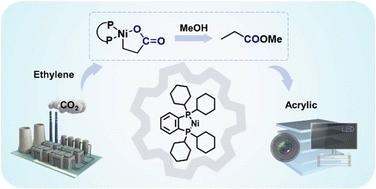
Reductive transformation of CO2 using green hydrogen or methanol enables the production of industrially significant chemicals such as carboxylic acid esters, which, however, is hindered by the dependence on noble metal catalysts and the use of halide additives. Here we report a robust non-noble metal-based, halide-free catalytic system for the reductive methoxycarbonylation of ethylene with CO2/MeOH. This system achieves a turnover number of up to 110 for methyl propionate, a key precursor in polymethyl methacrylate production, showing a better performance than conventional noble-metal-based systems. Remarkably, the present system exhibits moderate performance under simulated flue gas containing NOx and SOx, demonstrating the potential for in situ CO2 capture and conversion into value-added chemicals, promoting green and sustainable development.The success of the strategy lies in the unprecedented in situ formation and alcoholytic ring-opening of a five-membered nickelalactone, effectively bypassing the conventional but challenging CO2-to-CO-carbonylation pathway. Notably, this protocol offers a process free from noble metals, halide/acid additives, and strong/expensive reductants, for the production of next-generation CO2-based polymers.
利用绿色氢或甲醇对二氧化碳进行还原性转化,可以生产工业上重要的化学品,如羧酸酯,然而,由于依赖贵金属催化剂和使用卤化物添加剂,这种生产受到阻碍。在这里,我们报道了一个强大的非贵金属基,无卤化物催化体系,用于乙烯与CO2/MeOH的还原性甲氧羰基化。该系统对聚甲基丙烯酸甲酯生产中的关键前体丙酸甲酯的周转率高达110,表现出比传统的贵金属基系统更好的性能。值得注意的是,该系统在含NOx和SOx的模拟烟气中表现出适度的性能,表明了原位CO2捕获和转化为增值化学品的潜力,促进了绿色和可持续发展。该策略的成功在于前所未有的原位形成和五元镍内酯的醇解开环,有效地绕过了传统的但具有挑战性的co2 - co -羰基化途径。值得注意的是,该方案提供了一种不含贵金属、卤化物/酸添加剂和强/昂贵还原剂的工艺,用于生产下一代二氧化碳基聚合物。
期刊介绍:
Green Chemistry is a journal that provides a unique forum for the publication of innovative research on the development of alternative green and sustainable technologies. The scope of Green Chemistry is based on the definition proposed by Anastas and Warner (Green Chemistry: Theory and Practice, P T Anastas and J C Warner, Oxford University Press, Oxford, 1998), which defines green chemistry as the utilisation of a set of principles that reduces or eliminates the use or generation of hazardous substances in the design, manufacture and application of chemical products. Green Chemistry aims to reduce the environmental impact of the chemical enterprise by developing a technology base that is inherently non-toxic to living things and the environment. The journal welcomes submissions on all aspects of research relating to this endeavor and publishes original and significant cutting-edge research that is likely to be of wide general appeal. For a work to be published, it must present a significant advance in green chemistry, including a comparison with existing methods and a demonstration of advantages over those methods.



 京公网安备 11010802042870号
京ICP备2023020795号-1
京公网安备 11010802042870号
京ICP备2023020795号-1

 分享
分享
 求助内容:
求助内容: 应助结果提醒方式:
 扫码关注我们
