Yanfang Nie, Ye Tian, Ni Wang, Yunfan He, Yawen Wang, Yunfang Wang, Rui Li, Lulu Zhang and Jianxin Liu
{"title":"Secondary hydrogen spillover enhanced photocatalytic hydrogen evolution activity in Ru/TiO2–GO†","authors":"Yanfang Nie, Ye Tian, Ni Wang, Yunfan He, Yawen Wang, Yunfang Wang, Rui Li, Lulu Zhang and Jianxin Liu","doi":"10.1039/D5NJ00259A","DOIUrl":null,"url":null,"abstract":"<p >An effective strategy for enhancing photocatalytic hydrogen evolution reaction (HER) activity is the implementation of the hydrogen spillover effect. Herein, a Ru/TiO<small><sub>2</sub></small>–GO (graphene oxide) catalyst was fabricated by means of simple hydrothermal and ultrasound-assisted techniques. By using the secondary hydrogen spillover process, which involves the transfer of active hydrogen species from Ru to TiO<small><sub>2</sub></small> and then further to GO, the hydrogen evolution activity of Ru/TiO<small><sub>2</sub></small>–2GO reached 23.9 mmol g<small><sup>−1</sup></small> h<small><sup>−1</sup></small>, which is 45.2 times and 3.85 times greater than that of TiO<small><sub>2</sub></small> (0.53 mmol g<small><sup>−1</sup></small> h<small><sup>−1</sup></small>) and Ru/TiO<small><sub>2</sub></small> (6.2 mmol g<small><sup>−1</sup></small> h<small><sup>−1</sup></small>), respectively. Controlled experiments and detailed characterization have revealed that the dispersion of GO on the support provides critical desorption sites for H*, thereby promoting the cleavage of Ti–H bonds. H* undergoes secondary spillover onto GO and desorbs to generate H<small><sub>2</sub></small>, enhancing the photocatalytic HER activity. This study enhances the photocatalytic activity of water splitting for hydrogen production by employing a secondary hydrogen spillover strategy, thereby presenting a novel approach for the design of efficient hydrogen production catalysts.</p>","PeriodicalId":95,"journal":{"name":"New Journal of Chemistry","volume":" 17","pages":" 7259-7267"},"PeriodicalIF":2.5000,"publicationDate":"2025-04-10","publicationTypes":"Journal Article","fieldsOfStudy":null,"isOpenAccess":false,"openAccessPdf":"","citationCount":"0","resultStr":null,"platform":"Semanticscholar","paperid":null,"PeriodicalName":"New Journal of Chemistry","FirstCategoryId":"92","ListUrlMain":"https://pubs.rsc.org/en/content/articlelanding/2025/nj/d5nj00259a","RegionNum":3,"RegionCategory":"化学","ArticlePicture":[],"TitleCN":null,"AbstractTextCN":null,"PMCID":null,"EPubDate":"","PubModel":"","JCR":"Q2","JCRName":"CHEMISTRY, MULTIDISCIPLINARY","Score":null,"Total":0}
引用次数: 0
Abstract
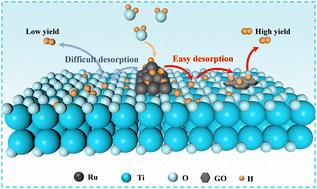
An effective strategy for enhancing photocatalytic hydrogen evolution reaction (HER) activity is the implementation of the hydrogen spillover effect. Herein, a Ru/TiO2–GO (graphene oxide) catalyst was fabricated by means of simple hydrothermal and ultrasound-assisted techniques. By using the secondary hydrogen spillover process, which involves the transfer of active hydrogen species from Ru to TiO2 and then further to GO, the hydrogen evolution activity of Ru/TiO2–2GO reached 23.9 mmol g−1 h−1, which is 45.2 times and 3.85 times greater than that of TiO2 (0.53 mmol g−1 h−1) and Ru/TiO2 (6.2 mmol g−1 h−1), respectively. Controlled experiments and detailed characterization have revealed that the dispersion of GO on the support provides critical desorption sites for H*, thereby promoting the cleavage of Ti–H bonds. H* undergoes secondary spillover onto GO and desorbs to generate H2, enhancing the photocatalytic HER activity. This study enhances the photocatalytic activity of water splitting for hydrogen production by employing a secondary hydrogen spillover strategy, thereby presenting a novel approach for the design of efficient hydrogen production catalysts.




 京公网安备 11010802042870号
京ICP备2023020795号-1
京公网安备 11010802042870号
京ICP备2023020795号-1

 分享
分享
 求助内容:
求助内容: 应助结果提醒方式:
 扫码关注我们
