Qingying Yao, Wenhua Feng, Yun Yang, Yuting Miao, Jinwen Zhang, Li Zhang, Yuanhang Ren, Lin Ye, Xueying Chen, Kai Xiong, Shixi Liu, Bin Yue, Heyong He
{"title":"MAS NMR Studies on the Formation and Catalytic Activity of Oxygen Vacancy on the ZnO {100} Surface","authors":"Qingying Yao, Wenhua Feng, Yun Yang, Yuting Miao, Jinwen Zhang, Li Zhang, Yuanhang Ren, Lin Ye, Xueying Chen, Kai Xiong, Shixi Liu, Bin Yue, Heyong He","doi":"10.1021/acs.jpcc.5c01283","DOIUrl":null,"url":null,"abstract":"ZnO is an important component of the Cu/ZnO catalyst for catalyzing the carbon dioxide hydrogenation, which is used not only as a support to stabilize other metal species loaded on its surface but also its surface oxygen vacancies provide adsorption and catalytic active sites for the reactants as well as intermediates. In order to investigate the generation and nature of surface oxygen vacancies on ZnO crystalline surfaces and the activation of CO<sub>2</sub> and H<sub>2</sub>, ZnO nanorods with exposed {100} surfaces were treated at different temperatures under vacuum conditions. The surface oxygen vacancies were characterized by <sup>31</sup>P MAS NMR with trimethylphosphine (TMP) as the probe molecule, <sup>1</sup>H–<sup>31</sup>P CP/MAS NMR, and pyridine adsorption infrared spectroscopies. Based on the characterization results, the adsorption model of the probe molecule TMP on the surface of ZnO was established, and the density of the oxygen vacancies on the surface was quantitatively measured. The concentration of surface oxygen vacancies reached the maximum value when the treatment temperature was 350 °C under vacuum conditions. On such surface, the activation mechanism of CO<sub>2</sub> and H<sub>2</sub> was proposed based on the surface structure of ZnO nanorods with exposed {100} surfaces before and after the adsorption and activation of H<sub>2</sub> as well as the relevant generated intermediates on the surface during CO<sub>2</sub> hydrogenation characterized by <sup>1</sup>H, <sup>31</sup>P, and <sup>13</sup>C MAS NMR techniques.","PeriodicalId":61,"journal":{"name":"The Journal of Physical Chemistry C","volume":"28 1","pages":""},"PeriodicalIF":3.2000,"publicationDate":"2025-04-22","publicationTypes":"Journal Article","fieldsOfStudy":null,"isOpenAccess":false,"openAccessPdf":"","citationCount":"0","resultStr":null,"platform":"Semanticscholar","paperid":null,"PeriodicalName":"The Journal of Physical Chemistry C","FirstCategoryId":"1","ListUrlMain":"https://doi.org/10.1021/acs.jpcc.5c01283","RegionNum":3,"RegionCategory":"化学","ArticlePicture":[],"TitleCN":null,"AbstractTextCN":null,"PMCID":null,"EPubDate":"","PubModel":"","JCR":"Q2","JCRName":"CHEMISTRY, PHYSICAL","Score":null,"Total":0}
引用次数: 0
Abstract
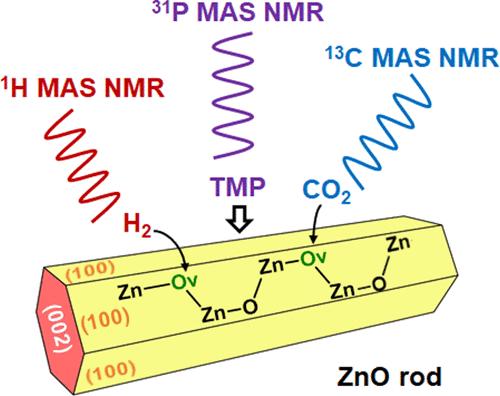
ZnO is an important component of the Cu/ZnO catalyst for catalyzing the carbon dioxide hydrogenation, which is used not only as a support to stabilize other metal species loaded on its surface but also its surface oxygen vacancies provide adsorption and catalytic active sites for the reactants as well as intermediates. In order to investigate the generation and nature of surface oxygen vacancies on ZnO crystalline surfaces and the activation of CO2 and H2, ZnO nanorods with exposed {100} surfaces were treated at different temperatures under vacuum conditions. The surface oxygen vacancies were characterized by 31P MAS NMR with trimethylphosphine (TMP) as the probe molecule, 1H–31P CP/MAS NMR, and pyridine adsorption infrared spectroscopies. Based on the characterization results, the adsorption model of the probe molecule TMP on the surface of ZnO was established, and the density of the oxygen vacancies on the surface was quantitatively measured. The concentration of surface oxygen vacancies reached the maximum value when the treatment temperature was 350 °C under vacuum conditions. On such surface, the activation mechanism of CO2 and H2 was proposed based on the surface structure of ZnO nanorods with exposed {100} surfaces before and after the adsorption and activation of H2 as well as the relevant generated intermediates on the surface during CO2 hydrogenation characterized by 1H, 31P, and 13C MAS NMR techniques.
ZnO是Cu/ZnO催化剂中催化二氧化碳加氢的重要组分,它不仅作为稳定负载在其表面的其他金属的载体,而且其表面氧空位为反应物和中间体提供了吸附和催化活性位点。为了研究ZnO晶体表面氧空位的产生和性质以及CO2和H2的活化,在真空条件下对暴露{100}表面的ZnO纳米棒进行了不同温度的处理。采用以三甲基膦(TMP)为探针分子的31P MAS NMR、1H-31P CP/MAS NMR和吡啶吸附红外光谱对表面氧空位进行了表征。基于表征结果,建立了探针分子TMP在ZnO表面的吸附模型,并定量测量了表面氧空位的密度。在真空条件下,当处理温度为350℃时,表面氧空位浓度达到最大值。在该表面上,基于H2吸附活化前后暴露{100}表面的ZnO纳米棒的表面结构,以及CO2加氢过程中在表面产生的相关中间体,通过1H、31P和13C MAS NMR技术表征,提出了CO2和H2的活化机理。
期刊介绍:
The Journal of Physical Chemistry A/B/C is devoted to reporting new and original experimental and theoretical basic research of interest to physical chemists, biophysical chemists, and chemical physicists.



 京公网安备 11010802042870号
京ICP备2023020795号-1
京公网安备 11010802042870号
京ICP备2023020795号-1

 分享
分享
 求助内容:
求助内容: 应助结果提醒方式:
 扫码关注我们
