Sudatta Giri, Purushothaman Manivannan and Debolina Misra
{"title":"Transition-metal-embedded boron-doped graphene for reduction of CO2 to HCOOH†","authors":"Sudatta Giri, Purushothaman Manivannan and Debolina Misra","doi":"10.1039/D5CP01427A","DOIUrl":null,"url":null,"abstract":"<p >The electrochemical conversion of carbon dioxide is an excellent strategy for alleviating the greenhouse effect. Lately, single-atom catalysts have gained notable attention as emerging candidates for the CO<small><sub>2</sub></small> reduction reaction owing to their remarkable cost-efficiency and unprecedented atomic utilization. By applying the density functional theory (DFT), our work examines the first couple of proton-coupled electron transfer steps of the CO<small><sub>2</sub></small>RR on 3d transition metal-doped B-Gr and compares the activity observed with previously studied supports. Since CO<small><sub>2</sub></small> activation is the first step of the CO<small><sub>2</sub></small>RR, we thoroughly investigated the capability of the TM SAs in effectively activating CO<small><sub>2</sub></small>, both in the dry phase and in the presence of water. According to our calculation, except for Ti, Cu and Zn, all other TM@B-Gr systems can activate the CO<small><sub>2</sub></small> molecule. CO<small><sub>2</sub></small> activation on the selected SACs is further attributed to the transfer of charges from the TM SA to the CO<small><sub>2</sub></small> molecule, as revealed by our Bader charge calculations. In addition, the Gibbs free energy changes for all the reaction intermediates are calculated to determine the most preferred pathway of the reaction. Our results indicate a preference for OCHO over COOH in the first protonation step, indicating the production of HCOOH as the preferred end product. The same trend is also observed in the presence of H<small><sub>2</sub></small>O. Our DFT-based analysis presented in this work reveals the crucial role that a support plays in determining the activity of a single-atom catalyst and paves the way for the efficient design of 2D catalysts for the CO<small><sub>2</sub></small> reduction reaction.</p>","PeriodicalId":99,"journal":{"name":"Physical Chemistry Chemical Physics","volume":" 20","pages":" 10660-10669"},"PeriodicalIF":2.9000,"publicationDate":"2025-04-23","publicationTypes":"Journal Article","fieldsOfStudy":null,"isOpenAccess":false,"openAccessPdf":"","citationCount":"0","resultStr":null,"platform":"Semanticscholar","paperid":null,"PeriodicalName":"Physical Chemistry Chemical Physics","FirstCategoryId":"92","ListUrlMain":"https://pubs.rsc.org/en/content/articlelanding/2025/cp/d5cp01427a","RegionNum":3,"RegionCategory":"化学","ArticlePicture":[],"TitleCN":null,"AbstractTextCN":null,"PMCID":null,"EPubDate":"","PubModel":"","JCR":"Q3","JCRName":"CHEMISTRY, PHYSICAL","Score":null,"Total":0}
引用次数: 0
Abstract
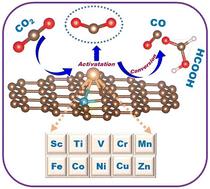
The electrochemical conversion of carbon dioxide is an excellent strategy for alleviating the greenhouse effect. Lately, single-atom catalysts have gained notable attention as emerging candidates for the CO2 reduction reaction owing to their remarkable cost-efficiency and unprecedented atomic utilization. By applying the density functional theory (DFT), our work examines the first couple of proton-coupled electron transfer steps of the CO2RR on 3d transition metal-doped B-Gr and compares the activity observed with previously studied supports. Since CO2 activation is the first step of the CO2RR, we thoroughly investigated the capability of the TM SAs in effectively activating CO2, both in the dry phase and in the presence of water. According to our calculation, except for Ti, Cu and Zn, all other TM@B-Gr systems can activate the CO2 molecule. CO2 activation on the selected SACs is further attributed to the transfer of charges from the TM SA to the CO2 molecule, as revealed by our Bader charge calculations. In addition, the Gibbs free energy changes for all the reaction intermediates are calculated to determine the most preferred pathway of the reaction. Our results indicate a preference for OCHO over COOH in the first protonation step, indicating the production of HCOOH as the preferred end product. The same trend is also observed in the presence of H2O. Our DFT-based analysis presented in this work reveals the crucial role that a support plays in determining the activity of a single-atom catalyst and paves the way for the efficient design of 2D catalysts for the CO2 reduction reaction.
期刊介绍:
Physical Chemistry Chemical Physics (PCCP) is an international journal co-owned by 19 physical chemistry and physics societies from around the world. This journal publishes original, cutting-edge research in physical chemistry, chemical physics and biophysical chemistry. To be suitable for publication in PCCP, articles must include significant innovation and/or insight into physical chemistry; this is the most important criterion that reviewers and Editors will judge against when evaluating submissions.
The journal has a broad scope and welcomes contributions spanning experiment, theory, computation and data science. Topical coverage includes spectroscopy, dynamics, kinetics, statistical mechanics, thermodynamics, electrochemistry, catalysis, surface science, quantum mechanics, quantum computing and machine learning. Interdisciplinary research areas such as polymers and soft matter, materials, nanoscience, energy, surfaces/interfaces, and biophysical chemistry are welcomed if they demonstrate significant innovation and/or insight into physical chemistry. Joined experimental/theoretical studies are particularly appreciated when complementary and based on up-to-date approaches.




 京公网安备 11010802042870号
京ICP备2023020795号-1
京公网安备 11010802042870号
京ICP备2023020795号-1

 分享
分享
 求助内容:
求助内容: 应助结果提醒方式:
 扫码关注我们
