Xiaolei Zhang, Xiaofei Sun, Lintong Zhou, Le Chang, Yan Zhang, Yingxia Zong, Jingjiang Sun, Qingfu Wang
{"title":"Preparation of Polyester Microspheres by Passerini Three-Component Dispersion Polymerization in Water","authors":"Xiaolei Zhang, Xiaofei Sun, Lintong Zhou, Le Chang, Yan Zhang, Yingxia Zong, Jingjiang Sun, Qingfu Wang","doi":"10.1021/acs.macromol.5c00071","DOIUrl":null,"url":null,"abstract":"Aqueous dispersion polymerization, predominantly based on the mechanism of radical polymerization, presents inherent limitations for polyester preparation through polycondensation or ring-opening polymerization approaches due to the substantial presence of water molecules. Herein, we report a facile and versatile strategy for the preparation of polyester microspheres (PEMs) via Passerini three-component dispersion polymerization (P-3CDP) under ambient aqueous conditions. By optimizing the polymerization parameters, we successfully synthesized a library of PEMs featuring diverse main-chain structures, including aliphatic carbon chains and functional backbones incorporating phenyl, alkenyl, biobased isosorbide, and furfuryl moieties, as well as reduction-responsive disulfide and pH-responsive Boc-protected <span>l</span>-glutamic acid groups. Comprehensive characterization of the resulting PEMs, including their chemical structures, microsphere morphologies, molar masses, and thermal properties, was performed using <sup>1</sup>H NMR, SEM, DLS, SEC, and DSC measurements. CCK-8 assays with mBMSC cells were conducted to assess the cytotoxicity and verify biological safety. Taking the PEM containing a Boc-protected <span>l</span>-glutamic acid backbone as an example, its pH-responsive self-immolative property was verified, suggesting the feasibility of straightforward preparation of stimuli-responsive PEMs through the aqueous P-3CDP method.","PeriodicalId":51,"journal":{"name":"Macromolecules","volume":"41 1","pages":""},"PeriodicalIF":5.2000,"publicationDate":"2025-04-22","publicationTypes":"Journal Article","fieldsOfStudy":null,"isOpenAccess":false,"openAccessPdf":"","citationCount":"0","resultStr":null,"platform":"Semanticscholar","paperid":null,"PeriodicalName":"Macromolecules","FirstCategoryId":"92","ListUrlMain":"https://doi.org/10.1021/acs.macromol.5c00071","RegionNum":1,"RegionCategory":"化学","ArticlePicture":[],"TitleCN":null,"AbstractTextCN":null,"PMCID":null,"EPubDate":"","PubModel":"","JCR":"Q1","JCRName":"POLYMER SCIENCE","Score":null,"Total":0}
引用次数: 0
Abstract
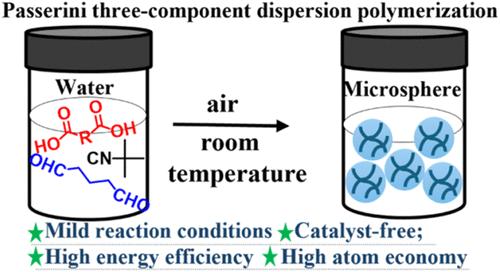
Aqueous dispersion polymerization, predominantly based on the mechanism of radical polymerization, presents inherent limitations for polyester preparation through polycondensation or ring-opening polymerization approaches due to the substantial presence of water molecules. Herein, we report a facile and versatile strategy for the preparation of polyester microspheres (PEMs) via Passerini three-component dispersion polymerization (P-3CDP) under ambient aqueous conditions. By optimizing the polymerization parameters, we successfully synthesized a library of PEMs featuring diverse main-chain structures, including aliphatic carbon chains and functional backbones incorporating phenyl, alkenyl, biobased isosorbide, and furfuryl moieties, as well as reduction-responsive disulfide and pH-responsive Boc-protected l-glutamic acid groups. Comprehensive characterization of the resulting PEMs, including their chemical structures, microsphere morphologies, molar masses, and thermal properties, was performed using 1H NMR, SEM, DLS, SEC, and DSC measurements. CCK-8 assays with mBMSC cells were conducted to assess the cytotoxicity and verify biological safety. Taking the PEM containing a Boc-protected l-glutamic acid backbone as an example, its pH-responsive self-immolative property was verified, suggesting the feasibility of straightforward preparation of stimuli-responsive PEMs through the aqueous P-3CDP method.
期刊介绍:
Macromolecules publishes original, fundamental, and impactful research on all aspects of polymer science. Topics of interest include synthesis (e.g., controlled polymerizations, polymerization catalysis, post polymerization modification, new monomer structures and polymer architectures, and polymerization mechanisms/kinetics analysis); phase behavior, thermodynamics, dynamic, and ordering/disordering phenomena (e.g., self-assembly, gelation, crystallization, solution/melt/solid-state characteristics); structure and properties (e.g., mechanical and rheological properties, surface/interfacial characteristics, electronic and transport properties); new state of the art characterization (e.g., spectroscopy, scattering, microscopy, rheology), simulation (e.g., Monte Carlo, molecular dynamics, multi-scale/coarse-grained modeling), and theoretical methods. Renewable/sustainable polymers, polymer networks, responsive polymers, electro-, magneto- and opto-active macromolecules, inorganic polymers, charge-transporting polymers (ion-containing, semiconducting, and conducting), nanostructured polymers, and polymer composites are also of interest. Typical papers published in Macromolecules showcase important and innovative concepts, experimental methods/observations, and theoretical/computational approaches that demonstrate a fundamental advance in the understanding of polymers.



 京公网安备 11010802042870号
京ICP备2023020795号-1
京公网安备 11010802042870号
京ICP备2023020795号-1

 分享
分享
 求助内容:
求助内容: 应助结果提醒方式:
 扫码关注我们
