Mengxue Du, Katalee Jariyavidyanont, Joachim Ulrich, Christoph Schick, René Androsch
{"title":"Intraspherulitic Melting-Temperature Distribution of Poly(butylene 2,6-naphthalate) Containing β′-Crystals Controlled by Secondary Crystallization","authors":"Mengxue Du, Katalee Jariyavidyanont, Joachim Ulrich, Christoph Schick, René Androsch","doi":"10.1021/acs.macromol.5c00542","DOIUrl":null,"url":null,"abstract":"The combination of low crystal-growth rate and low nuclei density, as evident, e.g., on hot-crystallization at low melt-supercooling, allows formation of rather large spherulites containing isothermally grown crystals subjected to different times of secondary crystallization, causing an intraspherulitic melting-temperature distribution. As demonstrated on example of the β′-high-temperature-crystal polymorph of poly(butylene 2,6-naphthalate) (PBN), crystals located in the spherulite centers, subjected to annealing during the slow growth of the spherulite, melt at distinctly higher temperature than non-annealed crystals near the spherulite boundary, causing spherulite inward melting. The melting-temperature gradient along the spherulite radius, however, diminishes if all parts of the spherulites are annealed, e.g., after a space-filled spherulitic morphology is achieved, yielding a radius-independent intraspherulitic melting temperature. Otherwise, the intraspherulitic melting-temperature distribution may be preserved/frozen-in by cooling, with implications on properties due to the presence of crystals of different stabilities. Assessing the intraspherulitic melting-temperature distribution required suppression of crystal reorganization on heating, which was achieved by analysis of the heating-rate dependence of melting. These experiments confirmed the initially lower stability of crystals near the spherulite periphery by their enhanced reorganization/stabilization on sufficiently slow heating compared to crystals located in the spherulite center, being less vulnerable for reorganization. In summary, the study highlights the importance of secondary crystallization/annealing on the thermodynamic stability/melting behavior of crystals arranged in a spherulitic semicrystalline superstructure. In addition, the performed study also provides new data about the growth of radial and tangential lamellae in PBN when crystallized at low melt-supercooling.","PeriodicalId":51,"journal":{"name":"Macromolecules","volume":"128 1","pages":""},"PeriodicalIF":5.2000,"publicationDate":"2025-04-22","publicationTypes":"Journal Article","fieldsOfStudy":null,"isOpenAccess":false,"openAccessPdf":"","citationCount":"0","resultStr":null,"platform":"Semanticscholar","paperid":null,"PeriodicalName":"Macromolecules","FirstCategoryId":"92","ListUrlMain":"https://doi.org/10.1021/acs.macromol.5c00542","RegionNum":1,"RegionCategory":"化学","ArticlePicture":[],"TitleCN":null,"AbstractTextCN":null,"PMCID":null,"EPubDate":"","PubModel":"","JCR":"Q1","JCRName":"POLYMER SCIENCE","Score":null,"Total":0}
引用次数: 0
Abstract
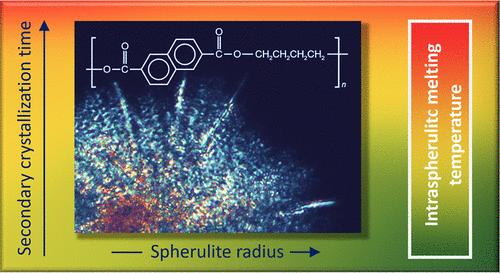
The combination of low crystal-growth rate and low nuclei density, as evident, e.g., on hot-crystallization at low melt-supercooling, allows formation of rather large spherulites containing isothermally grown crystals subjected to different times of secondary crystallization, causing an intraspherulitic melting-temperature distribution. As demonstrated on example of the β′-high-temperature-crystal polymorph of poly(butylene 2,6-naphthalate) (PBN), crystals located in the spherulite centers, subjected to annealing during the slow growth of the spherulite, melt at distinctly higher temperature than non-annealed crystals near the spherulite boundary, causing spherulite inward melting. The melting-temperature gradient along the spherulite radius, however, diminishes if all parts of the spherulites are annealed, e.g., after a space-filled spherulitic morphology is achieved, yielding a radius-independent intraspherulitic melting temperature. Otherwise, the intraspherulitic melting-temperature distribution may be preserved/frozen-in by cooling, with implications on properties due to the presence of crystals of different stabilities. Assessing the intraspherulitic melting-temperature distribution required suppression of crystal reorganization on heating, which was achieved by analysis of the heating-rate dependence of melting. These experiments confirmed the initially lower stability of crystals near the spherulite periphery by their enhanced reorganization/stabilization on sufficiently slow heating compared to crystals located in the spherulite center, being less vulnerable for reorganization. In summary, the study highlights the importance of secondary crystallization/annealing on the thermodynamic stability/melting behavior of crystals arranged in a spherulitic semicrystalline superstructure. In addition, the performed study also provides new data about the growth of radial and tangential lamellae in PBN when crystallized at low melt-supercooling.
期刊介绍:
Macromolecules publishes original, fundamental, and impactful research on all aspects of polymer science. Topics of interest include synthesis (e.g., controlled polymerizations, polymerization catalysis, post polymerization modification, new monomer structures and polymer architectures, and polymerization mechanisms/kinetics analysis); phase behavior, thermodynamics, dynamic, and ordering/disordering phenomena (e.g., self-assembly, gelation, crystallization, solution/melt/solid-state characteristics); structure and properties (e.g., mechanical and rheological properties, surface/interfacial characteristics, electronic and transport properties); new state of the art characterization (e.g., spectroscopy, scattering, microscopy, rheology), simulation (e.g., Monte Carlo, molecular dynamics, multi-scale/coarse-grained modeling), and theoretical methods. Renewable/sustainable polymers, polymer networks, responsive polymers, electro-, magneto- and opto-active macromolecules, inorganic polymers, charge-transporting polymers (ion-containing, semiconducting, and conducting), nanostructured polymers, and polymer composites are also of interest. Typical papers published in Macromolecules showcase important and innovative concepts, experimental methods/observations, and theoretical/computational approaches that demonstrate a fundamental advance in the understanding of polymers.



 京公网安备 11010802042870号
京ICP备2023020795号-1
京公网安备 11010802042870号
京ICP备2023020795号-1

 分享
分享
 求助内容:
求助内容: 应助结果提醒方式:
 扫码关注我们
