{"title":"Poleward shift of subtropical highs drives Patagonian glacier mass loss","authors":"Brice Noël, Stef Lhermitte, Bert Wouters, Xavier Fettweis","doi":"10.1038/s41467-025-58974-1","DOIUrl":null,"url":null,"abstract":"<p>Patagonian glaciers have been rapidly losing mass in the last two decades, but the driving processes remain poorly known. Here we use two state-of-the-art regional climate models to reconstruct long-term (1940-2023) glacier surface mass balance (SMB), i.e., the difference between precipitation accumulation, surface runoff and sublimation, at about 5 km spatial resolution, further statistically downscaled to 500 m. High-resolution SMB agrees well with in-situ observations and, combined with solid ice discharge estimates, captures recent GRACE/GRACE-FO satellite mass change. Glacier mass loss coincides with a long-term SMB decline (−0.35 Gt yr<sup>−2</sup>), primarily driven by enhanced surface runoff (+0.47 Gt yr<sup>−2</sup>) and steady precipitation. We link these trends to a poleward shift of the subtropical highs favouring warm northwesterly air advections towards Patagonia (+0.14°C dec<sup>−1</sup> at 850 hPa). Since the 1940s, Patagonian glaciers have lost 1350 ± 449 Gt of ice, equivalent to 3.7 ± 1.2 mm of global mean sea-level rise.</p>","PeriodicalId":19066,"journal":{"name":"Nature Communications","volume":"12 1","pages":""},"PeriodicalIF":15.7000,"publicationDate":"2025-04-23","publicationTypes":"Journal Article","fieldsOfStudy":null,"isOpenAccess":false,"openAccessPdf":"","citationCount":"0","resultStr":null,"platform":"Semanticscholar","paperid":null,"PeriodicalName":"Nature Communications","FirstCategoryId":"103","ListUrlMain":"https://doi.org/10.1038/s41467-025-58974-1","RegionNum":1,"RegionCategory":"综合性期刊","ArticlePicture":[],"TitleCN":null,"AbstractTextCN":null,"PMCID":null,"EPubDate":"","PubModel":"","JCR":"Q1","JCRName":"MULTIDISCIPLINARY SCIENCES","Score":null,"Total":0}
引用次数: 0
Abstract
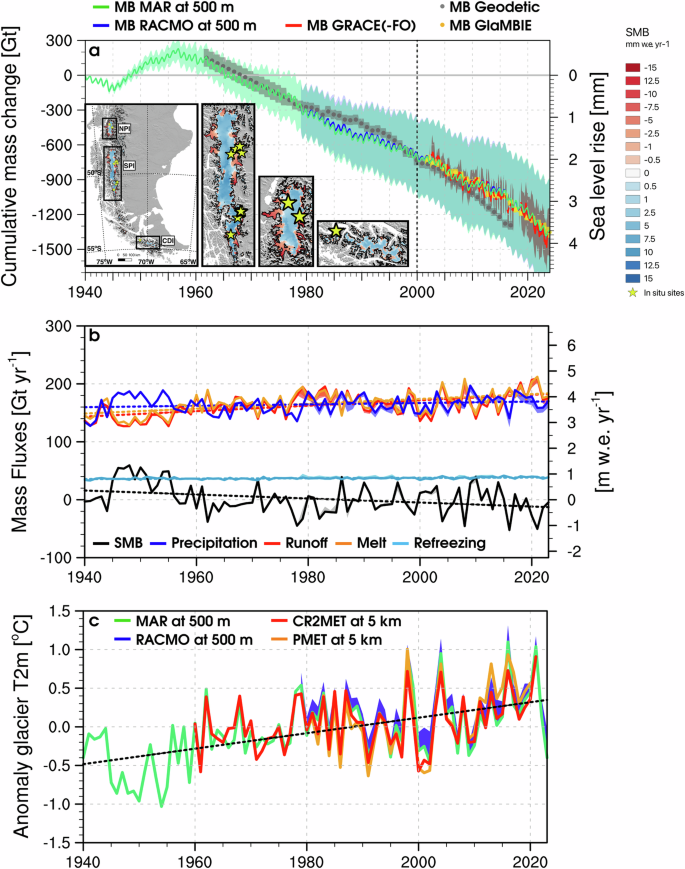
Patagonian glaciers have been rapidly losing mass in the last two decades, but the driving processes remain poorly known. Here we use two state-of-the-art regional climate models to reconstruct long-term (1940-2023) glacier surface mass balance (SMB), i.e., the difference between precipitation accumulation, surface runoff and sublimation, at about 5 km spatial resolution, further statistically downscaled to 500 m. High-resolution SMB agrees well with in-situ observations and, combined with solid ice discharge estimates, captures recent GRACE/GRACE-FO satellite mass change. Glacier mass loss coincides with a long-term SMB decline (−0.35 Gt yr−2), primarily driven by enhanced surface runoff (+0.47 Gt yr−2) and steady precipitation. We link these trends to a poleward shift of the subtropical highs favouring warm northwesterly air advections towards Patagonia (+0.14°C dec−1 at 850 hPa). Since the 1940s, Patagonian glaciers have lost 1350 ± 449 Gt of ice, equivalent to 3.7 ± 1.2 mm of global mean sea-level rise.
期刊介绍:
Nature Communications, an open-access journal, publishes high-quality research spanning all areas of the natural sciences. Papers featured in the journal showcase significant advances relevant to specialists in each respective field. With a 2-year impact factor of 16.6 (2022) and a median time of 8 days from submission to the first editorial decision, Nature Communications is committed to rapid dissemination of research findings. As a multidisciplinary journal, it welcomes contributions from biological, health, physical, chemical, Earth, social, mathematical, applied, and engineering sciences, aiming to highlight important breakthroughs within each domain.




 京公网安备 11010802042870号
京ICP备2023020795号-1
京公网安备 11010802042870号
京ICP备2023020795号-1

 分享
分享
 求助内容:
求助内容: 应助结果提醒方式:
 扫码关注我们
