Ziang Zhang, Yang Yang, Jinfeng Wang, Xu Jing and Chunying Duan
{"title":"Selective electrocatalytic reduction of carbon dioxide to methane using a guanidine-based metal–organic cage†","authors":"Ziang Zhang, Yang Yang, Jinfeng Wang, Xu Jing and Chunying Duan","doi":"10.1039/D5QI00756A","DOIUrl":null,"url":null,"abstract":"<p >In the context of energy shortages and environmental disasters, converting the greenhouse gas carbon dioxide into high-value carbon-based energy provides a practical pathway for achieving a sustainable artificial carbon cycle. However, integrating CO<small><sub>2</sub></small> capture with electrocatalysis remains challenging. Herein, we constructed a guanidine-based metal–organic cage (MOC) as a homogeneous electrocatalyst to encapsulate and activate the adduct <em>in situ</em> formed by CO<small><sub>2</sub></small> and ethanolamine, significantly lowering the reduction potential of CO<small><sub>2</sub></small> and achieving a record-low potential for CO<small><sub>2</sub></small> reduction to methane (0.16 V <em>vs.</em> reversible hydrogen electrode, RHE). Our research demonstrates that under the condition of −0.04 V <em>vs.</em> RHE, the faradaic efficiency (FE) for methane reaches 69.8%, with a selectivity exceeding 99% for continuous operation over 18 hours.</p>","PeriodicalId":79,"journal":{"name":"Inorganic Chemistry Frontiers","volume":" 18","pages":" 5389-5396"},"PeriodicalIF":6.4000,"publicationDate":"2025-04-23","publicationTypes":"Journal Article","fieldsOfStudy":null,"isOpenAccess":false,"openAccessPdf":"","citationCount":"0","resultStr":null,"platform":"Semanticscholar","paperid":null,"PeriodicalName":"Inorganic Chemistry Frontiers","FirstCategoryId":"92","ListUrlMain":"https://pubs.rsc.org/en/content/articlelanding/2025/qi/d5qi00756a","RegionNum":1,"RegionCategory":"化学","ArticlePicture":[],"TitleCN":null,"AbstractTextCN":null,"PMCID":null,"EPubDate":"","PubModel":"","JCR":"Q1","JCRName":"CHEMISTRY, INORGANIC & NUCLEAR","Score":null,"Total":0}
引用次数: 0
Abstract
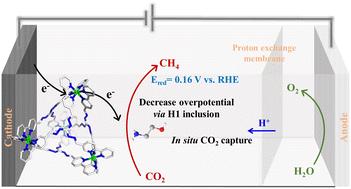
In the context of energy shortages and environmental disasters, converting the greenhouse gas carbon dioxide into high-value carbon-based energy provides a practical pathway for achieving a sustainable artificial carbon cycle. However, integrating CO2 capture with electrocatalysis remains challenging. Herein, we constructed a guanidine-based metal–organic cage (MOC) as a homogeneous electrocatalyst to encapsulate and activate the adduct in situ formed by CO2 and ethanolamine, significantly lowering the reduction potential of CO2 and achieving a record-low potential for CO2 reduction to methane (0.16 V vs. reversible hydrogen electrode, RHE). Our research demonstrates that under the condition of −0.04 V vs. RHE, the faradaic efficiency (FE) for methane reaches 69.8%, with a selectivity exceeding 99% for continuous operation over 18 hours.
在能源短缺和环境灾害的背景下,将温室气体二氧化碳转化为高价值的碳基能源为实现可持续的人工碳循环提供了一条切实可行的途径。然而,将二氧化碳捕获与电催化相结合仍然具有挑战性。在此,我们构建了一个胍基金属有机笼作为均相电催化剂,封装并激活了CO₂和乙醇胺形成的原位加合物,显著降低了CO₂的还原电位,实现了CO₂还原成甲烷的最低电位(相对于可逆氢电极,RHE, 0.16 V)。研究表明,在-0.04 V vs. RHE条件下,甲烷的法拉第效率(FE)达到69.8%,连续运行18小时的选择性超过99%。



 京公网安备 11010802042870号
京ICP备2023020795号-1
京公网安备 11010802042870号
京ICP备2023020795号-1

 分享
分享
 求助内容:
求助内容: 应助结果提醒方式:
 扫码关注我们
