Tengyue Liu, Ben Jia, Jiaqi Wang, Yuliang Zhou, Peng Zheng, Wangfeng Bai, Qiaolan Fan, Liang Zheng and Yang Zhang
{"title":"High capacitive performances obtained in sandwich structured Bi0.5Na0.5TiO3-based dielectric ceramics†","authors":"Tengyue Liu, Ben Jia, Jiaqi Wang, Yuliang Zhou, Peng Zheng, Wangfeng Bai, Qiaolan Fan, Liang Zheng and Yang Zhang","doi":"10.1039/D5QI00499C","DOIUrl":null,"url":null,"abstract":"<p >As power electronics continue to advance and environmental concerns grow, high energy storage lead-free ceramic capacitors have become pivotal in dielectric materials research. However, the inherent compromise between improved dielectric polarization properties and increased breakdown strength persists as a primary constraint in advancing energy storage capabilities. To break through this shackle, sandwich structured Bi<small><sub>0.5</sub></small>Na<small><sub>0.5</sub></small>TiO<small><sub>3</sub></small>-based lead-free ceramics are designed by alternatively arranging the relaxor ferroelectric layer with high polarization and the linear-like dielectric layer with high electric field breakdown and fabricated through tape casting and solid state sintering in this work. The material demonstrates exceptional energy storage capability featuring a record recoverable density of 11.02 J cm<small><sup>−3</sup></small> and superior efficiency (79.1%) at 800 kV cm<small><sup>−1</sup></small>. Remarkably, it maintains stable capacitive behavior across wide frequency (1–100 Hz) and temperature (30–160 °C) ranges, and fatigue cycles (1–10<small><sup>5</sup></small>). This breakthrough demonstrates that sandwich architecture synergistically resolves the polarization–breakdown strength paradox in lead-free ceramics, achieving simultaneous dielectric reinforcement and energy storage enhancement through interfacial engineering optimization.</p>","PeriodicalId":79,"journal":{"name":"Inorganic Chemistry Frontiers","volume":" 16","pages":" 4901-4910"},"PeriodicalIF":6.4000,"publicationDate":"2025-04-22","publicationTypes":"Journal Article","fieldsOfStudy":null,"isOpenAccess":false,"openAccessPdf":"","citationCount":"0","resultStr":null,"platform":"Semanticscholar","paperid":null,"PeriodicalName":"Inorganic Chemistry Frontiers","FirstCategoryId":"92","ListUrlMain":"https://pubs.rsc.org/en/content/articlelanding/2025/qi/d5qi00499c","RegionNum":1,"RegionCategory":"化学","ArticlePicture":[],"TitleCN":null,"AbstractTextCN":null,"PMCID":null,"EPubDate":"","PubModel":"","JCR":"Q1","JCRName":"CHEMISTRY, INORGANIC & NUCLEAR","Score":null,"Total":0}
引用次数: 0
Abstract
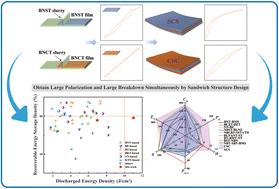
As power electronics continue to advance and environmental concerns grow, high energy storage lead-free ceramic capacitors have become pivotal in dielectric materials research. However, the inherent compromise between improved dielectric polarization properties and increased breakdown strength persists as a primary constraint in advancing energy storage capabilities. To break through this shackle, sandwich structured Bi0.5Na0.5TiO3-based lead-free ceramics are designed by alternatively arranging the relaxor ferroelectric layer with high polarization and the linear-like dielectric layer with high electric field breakdown and fabricated through tape casting and solid state sintering in this work. The material demonstrates exceptional energy storage capability featuring a record recoverable density of 11.02 J cm−3 and superior efficiency (79.1%) at 800 kV cm−1. Remarkably, it maintains stable capacitive behavior across wide frequency (1–100 Hz) and temperature (30–160 °C) ranges, and fatigue cycles (1–105). This breakthrough demonstrates that sandwich architecture synergistically resolves the polarization–breakdown strength paradox in lead-free ceramics, achieving simultaneous dielectric reinforcement and energy storage enhancement through interfacial engineering optimization.




 京公网安备 11010802042870号
京ICP备2023020795号-1
京公网安备 11010802042870号
京ICP备2023020795号-1

 分享
分享
 求助内容:
求助内容: 应助结果提醒方式:
 扫码关注我们
