Anna Vidal-López, Judith Mahringer, Aleix Comas-Vives
{"title":"Key Descriptors of Single-Atom Catalysts Supported on MXenes (Mo2C, Ti2C) Determining CO2 Activation","authors":"Anna Vidal-López, Judith Mahringer, Aleix Comas-Vives","doi":"10.1021/acs.jpcc.4c07850","DOIUrl":null,"url":null,"abstract":"CO<sub>2</sub> activation is crucial to its upgrade to fuels and chemicals. In this work, we systematically studied CO<sub>2</sub> cleavage on single-atom catalysts (SACs) based on metals M = (Fe, Ru, Co, Rh, Ni, Pd, Pt, Cu, Ag, Au) supported on Mo<sub>2</sub>CO<sub><i>x</i></sub> (6/9 O ML) and Ti<sub>2</sub>CO<sub><i>x</i></sub> (7/9 O ML) MXenes via Density Functional Theory (DFT) calculations and Bader charge analysis to provide insights into the charge redistribution among the metal, MXene, interface, and CO<sub>2</sub> during the process. CO<sub>2</sub> activation involves a two-step mechanism, adsorbing at the M–MXene interface where it bends and acquires a highly anionic character and then breaks, forming CO* and O*. The energy barriers analyzed for the CO<sub>2</sub> activation on M/Mo<sub>2</sub>CO<sub><i>x</i></sub> and M/Ti<sub>2</sub>CO<sub><i>x</i></sub> surfaces show that Cu, Ni, Rh, and Pt on Mo<sub>2</sub>CO<sub><i>x</i></sub> and Cu, Ru, and Rh on Ti<sub>2</sub>CO<sub><i>x</i></sub> presented the lowest energy barriers. Comparing the two MXenes, the electrophilic nature of Mo atoms facilitates CO<sub>2</sub> cleavage, while the Ti atoms distribute charge differently, hindering the CO<sub>2</sub> activation process. The energy barriers toward CO<sub>2</sub> activation on M/Mo<sub>2</sub>CO<sub><i>x</i></sub> and M/Ti<sub>2</sub>CO<sub><i>x</i></sub> surfaces show that Cu, Ni, Rh, and Pt on Mo<sub>2</sub>CO<sub><i>x</i></sub> and Cu, Ru, and Rh on Ti<sub>2</sub>CO<sub><i>x</i></sub> presented the lowest energy barriers. Mo<sub>2</sub>CO<sub><i>x</i></sub> systems presented geometrical structures of the transition states that were more product-like aligning with the Hammond’s principle, implying exoenergetic processes and lower energy barriers in contrast to Ti<sub>2</sub>CO<sub><i>x</i></sub>. Moreover, the CO<sub>2</sub> activation on M/2D-Mo<sub>2</sub>C follows a Brønsted–Evans–Polanyi (BEP) relationship while M/2D-Ti<sub>2</sub>C breaks it, a crucial factor to identify better catalytic materials. The ExtraTreesRegressor machine learning algorithm effectively predicts adsorption and transition-state energies using a small set of descriptors. The findings underscore the importance of transition metal electronic states, charge transfer, and support structure effects for SACs on MXenes, providing valuable insights for the design of catalytic materials. This detailed analysis provides a deeper understanding of the mechanistic aspects of CO<sub>2</sub> activation, highlighting the role of single-atom metals and their interaction with metal-carbide surfaces.","PeriodicalId":61,"journal":{"name":"The Journal of Physical Chemistry C","volume":"52 1","pages":""},"PeriodicalIF":3.2000,"publicationDate":"2025-04-23","publicationTypes":"Journal Article","fieldsOfStudy":null,"isOpenAccess":false,"openAccessPdf":"","citationCount":"0","resultStr":null,"platform":"Semanticscholar","paperid":null,"PeriodicalName":"The Journal of Physical Chemistry C","FirstCategoryId":"1","ListUrlMain":"https://doi.org/10.1021/acs.jpcc.4c07850","RegionNum":3,"RegionCategory":"化学","ArticlePicture":[],"TitleCN":null,"AbstractTextCN":null,"PMCID":null,"EPubDate":"","PubModel":"","JCR":"Q2","JCRName":"CHEMISTRY, PHYSICAL","Score":null,"Total":0}
引用次数: 0
Abstract
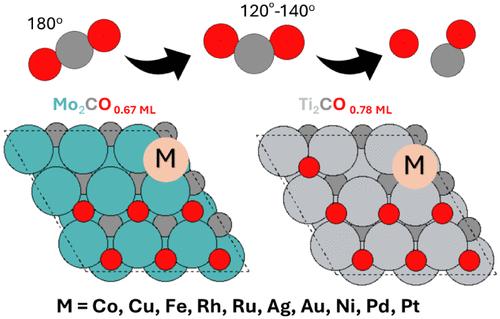
CO2 activation is crucial to its upgrade to fuels and chemicals. In this work, we systematically studied CO2 cleavage on single-atom catalysts (SACs) based on metals M = (Fe, Ru, Co, Rh, Ni, Pd, Pt, Cu, Ag, Au) supported on Mo2COx (6/9 O ML) and Ti2COx (7/9 O ML) MXenes via Density Functional Theory (DFT) calculations and Bader charge analysis to provide insights into the charge redistribution among the metal, MXene, interface, and CO2 during the process. CO2 activation involves a two-step mechanism, adsorbing at the M–MXene interface where it bends and acquires a highly anionic character and then breaks, forming CO* and O*. The energy barriers analyzed for the CO2 activation on M/Mo2COx and M/Ti2COx surfaces show that Cu, Ni, Rh, and Pt on Mo2COx and Cu, Ru, and Rh on Ti2COx presented the lowest energy barriers. Comparing the two MXenes, the electrophilic nature of Mo atoms facilitates CO2 cleavage, while the Ti atoms distribute charge differently, hindering the CO2 activation process. The energy barriers toward CO2 activation on M/Mo2COx and M/Ti2COx surfaces show that Cu, Ni, Rh, and Pt on Mo2COx and Cu, Ru, and Rh on Ti2COx presented the lowest energy barriers. Mo2COx systems presented geometrical structures of the transition states that were more product-like aligning with the Hammond’s principle, implying exoenergetic processes and lower energy barriers in contrast to Ti2COx. Moreover, the CO2 activation on M/2D-Mo2C follows a Brønsted–Evans–Polanyi (BEP) relationship while M/2D-Ti2C breaks it, a crucial factor to identify better catalytic materials. The ExtraTreesRegressor machine learning algorithm effectively predicts adsorption and transition-state energies using a small set of descriptors. The findings underscore the importance of transition metal electronic states, charge transfer, and support structure effects for SACs on MXenes, providing valuable insights for the design of catalytic materials. This detailed analysis provides a deeper understanding of the mechanistic aspects of CO2 activation, highlighting the role of single-atom metals and their interaction with metal-carbide surfaces.
期刊介绍:
The Journal of Physical Chemistry A/B/C is devoted to reporting new and original experimental and theoretical basic research of interest to physical chemists, biophysical chemists, and chemical physicists.



 京公网安备 11010802042870号
京ICP备2023020795号-1
京公网安备 11010802042870号
京ICP备2023020795号-1

 分享
分享
 求助内容:
求助内容: 应助结果提醒方式:
 扫码关注我们
