The Asiatic garden beetle, Maladera formosae, emerged as a significant early season pest of field corn in the Great Lakes region beginning in the mid-2000s. Management tools used broadly for annual white grub species, like seed- and soil-applied insecticides, are ineffective against or have not been evaluated specifically for M. formosae. Biological control, including entomopathogenic nematodes, is successful against M. formosae in turf systems. The goals of this study were to (i) isolate and identify nematode species from agricultural fields in northern Ohio with field histories of M. formosae, and (ii) evaluate their ability to infect M. formosae grubs in greenhouse and field trials.
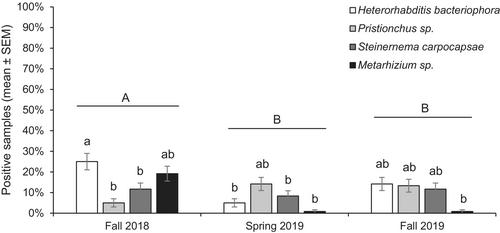
We isolated two naturally occurring entomopathogenic nematode species from the field, Heterorhabditis bacteriophora and Steinernema carpocapsae, in addition to a free-living Pristionchus sp. nematode. The entomopathogen communities sampled varied among field sites and were not correlated with soil physical properties or M. formosae. We confirmed that all three nematodes can infect and kill M. formosae grubs. In a greenhouse study, H. bacteriophora and H. bacteriophora + Pristionchus sp. killed significantly more grubs than the water control. In an outdoor microcosm study, nematodes successfully overwintered and subsequently killed M. formosae grubs at similar rates, regardless of treatment or inoculation rate.
These findings indicate that insect-killing nematodes are prevalent in corn–soybean systems with M. formosae and have the potential to be an effective tool for the management of M. formosae in field cropping systems in the Great Lakes region. © 2025 The Author(s). Pest Management Science published by John Wiley & Sons Ltd on behalf of Society of Chemical Industry.





 京公网安备 11010802042870号
京ICP备2023020795号-1
京公网安备 11010802042870号
京ICP备2023020795号-1

 分享
分享
 求助内容:
求助内容: 应助结果提醒方式:
 扫码关注我们
