{"title":"Characterization and Full Sequencing of 100 Nt sgRNA and Large RNA Using Site-Directed Cleavage and Liquid Chromatography Tandem Mass Spectrometry","authors":"Hong Yan, Mingpan Qi, Hong Li","doi":"10.1021/acs.analchem.4c06606","DOIUrl":null,"url":null,"abstract":"CRISPR/Cas9 is widely recognized as the most effective, efficient, and precise genome editing tool, inspiring numerous applications in basic science, medicine, and biotechnology. In the CRISPR/Cas9 system, single guide RNA (sgRNA) and Cas9 enzyme form a ribonucleoprotein complex that specifically and effectively cleaves target DNA. Accurate sequencing of sgRNA, particularly identifying the target sequence within the first 20 nucleotides (nt) at the 5′-end, is crucial for quality assurance and regulatory compliance. In this study, we used site-directed cleavage using ribonuclease H (RNase H) and DNAzyme for the first time to digest 100 nt sgRNA, achieving full sequencing with 100% coverage by analyzing the two cleaved fragments separately via LC MS/MS. We evaluated four different DNA-RNA chimeras as capture probes for the RNase H site-directed cleavage approach, finding that the chimera with four deoxynucleotides provided the most specific cleavage. Compared to RNase H, the DNAzyme demonstrated higher specificity and stability for 100 nt sgRNA digestion, successfully identifying up to 200 nucleotides of large RNA with 100% sequence coverage by fully sequencing the four short cleaved fragments. Due to the high specificity of DNAzyme cleavage, we used this method to study the designed 5′-end N-X truncated impurities of 100 nt sgRNA, demonstrating accurate identification and relative quantification. For 100 nt sgRNA, the limited available cleavage site was set on the scaffold sequence for both site-directed cleavage approaches, and the captured probes designed for RNase H and DNAzyme can be universally applied to sequence all 100 nt sgRNAs because of the conserved scaffold sequence.","PeriodicalId":27,"journal":{"name":"Analytical Chemistry","volume":"13 1","pages":""},"PeriodicalIF":6.7000,"publicationDate":"2025-04-22","publicationTypes":"Journal Article","fieldsOfStudy":null,"isOpenAccess":false,"openAccessPdf":"","citationCount":"0","resultStr":null,"platform":"Semanticscholar","paperid":null,"PeriodicalName":"Analytical Chemistry","FirstCategoryId":"92","ListUrlMain":"https://doi.org/10.1021/acs.analchem.4c06606","RegionNum":1,"RegionCategory":"化学","ArticlePicture":[],"TitleCN":null,"AbstractTextCN":null,"PMCID":null,"EPubDate":"","PubModel":"","JCR":"Q1","JCRName":"CHEMISTRY, ANALYTICAL","Score":null,"Total":0}
引用次数: 0
Abstract
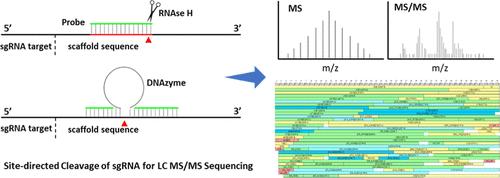
CRISPR/Cas9 is widely recognized as the most effective, efficient, and precise genome editing tool, inspiring numerous applications in basic science, medicine, and biotechnology. In the CRISPR/Cas9 system, single guide RNA (sgRNA) and Cas9 enzyme form a ribonucleoprotein complex that specifically and effectively cleaves target DNA. Accurate sequencing of sgRNA, particularly identifying the target sequence within the first 20 nucleotides (nt) at the 5′-end, is crucial for quality assurance and regulatory compliance. In this study, we used site-directed cleavage using ribonuclease H (RNase H) and DNAzyme for the first time to digest 100 nt sgRNA, achieving full sequencing with 100% coverage by analyzing the two cleaved fragments separately via LC MS/MS. We evaluated four different DNA-RNA chimeras as capture probes for the RNase H site-directed cleavage approach, finding that the chimera with four deoxynucleotides provided the most specific cleavage. Compared to RNase H, the DNAzyme demonstrated higher specificity and stability for 100 nt sgRNA digestion, successfully identifying up to 200 nucleotides of large RNA with 100% sequence coverage by fully sequencing the four short cleaved fragments. Due to the high specificity of DNAzyme cleavage, we used this method to study the designed 5′-end N-X truncated impurities of 100 nt sgRNA, demonstrating accurate identification and relative quantification. For 100 nt sgRNA, the limited available cleavage site was set on the scaffold sequence for both site-directed cleavage approaches, and the captured probes designed for RNase H and DNAzyme can be universally applied to sequence all 100 nt sgRNAs because of the conserved scaffold sequence.
期刊介绍:
Analytical Chemistry, a peer-reviewed research journal, focuses on disseminating new and original knowledge across all branches of analytical chemistry. Fundamental articles may explore general principles of chemical measurement science and need not directly address existing or potential analytical methodology. They can be entirely theoretical or report experimental results. Contributions may cover various phases of analytical operations, including sampling, bioanalysis, electrochemistry, mass spectrometry, microscale and nanoscale systems, environmental analysis, separations, spectroscopy, chemical reactions and selectivity, instrumentation, imaging, surface analysis, and data processing. Papers discussing known analytical methods should present a significant, original application of the method, a notable improvement, or results on an important analyte.



 京公网安备 11010802042870号
京ICP备2023020795号-1
京公网安备 11010802042870号
京ICP备2023020795号-1

 分享
分享
 求助内容:
求助内容: 应助结果提醒方式:
 扫码关注我们
