Yue Zhu, Lei Zhang, Sha Li, Yingying Luo, Long Xiao, Qiao Yu, Zhong-Xing Jiang, Xin Zhou, Shizhen Chen
{"title":"Caspase-3-Responsive Dual-Enhanced 1H/19F MRI Bimodal Probe for In Vivo Tumor Apoptosis Imaging","authors":"Yue Zhu, Lei Zhang, Sha Li, Yingying Luo, Long Xiao, Qiao Yu, Zhong-Xing Jiang, Xin Zhou, Shizhen Chen","doi":"10.1021/acs.analchem.4c06853","DOIUrl":null,"url":null,"abstract":"Caspase-3 (Cas-3) is a crucial cysteine protease involved in executing cell apoptosis, a process that is a hallmark of tumor cell apoptosis response to chemotherapy. Developing molecular imaging probes that specifically detect apoptotic signals during tumor treatment is considered to be one of the most important and effective strategies for reducing cancer-associated death rates and improving treatment outcomes. However, achieving a dual-enhanced bimodal probe in a single molecule remains a significant challenge. In this study, we developed a <sup>1</sup>H/<sup>19</sup>F dual-enhanced magnetic resonance imaging (MRI) probe, <b>CF</b><sub><b>3</b></sub><b>DEVDFFFK(Fmoc)-Gd</b>, responsive to caspase-3 for <i>in vivo</i> imaging of apoptotic cells. Upon interaction with caspase-3, <b>CF</b><sub><b>3</b></sub><b>DEVDFFFK(Fmoc)-Gd</b> efficiently splits into two components <b>CF</b><sub><b>3</b></sub><b>DEVD</b> and <b>FFFK(Fmoc)-C</b><sub><b>2</b></sub><b>-Gd</b>, where <b>FFFK(Fmoc)-C</b><sub><b>2</b></sub><b>-Gd</b> subsequently self-assembles into nanofibers. This process activates both <sup>19</sup>F MRI and <sup>1</sup>H MRI, with longitudinal relaxivity (<i>r</i><sub>1</sub>) increasing from 9.38 ± 0.22 to 23.24 ± 2.33 mM<sup>–1</sup> s<sup>–1</sup> at 0.5 T and turning on the <sup>19</sup>F MRI signal due to the absence of the paramagnetic relaxation enhancement (PRE) effect. <i>In vivo</i> imaging results demonstrated that, after systemic administration, <b>CF</b><sub><b>3</b></sub><b>DEVDFFFK(Fmoc)-Gd</b> effectively accumulated in apoptotic 4T1 tumor tissues, resulting in significantly enhanced <sup>1</sup>H MRI signals for visualization of caspase-3 activity in doxorubicin-treated apoptotic 4T1 tumor tissues, with signal intensity three times greater than that of Gd-DTPA. <sup>19</sup>F MRI further complemented <sup>1</sup>H MRI, with a notable recovery of the <sup>19</sup>F MRI signal after intratumoral injection. These results confirm that <b>CF</b><sub><b>3</b></sub><b>DEVDFFFK(Fmoc)-Gd</b> effectively reports tumor apoptosis through combined <sup>1</sup>H and <sup>19</sup>F MRI, offering a promising approach for the preliminary assessment of antitumor efficacy <i>in vivo</i>.","PeriodicalId":27,"journal":{"name":"Analytical Chemistry","volume":"47 1","pages":""},"PeriodicalIF":6.7000,"publicationDate":"2025-04-22","publicationTypes":"Journal Article","fieldsOfStudy":null,"isOpenAccess":false,"openAccessPdf":"","citationCount":"0","resultStr":null,"platform":"Semanticscholar","paperid":null,"PeriodicalName":"Analytical Chemistry","FirstCategoryId":"92","ListUrlMain":"https://doi.org/10.1021/acs.analchem.4c06853","RegionNum":1,"RegionCategory":"化学","ArticlePicture":[],"TitleCN":null,"AbstractTextCN":null,"PMCID":null,"EPubDate":"","PubModel":"","JCR":"Q1","JCRName":"CHEMISTRY, ANALYTICAL","Score":null,"Total":0}
引用次数: 0
Abstract
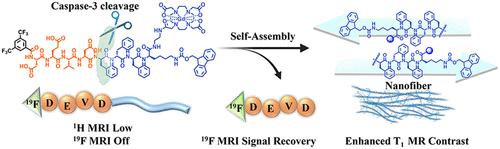
Caspase-3 (Cas-3) is a crucial cysteine protease involved in executing cell apoptosis, a process that is a hallmark of tumor cell apoptosis response to chemotherapy. Developing molecular imaging probes that specifically detect apoptotic signals during tumor treatment is considered to be one of the most important and effective strategies for reducing cancer-associated death rates and improving treatment outcomes. However, achieving a dual-enhanced bimodal probe in a single molecule remains a significant challenge. In this study, we developed a 1H/19F dual-enhanced magnetic resonance imaging (MRI) probe, CF3DEVDFFFK(Fmoc)-Gd, responsive to caspase-3 for in vivo imaging of apoptotic cells. Upon interaction with caspase-3, CF3DEVDFFFK(Fmoc)-Gd efficiently splits into two components CF3DEVD and FFFK(Fmoc)-C2-Gd, where FFFK(Fmoc)-C2-Gd subsequently self-assembles into nanofibers. This process activates both 19F MRI and 1H MRI, with longitudinal relaxivity (r1) increasing from 9.38 ± 0.22 to 23.24 ± 2.33 mM–1 s–1 at 0.5 T and turning on the 19F MRI signal due to the absence of the paramagnetic relaxation enhancement (PRE) effect. In vivo imaging results demonstrated that, after systemic administration, CF3DEVDFFFK(Fmoc)-Gd effectively accumulated in apoptotic 4T1 tumor tissues, resulting in significantly enhanced 1H MRI signals for visualization of caspase-3 activity in doxorubicin-treated apoptotic 4T1 tumor tissues, with signal intensity three times greater than that of Gd-DTPA. 19F MRI further complemented 1H MRI, with a notable recovery of the 19F MRI signal after intratumoral injection. These results confirm that CF3DEVDFFFK(Fmoc)-Gd effectively reports tumor apoptosis through combined 1H and 19F MRI, offering a promising approach for the preliminary assessment of antitumor efficacy in vivo.
期刊介绍:
Analytical Chemistry, a peer-reviewed research journal, focuses on disseminating new and original knowledge across all branches of analytical chemistry. Fundamental articles may explore general principles of chemical measurement science and need not directly address existing or potential analytical methodology. They can be entirely theoretical or report experimental results. Contributions may cover various phases of analytical operations, including sampling, bioanalysis, electrochemistry, mass spectrometry, microscale and nanoscale systems, environmental analysis, separations, spectroscopy, chemical reactions and selectivity, instrumentation, imaging, surface analysis, and data processing. Papers discussing known analytical methods should present a significant, original application of the method, a notable improvement, or results on an important analyte.



 京公网安备 11010802042870号
京ICP备2023020795号-1
京公网安备 11010802042870号
京ICP备2023020795号-1

 分享
分享
 求助内容:
求助内容: 应助结果提醒方式:
 扫码关注我们
