Multiplexed Detection of Tumor Markers and Discrimination of Cancer Cell Types by Laser Ablation-Dielectric Barrier Discharge Ionization-Mass Spectrometry
{"title":"Multiplexed Detection of Tumor Markers and Discrimination of Cancer Cell Types by Laser Ablation-Dielectric Barrier Discharge Ionization-Mass Spectrometry","authors":"Xiaokang Guan, Qiao Lu, Naijie Wei, Shuxian Liu, Haowen Li, Qin Wu, Xiaowen Yan, Renato Zenobi","doi":"10.1021/acs.analchem.4c06927","DOIUrl":null,"url":null,"abstract":"We present an ambient mass spectrometry immunoassay platform based on specific mass tags detected by laser ablation-dielectric barrier discharge ionization-mass spectrometry (LA-DBDI-MS). It features high sensitivity, multiplexed quantitation, minimal sample consumption, and convenient operation. The organic small-molecule mass tags allow very high sensitivity and quantitative detection of multiple proteins, even of membrane-bound proteins on cell surfaces, through signal amplification (approximately 600 times). By using just 2 μL of serum, we achieved the detection of thrombin (LOD 6.6 pM) and cancer antigen 125 (CA125) (LOD 1.4 U/mL). Seven protein biomarkers, including CA125, carcinoembryonic antigen (CEA), epithelial cell adhesion molecule (EpCAM), protein tyrosine kinase 7 (PTK7), transferrin receptor 1 (CD71), cluster of differentiation 8 alpha protein (CD8a), and cluster of differentiation 33 (CD33), were simultaneously detected in situ in four types of cancer cells within 2 h. This platform is expected to enable multiplexed protein detection in single-drop samples or at the single-cell scale, distinguish different types of cells, and has potential applications in clinical diagnosis.","PeriodicalId":27,"journal":{"name":"Analytical Chemistry","volume":"219 1","pages":""},"PeriodicalIF":6.7000,"publicationDate":"2025-04-22","publicationTypes":"Journal Article","fieldsOfStudy":null,"isOpenAccess":false,"openAccessPdf":"","citationCount":"0","resultStr":null,"platform":"Semanticscholar","paperid":null,"PeriodicalName":"Analytical Chemistry","FirstCategoryId":"92","ListUrlMain":"https://doi.org/10.1021/acs.analchem.4c06927","RegionNum":1,"RegionCategory":"化学","ArticlePicture":[],"TitleCN":null,"AbstractTextCN":null,"PMCID":null,"EPubDate":"","PubModel":"","JCR":"Q1","JCRName":"CHEMISTRY, ANALYTICAL","Score":null,"Total":0}
引用次数: 0
Abstract
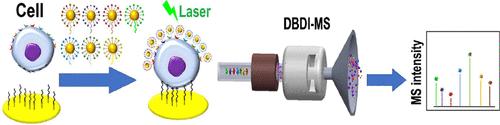
We present an ambient mass spectrometry immunoassay platform based on specific mass tags detected by laser ablation-dielectric barrier discharge ionization-mass spectrometry (LA-DBDI-MS). It features high sensitivity, multiplexed quantitation, minimal sample consumption, and convenient operation. The organic small-molecule mass tags allow very high sensitivity and quantitative detection of multiple proteins, even of membrane-bound proteins on cell surfaces, through signal amplification (approximately 600 times). By using just 2 μL of serum, we achieved the detection of thrombin (LOD 6.6 pM) and cancer antigen 125 (CA125) (LOD 1.4 U/mL). Seven protein biomarkers, including CA125, carcinoembryonic antigen (CEA), epithelial cell adhesion molecule (EpCAM), protein tyrosine kinase 7 (PTK7), transferrin receptor 1 (CD71), cluster of differentiation 8 alpha protein (CD8a), and cluster of differentiation 33 (CD33), were simultaneously detected in situ in four types of cancer cells within 2 h. This platform is expected to enable multiplexed protein detection in single-drop samples or at the single-cell scale, distinguish different types of cells, and has potential applications in clinical diagnosis.
期刊介绍:
Analytical Chemistry, a peer-reviewed research journal, focuses on disseminating new and original knowledge across all branches of analytical chemistry. Fundamental articles may explore general principles of chemical measurement science and need not directly address existing or potential analytical methodology. They can be entirely theoretical or report experimental results. Contributions may cover various phases of analytical operations, including sampling, bioanalysis, electrochemistry, mass spectrometry, microscale and nanoscale systems, environmental analysis, separations, spectroscopy, chemical reactions and selectivity, instrumentation, imaging, surface analysis, and data processing. Papers discussing known analytical methods should present a significant, original application of the method, a notable improvement, or results on an important analyte.



 京公网安备 11010802042870号
京ICP备2023020795号-1
京公网安备 11010802042870号
京ICP备2023020795号-1

 分享
分享
 求助内容:
求助内容: 应助结果提醒方式:
 扫码关注我们
