{"title":"S9.6 Antibody-Mediated Wireless Portable Biosensor with Multiple Affinity Enhancements for Comprehensive Detection of Nucleic Acid in Serum","authors":"Yi Wang, Zeyu Ma, Yingjing Li, Hongyan Yang, Jia Jin, Yuxia Jin, Guobao Zhou","doi":"10.1021/acs.analchem.5c00566","DOIUrl":null,"url":null,"abstract":"Creating biosensors capable of facilely and entirely excluding the influence of interfering biomolecules in complex samples holds profound significance for advancing detection technology and diagnostics. Here, we develop a wireless portable biosensor (WPB) that prevents interference from abundant biomolecules in serum through homogeneous hybridization and S9.6 antibody-mediated multivalent capture. By transferring the hybridization environment from a heterogeneous chip surface to a homogeneous solution, the biosensor maintains consistent hybridization efficiency in serum as in buffer. Additionally, the use of S9.6 antibody-mediated multivalent capture ensures nearly unchanged binding affinity in serum compared to buffer. On the basis of the multiple affinity enhancements, S9.6 antibody-mediated WPB can achieve ultrasensitive detection of nucleic acid in 50% human serum. Specifically, a subtle blocker is designed to eliminate the competitive monovalent S9.6 antibody–heteroduplex binding, ensuring the efficiency of multivalent S9.6 antibody–heteroduplex interactions. The blocker also enables single-step detection. Moreover, the sensing platform utilizes interferents in serum as in situ antifouling biomolecules to prevent nonspecific adsorption. As a result, the proposed WPB achieves a similar limit of detection for nucleic acids in human serum (95 aM) and in buffer (86 aM). This approach inspires a new idea for complex interference elimination and usage and exhibits comprehensive detection performance in complex samples with potential future diagnostic applications.","PeriodicalId":27,"journal":{"name":"Analytical Chemistry","volume":"16 1","pages":""},"PeriodicalIF":6.7000,"publicationDate":"2025-04-22","publicationTypes":"Journal Article","fieldsOfStudy":null,"isOpenAccess":false,"openAccessPdf":"","citationCount":"0","resultStr":null,"platform":"Semanticscholar","paperid":null,"PeriodicalName":"Analytical Chemistry","FirstCategoryId":"92","ListUrlMain":"https://doi.org/10.1021/acs.analchem.5c00566","RegionNum":1,"RegionCategory":"化学","ArticlePicture":[],"TitleCN":null,"AbstractTextCN":null,"PMCID":null,"EPubDate":"","PubModel":"","JCR":"Q1","JCRName":"CHEMISTRY, ANALYTICAL","Score":null,"Total":0}
引用次数: 0
Abstract
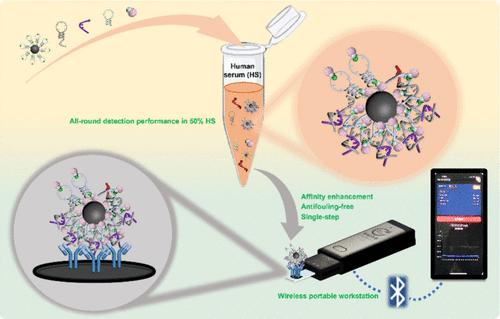
Creating biosensors capable of facilely and entirely excluding the influence of interfering biomolecules in complex samples holds profound significance for advancing detection technology and diagnostics. Here, we develop a wireless portable biosensor (WPB) that prevents interference from abundant biomolecules in serum through homogeneous hybridization and S9.6 antibody-mediated multivalent capture. By transferring the hybridization environment from a heterogeneous chip surface to a homogeneous solution, the biosensor maintains consistent hybridization efficiency in serum as in buffer. Additionally, the use of S9.6 antibody-mediated multivalent capture ensures nearly unchanged binding affinity in serum compared to buffer. On the basis of the multiple affinity enhancements, S9.6 antibody-mediated WPB can achieve ultrasensitive detection of nucleic acid in 50% human serum. Specifically, a subtle blocker is designed to eliminate the competitive monovalent S9.6 antibody–heteroduplex binding, ensuring the efficiency of multivalent S9.6 antibody–heteroduplex interactions. The blocker also enables single-step detection. Moreover, the sensing platform utilizes interferents in serum as in situ antifouling biomolecules to prevent nonspecific adsorption. As a result, the proposed WPB achieves a similar limit of detection for nucleic acids in human serum (95 aM) and in buffer (86 aM). This approach inspires a new idea for complex interference elimination and usage and exhibits comprehensive detection performance in complex samples with potential future diagnostic applications.
期刊介绍:
Analytical Chemistry, a peer-reviewed research journal, focuses on disseminating new and original knowledge across all branches of analytical chemistry. Fundamental articles may explore general principles of chemical measurement science and need not directly address existing or potential analytical methodology. They can be entirely theoretical or report experimental results. Contributions may cover various phases of analytical operations, including sampling, bioanalysis, electrochemistry, mass spectrometry, microscale and nanoscale systems, environmental analysis, separations, spectroscopy, chemical reactions and selectivity, instrumentation, imaging, surface analysis, and data processing. Papers discussing known analytical methods should present a significant, original application of the method, a notable improvement, or results on an important analyte.



 京公网安备 11010802042870号
京ICP备2023020795号-1
京公网安备 11010802042870号
京ICP备2023020795号-1

 分享
分享
 求助内容:
求助内容: 应助结果提醒方式:
 扫码关注我们
