Jinyu Wang, Xingfeng Liu, Kaitong Li, Tao Shi, Qianqian Xu, Tiantian Peng, Qingjun Huang, Ziqi Gao, Hongqi Zhou, Wei Lu, Jie Wang
{"title":"Design and Evolution of a Phosphorescent Protein via the Proximal Encoding of Lanthanide and the Antenna Chromophore","authors":"Jinyu Wang, Xingfeng Liu, Kaitong Li, Tao Shi, Qianqian Xu, Tiantian Peng, Qingjun Huang, Ziqi Gao, Hongqi Zhou, Wei Lu, Jie Wang","doi":"10.1021/jacs.5c00199","DOIUrl":null,"url":null,"abstract":"Genetically encoded phosphorescent proteins with extended luminescence lifetimes provide an orthogonal channel for biological imaging and detection. While conventional fluorescent proteins typically exhibit nanosecond-scale lifetimes, the development of proteins with longer lifetimes enables time-resolved detection and enhanced signal-to-noise ratios. Here, we designed a novel phosphorescent protein system by incorporating photosensitizing unnatural amino acids (UAAs) proximal to the metal center of a lanthanide binding protein (LanM). Through systematic optimization of the incorporation sites, we achieved considerable enhancement in lanthanide phosphorescence compared with that of the wild-type LanM protein. The subsequent directed evolution of LanM and chemical evolution of UAA yielded variants with an additional muti-fold increase in signal intensity. This iterative optimization strategy generated phosphorescent proteins with extended lifetimes of up to 500 μs and significantly increased brightness. Using this phosphorescence protein platform, a europium sensor with a signal-to-noise ratio of more than 100 for 200 nM Eu(III) and a detection limit of less than 10 nM was developed. In addition, a protease sensor was further designed by inserting a cleavage site into a loop of the phosphorescent protein, achieving remarkable signal-to-noise ratios at nanomolar concentrations. Finally, this phosphorescent protein was fused to the affibody and further used for immunofluorescence imaging. These applications demonstrated a novel platform for developing genetically encoded sensors with enhanced detection sensitivity through time-resolved measurements.","PeriodicalId":49,"journal":{"name":"Journal of the American Chemical Society","volume":"71 1","pages":""},"PeriodicalIF":15.6000,"publicationDate":"2025-04-23","publicationTypes":"Journal Article","fieldsOfStudy":null,"isOpenAccess":false,"openAccessPdf":"","citationCount":"0","resultStr":null,"platform":"Semanticscholar","paperid":null,"PeriodicalName":"Journal of the American Chemical Society","FirstCategoryId":"92","ListUrlMain":"https://doi.org/10.1021/jacs.5c00199","RegionNum":1,"RegionCategory":"化学","ArticlePicture":[],"TitleCN":null,"AbstractTextCN":null,"PMCID":null,"EPubDate":"","PubModel":"","JCR":"Q1","JCRName":"CHEMISTRY, MULTIDISCIPLINARY","Score":null,"Total":0}
引用次数: 0
Abstract
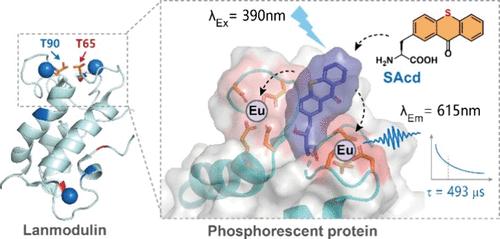
Genetically encoded phosphorescent proteins with extended luminescence lifetimes provide an orthogonal channel for biological imaging and detection. While conventional fluorescent proteins typically exhibit nanosecond-scale lifetimes, the development of proteins with longer lifetimes enables time-resolved detection and enhanced signal-to-noise ratios. Here, we designed a novel phosphorescent protein system by incorporating photosensitizing unnatural amino acids (UAAs) proximal to the metal center of a lanthanide binding protein (LanM). Through systematic optimization of the incorporation sites, we achieved considerable enhancement in lanthanide phosphorescence compared with that of the wild-type LanM protein. The subsequent directed evolution of LanM and chemical evolution of UAA yielded variants with an additional muti-fold increase in signal intensity. This iterative optimization strategy generated phosphorescent proteins with extended lifetimes of up to 500 μs and significantly increased brightness. Using this phosphorescence protein platform, a europium sensor with a signal-to-noise ratio of more than 100 for 200 nM Eu(III) and a detection limit of less than 10 nM was developed. In addition, a protease sensor was further designed by inserting a cleavage site into a loop of the phosphorescent protein, achieving remarkable signal-to-noise ratios at nanomolar concentrations. Finally, this phosphorescent protein was fused to the affibody and further used for immunofluorescence imaging. These applications demonstrated a novel platform for developing genetically encoded sensors with enhanced detection sensitivity through time-resolved measurements.
期刊介绍:
The flagship journal of the American Chemical Society, known as the Journal of the American Chemical Society (JACS), has been a prestigious publication since its establishment in 1879. It holds a preeminent position in the field of chemistry and related interdisciplinary sciences. JACS is committed to disseminating cutting-edge research papers, covering a wide range of topics, and encompasses approximately 19,000 pages of Articles, Communications, and Perspectives annually. With a weekly publication frequency, JACS plays a vital role in advancing the field of chemistry by providing essential research.



 京公网安备 11010802042870号
京ICP备2023020795号-1
京公网安备 11010802042870号
京ICP备2023020795号-1

 分享
分享
 求助内容:
求助内容: 应助结果提醒方式:
 扫码关注我们
