Jinling Wang, Kateryna A. Tolmachova, Jeffrey W. Bode
{"title":"Chemoenzymatic Site-Specific Lysine Modification of Nanobodies and Subsequent Bioconjugation via Potassium Acyltrifluoroborate (KAT) Ligations","authors":"Jinling Wang, Kateryna A. Tolmachova, Jeffrey W. Bode","doi":"10.1021/jacs.5c01418","DOIUrl":null,"url":null,"abstract":"Single chain camelid antigen binding domains, often called nanobodies, have emerged as powerful tools for diagnostics and therapy. Methods for their site-specific modification offer immense potential for enhancing their therapeutic applications, but established approaches, such as fusion proteins, have well-known limitations in the nanobody format. Here, we report a convenient and broadly applicable method for site-specifically functionalizing a single residue near the C-terminus of VHH nanobodies by employing lysine acylation using conjugating enzymes (LACE) to transfer short peptides bearing functional group handles for potassium acyltrifluoroborate (KAT) ligations onto a single lysine residue of the expressed nanobodies. This approach requires a LACE tag (4 residues or 11 residues) in the recombinant nanobodies and enables direct elaboration of the products via a rapid amide forming reaction. In this study, VHH nanobodies expressed in <i>Escherichia coli</i> could be efficiently modified through the transfer of specific chemical handles, enabling their conjugation to small molecules, nanobodies, and antibodies by chemoselective, amide-forming KAT ligations that operate at micromolar concentrations.","PeriodicalId":49,"journal":{"name":"Journal of the American Chemical Society","volume":"24 1","pages":""},"PeriodicalIF":15.6000,"publicationDate":"2025-04-23","publicationTypes":"Journal Article","fieldsOfStudy":null,"isOpenAccess":false,"openAccessPdf":"","citationCount":"0","resultStr":null,"platform":"Semanticscholar","paperid":null,"PeriodicalName":"Journal of the American Chemical Society","FirstCategoryId":"92","ListUrlMain":"https://doi.org/10.1021/jacs.5c01418","RegionNum":1,"RegionCategory":"化学","ArticlePicture":[],"TitleCN":null,"AbstractTextCN":null,"PMCID":null,"EPubDate":"","PubModel":"","JCR":"Q1","JCRName":"CHEMISTRY, MULTIDISCIPLINARY","Score":null,"Total":0}
引用次数: 0
Abstract
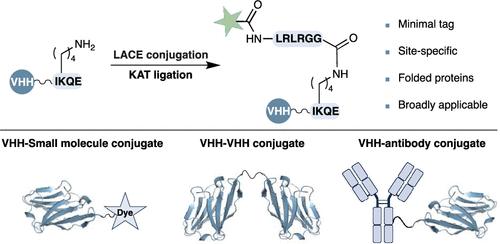
Single chain camelid antigen binding domains, often called nanobodies, have emerged as powerful tools for diagnostics and therapy. Methods for their site-specific modification offer immense potential for enhancing their therapeutic applications, but established approaches, such as fusion proteins, have well-known limitations in the nanobody format. Here, we report a convenient and broadly applicable method for site-specifically functionalizing a single residue near the C-terminus of VHH nanobodies by employing lysine acylation using conjugating enzymes (LACE) to transfer short peptides bearing functional group handles for potassium acyltrifluoroborate (KAT) ligations onto a single lysine residue of the expressed nanobodies. This approach requires a LACE tag (4 residues or 11 residues) in the recombinant nanobodies and enables direct elaboration of the products via a rapid amide forming reaction. In this study, VHH nanobodies expressed in Escherichia coli could be efficiently modified through the transfer of specific chemical handles, enabling their conjugation to small molecules, nanobodies, and antibodies by chemoselective, amide-forming KAT ligations that operate at micromolar concentrations.
期刊介绍:
The flagship journal of the American Chemical Society, known as the Journal of the American Chemical Society (JACS), has been a prestigious publication since its establishment in 1879. It holds a preeminent position in the field of chemistry and related interdisciplinary sciences. JACS is committed to disseminating cutting-edge research papers, covering a wide range of topics, and encompasses approximately 19,000 pages of Articles, Communications, and Perspectives annually. With a weekly publication frequency, JACS plays a vital role in advancing the field of chemistry by providing essential research.



 京公网安备 11010802042870号
京ICP备2023020795号-1
京公网安备 11010802042870号
京ICP备2023020795号-1

 分享
分享
 求助内容:
求助内容: 应助结果提醒方式:
 扫码关注我们
