Pei Tang, Siqi Guan, Chen Wu, Huize Wu, Ni Lu, Jun Tan, Chunyang Wang, Hui-Ming Cheng, Feng Li
{"title":"Deciphering the Crystallographic Effect in Radially Architectured Polycrystalline Layered Cathode Materials for Lithium-Ion Batteries","authors":"Pei Tang, Siqi Guan, Chen Wu, Huize Wu, Ni Lu, Jun Tan, Chunyang Wang, Hui-Ming Cheng, Feng Li","doi":"10.1002/anie.202503108","DOIUrl":null,"url":null,"abstract":"<p>Layered oxide cathode materials with primary–secondary architecture face challenges of inhomogeneous Li<sup>+</sup> diffusion and chemomechanical degradation due to misorientations between equiaxed primary particles. Although a radial architecture, featuring elongated grains, is widely believed to enhance diffusion, it does not address the root cause of chemomechanical failure—crystallographic misorientation. The impact of crystallography on the electrochemical performance of radially architectured secondary particles, compared to conventional designs, remains poorly understood. Here, by combining transmission Kikuchi diffraction with multimodal characterization, we decipher the crucial role of crystallography in the performance and stability of polycrystalline high-Ni layered oxide cathode materials. Contrary to the conventional belief that a preferential texture induced by the radial architecture is the key to performance enhancement, we uncover that the radial architecture primarily alters the misorientation distribution by introducing substantially increased low-angle grain boundaries and twin boundaries that significantly mitigate chemomechanical cracking and phase degradation. This crystallographic refinement facilitates enhanced Li<sup>+</sup> diffusion between primary particles, ultimately boosting the rate capability and long-term stability of the cathodes. By quantitatively uncovering the crystallographic influence on performance, this work provides a new avenue for optimizing Li<sup>+</sup> diffusion kinetics and chemomechanical resilience in polycrystalline cathode materials through crystallographic engineering.</p>","PeriodicalId":125,"journal":{"name":"Angewandte Chemie International Edition","volume":"64 26","pages":""},"PeriodicalIF":16.9000,"publicationDate":"2025-04-23","publicationTypes":"Journal Article","fieldsOfStudy":null,"isOpenAccess":false,"openAccessPdf":"","citationCount":"0","resultStr":null,"platform":"Semanticscholar","paperid":null,"PeriodicalName":"Angewandte Chemie International Edition","FirstCategoryId":"92","ListUrlMain":"https://onlinelibrary.wiley.com/doi/10.1002/anie.202503108","RegionNum":1,"RegionCategory":"化学","ArticlePicture":[],"TitleCN":null,"AbstractTextCN":null,"PMCID":null,"EPubDate":"","PubModel":"","JCR":"Q1","JCRName":"CHEMISTRY, MULTIDISCIPLINARY","Score":null,"Total":0}
引用次数: 0
Abstract
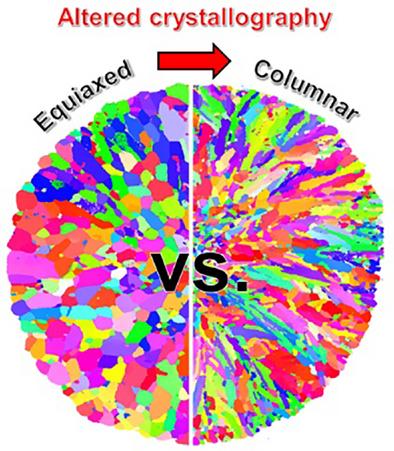
Layered oxide cathode materials with primary–secondary architecture face challenges of inhomogeneous Li+ diffusion and chemomechanical degradation due to misorientations between equiaxed primary particles. Although a radial architecture, featuring elongated grains, is widely believed to enhance diffusion, it does not address the root cause of chemomechanical failure—crystallographic misorientation. The impact of crystallography on the electrochemical performance of radially architectured secondary particles, compared to conventional designs, remains poorly understood. Here, by combining transmission Kikuchi diffraction with multimodal characterization, we decipher the crucial role of crystallography in the performance and stability of polycrystalline high-Ni layered oxide cathode materials. Contrary to the conventional belief that a preferential texture induced by the radial architecture is the key to performance enhancement, we uncover that the radial architecture primarily alters the misorientation distribution by introducing substantially increased low-angle grain boundaries and twin boundaries that significantly mitigate chemomechanical cracking and phase degradation. This crystallographic refinement facilitates enhanced Li+ diffusion between primary particles, ultimately boosting the rate capability and long-term stability of the cathodes. By quantitatively uncovering the crystallographic influence on performance, this work provides a new avenue for optimizing Li+ diffusion kinetics and chemomechanical resilience in polycrystalline cathode materials through crystallographic engineering.
期刊介绍:
Angewandte Chemie, a journal of the German Chemical Society (GDCh), maintains a leading position among scholarly journals in general chemistry with an impressive Impact Factor of 16.6 (2022 Journal Citation Reports, Clarivate, 2023). Published weekly in a reader-friendly format, it features new articles almost every day. Established in 1887, Angewandte Chemie is a prominent chemistry journal, offering a dynamic blend of Review-type articles, Highlights, Communications, and Research Articles on a weekly basis, making it unique in the field.




 京公网安备 11010802042870号
京ICP备2023020795号-1
京公网安备 11010802042870号
京ICP备2023020795号-1

 分享
分享
 求助内容:
求助内容: 应助结果提醒方式:
 扫码关注我们
