Zhengyu Li , Yingjie Liu , Zepeng Gao , Zihao Yin , Zihan Wang , Zhenbo Qin , Yang Zhu , Zhong Wu , Wenbin Hu
{"title":"Effect of plastic deformation on discharge performance of aluminum–air battery","authors":"Zhengyu Li , Yingjie Liu , Zepeng Gao , Zihao Yin , Zihan Wang , Zhenbo Qin , Yang Zhu , Zhong Wu , Wenbin Hu","doi":"10.1016/j.jallcom.2025.180571","DOIUrl":null,"url":null,"abstract":"<div><div>In this study, the effect of plastic deformation on the discharge performance of an aluminum–air battery (AAB) was investigated. High-purity Al anodes were processed by cold rolling (CR) under different degrees of plastic deformation and analyzed using discharge tests. The discharge voltage and specific capacity initially increased and then decreased with extended cold rolling, achieving the highest values of 1.15 V and 2682.38 mAh/g<sub>Al</sub> at 50 mA/cm<sup>2</sup> with 60 % deformation. Deformation via CR significantly affected the microstructure of the Al anode, where the preferred orientation of the crystal plane gradually changed from Al(111) to Al(200) when deformed up to 60 %, and remarkable grain refinement was only observed at 80 % deformation, inducing dynamic recrystallization with a change in the orientation toward Al(111). Although grain refinement can improve the discharge performance to a certain extent, preferred orientation along the Al(200) crystal plane played a dominant role in inhibiting the HER and improving the discharge performance of the AAB. Density functional theory calculation showed that Al(200) had a lower adsorption capacity for H<sub>2</sub>O compared to Al(111), thereby improving the discharge performance of the AAB.</div></div>","PeriodicalId":344,"journal":{"name":"Journal of Alloys and Compounds","volume":"1027 ","pages":"Article 180571"},"PeriodicalIF":6.3000,"publicationDate":"2025-05-10","publicationTypes":"Journal Article","fieldsOfStudy":null,"isOpenAccess":false,"openAccessPdf":"","citationCount":"0","resultStr":null,"platform":"Semanticscholar","paperid":null,"PeriodicalName":"Journal of Alloys and Compounds","FirstCategoryId":"88","ListUrlMain":"https://www.sciencedirect.com/science/article/pii/S0925838825021322","RegionNum":2,"RegionCategory":"材料科学","ArticlePicture":[],"TitleCN":null,"AbstractTextCN":null,"PMCID":null,"EPubDate":"2025/4/22 0:00:00","PubModel":"Epub","JCR":"Q2","JCRName":"CHEMISTRY, PHYSICAL","Score":null,"Total":0}
引用次数: 0
Abstract
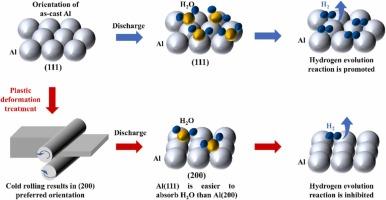
In this study, the effect of plastic deformation on the discharge performance of an aluminum–air battery (AAB) was investigated. High-purity Al anodes were processed by cold rolling (CR) under different degrees of plastic deformation and analyzed using discharge tests. The discharge voltage and specific capacity initially increased and then decreased with extended cold rolling, achieving the highest values of 1.15 V and 2682.38 mAh/gAl at 50 mA/cm2 with 60 % deformation. Deformation via CR significantly affected the microstructure of the Al anode, where the preferred orientation of the crystal plane gradually changed from Al(111) to Al(200) when deformed up to 60 %, and remarkable grain refinement was only observed at 80 % deformation, inducing dynamic recrystallization with a change in the orientation toward Al(111). Although grain refinement can improve the discharge performance to a certain extent, preferred orientation along the Al(200) crystal plane played a dominant role in inhibiting the HER and improving the discharge performance of the AAB. Density functional theory calculation showed that Al(200) had a lower adsorption capacity for H2O compared to Al(111), thereby improving the discharge performance of the AAB.
期刊介绍:
The Journal of Alloys and Compounds is intended to serve as an international medium for the publication of work on solid materials comprising compounds as well as alloys. Its great strength lies in the diversity of discipline which it encompasses, drawing together results from materials science, solid-state chemistry and physics.




 京公网安备 11010802042870号
京ICP备2023020795号-1
京公网安备 11010802042870号
京ICP备2023020795号-1

 分享
分享
 求助内容:
求助内容: 应助结果提醒方式:
 扫码关注我们
