Lingxi Qiu , Yipeng An , Liyan Shang , Yawei Li , Cheng Gong , Junhao Chu , Zhigao Hu , Shi-Jing Gong
{"title":"Bipolar magnetic semiconductor of 2D Janus Cr2Ge2Te3Se3 and its application in spin-FET","authors":"Lingxi Qiu , Yipeng An , Liyan Shang , Yawei Li , Cheng Gong , Junhao Chu , Zhigao Hu , Shi-Jing Gong","doi":"10.1016/j.jallcom.2025.180578","DOIUrl":null,"url":null,"abstract":"<div><div>Two-dimensional (2D) Janus magnets exhibit a broad range of exotic physical phenomena, e.g. skyrmions and strong Rashba SOC, and become an important category of spintronic materials. Here, we design the Janus structure Cr<sub>2</sub>Ge<sub>2</sub>Te<sub>3</sub>Se<sub>3</sub> based on the unipolar magnetic semiconductor (UMS) Cr<sub>2</sub>Ge<sub>2</sub>Te<sub>6</sub>, and find that Cr<sub>2</sub>Ge<sub>2</sub>Te<sub>3</sub>Se<sub>3</sub> becomes a bipolar magnetic semiconductor (BMS), whose valence band maximum (VBM) and conduction band minimum (CBM) have opposite spin polarization. The transition from UMS Cr<sub>2</sub>Ge<sub>2</sub>Te<sub>6</sub> to BMS Cr<sub>2</sub>Ge<sub>2</sub>Te<sub>3</sub>Se<sub>3</sub> is achieved because the VBM is contributed by electronic states of the Se and Te atoms, which can be effectively modified by the mirror symmetry breaking. We then design a spin field-effect transistor (FET) based on Cr<sub>2</sub>Ge<sub>2</sub>Te<sub>3</sub>Se<sub>3</sub>, and demonstrate the half-metallic current tuned by the gate and bias voltages, through non-equilibrium Green’s function theory. Our investigation schemes a 2D BMS and simulates its application in spin-FET, which potentially contributes to the development of 2D spintronic materials and devices.</div></div>","PeriodicalId":344,"journal":{"name":"Journal of Alloys and Compounds","volume":"1027 ","pages":"Article 180578"},"PeriodicalIF":6.3000,"publicationDate":"2025-05-10","publicationTypes":"Journal Article","fieldsOfStudy":null,"isOpenAccess":false,"openAccessPdf":"","citationCount":"0","resultStr":null,"platform":"Semanticscholar","paperid":null,"PeriodicalName":"Journal of Alloys and Compounds","FirstCategoryId":"88","ListUrlMain":"https://www.sciencedirect.com/science/article/pii/S0925838825021395","RegionNum":2,"RegionCategory":"材料科学","ArticlePicture":[],"TitleCN":null,"AbstractTextCN":null,"PMCID":null,"EPubDate":"2025/4/22 0:00:00","PubModel":"Epub","JCR":"Q2","JCRName":"CHEMISTRY, PHYSICAL","Score":null,"Total":0}
引用次数: 0
Abstract
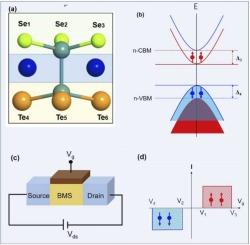
Two-dimensional (2D) Janus magnets exhibit a broad range of exotic physical phenomena, e.g. skyrmions and strong Rashba SOC, and become an important category of spintronic materials. Here, we design the Janus structure Cr2Ge2Te3Se3 based on the unipolar magnetic semiconductor (UMS) Cr2Ge2Te6, and find that Cr2Ge2Te3Se3 becomes a bipolar magnetic semiconductor (BMS), whose valence band maximum (VBM) and conduction band minimum (CBM) have opposite spin polarization. The transition from UMS Cr2Ge2Te6 to BMS Cr2Ge2Te3Se3 is achieved because the VBM is contributed by electronic states of the Se and Te atoms, which can be effectively modified by the mirror symmetry breaking. We then design a spin field-effect transistor (FET) based on Cr2Ge2Te3Se3, and demonstrate the half-metallic current tuned by the gate and bias voltages, through non-equilibrium Green’s function theory. Our investigation schemes a 2D BMS and simulates its application in spin-FET, which potentially contributes to the development of 2D spintronic materials and devices.
期刊介绍:
The Journal of Alloys and Compounds is intended to serve as an international medium for the publication of work on solid materials comprising compounds as well as alloys. Its great strength lies in the diversity of discipline which it encompasses, drawing together results from materials science, solid-state chemistry and physics.



 京公网安备 11010802042870号
京ICP备2023020795号-1
京公网安备 11010802042870号
京ICP备2023020795号-1

 分享
分享
 求助内容:
求助内容: 应助结果提醒方式:
 扫码关注我们
