Fangyin Lu , Qingshuang Ma , Enyu Liu , Ruibo Wei , Jing Bai , Qiuzhi Gao , Jian Qi
{"title":"Advancements in understanding the microstructure and properties of additive manufacturing Ti-6Al-4V alloy: A comprehensive review","authors":"Fangyin Lu , Qingshuang Ma , Enyu Liu , Ruibo Wei , Jing Bai , Qiuzhi Gao , Jian Qi","doi":"10.1016/j.jallcom.2025.180543","DOIUrl":null,"url":null,"abstract":"<div><div>In recent years, considerable attention has been devoted to implementing additive manufacturing (AM) techniques in the fabrication of Ti-6Al-4V alloy. During manufacturing, metallic powders are melted and rapidly solidified utilizing laser or electron beam sources, experiencing intricate thermal cycles that confer unique microstructural characteristics and exceptional performance attributes upon the titanium alloys. This paper presents an exhaustive review of the utilization of AM technologies in the production of Ti-6Al-4V alloy, with particular emphasis placed on this alloy itself. Specifically, the advantages and limitations of two prominent AM methodologies—laser powder bed fusion (LPBF) and directed energy deposition (DED)—are critically evaluated. Moreover, an in-depth analysis of pore defect formation mechanisms is provided, elucidating their consequential influence on the mechanical integrity of AM-processed Ti-6Al-4V alloy. Additionally, this review summarizes and contrasts the mechanical properties, hardness, wear resistance, corrosion resistance, and oxidation resistance exhibited by Ti-6Al-4V alloy fabricated through various AM technologies, as well as methodologies implemented to enhance these characteristics. In aggregate, this review aims to provide a robust theoretical framework and pivotal insights essential for advancing the development of high-performance titanium alloys through the strategic deployment of AM technologies.</div><div>Additive manufacturing (AM) processes, such as DED and LPBF, involve melting metal powders with lasers or electron beams to produce unique microstructures and outstanding performance. This review summarizes the advantages and disadvantages, microstructure, pore defect formation mechanism, and their impact on performance of these 3 AM methods. At the same time, the mechanical properties, hardness, wear, corrosion, and oxidation resistance of Ti-6Al-4V alloy produced by AM are summarized, providing insights for the future development of high-performance titanium alloy manufacturing.</div></div>","PeriodicalId":344,"journal":{"name":"Journal of Alloys and Compounds","volume":"1027 ","pages":"Article 180543"},"PeriodicalIF":6.3000,"publicationDate":"2025-05-10","publicationTypes":"Journal Article","fieldsOfStudy":null,"isOpenAccess":false,"openAccessPdf":"","citationCount":"0","resultStr":null,"platform":"Semanticscholar","paperid":null,"PeriodicalName":"Journal of Alloys and Compounds","FirstCategoryId":"88","ListUrlMain":"https://www.sciencedirect.com/science/article/pii/S0925838825021048","RegionNum":2,"RegionCategory":"材料科学","ArticlePicture":[],"TitleCN":null,"AbstractTextCN":null,"PMCID":null,"EPubDate":"2025/4/22 0:00:00","PubModel":"Epub","JCR":"Q2","JCRName":"CHEMISTRY, PHYSICAL","Score":null,"Total":0}
引用次数: 0
Abstract
In recent years, considerable attention has been devoted to implementing additive manufacturing (AM) techniques in the fabrication of Ti-6Al-4V alloy. During manufacturing, metallic powders are melted and rapidly solidified utilizing laser or electron beam sources, experiencing intricate thermal cycles that confer unique microstructural characteristics and exceptional performance attributes upon the titanium alloys. This paper presents an exhaustive review of the utilization of AM technologies in the production of Ti-6Al-4V alloy, with particular emphasis placed on this alloy itself. Specifically, the advantages and limitations of two prominent AM methodologies—laser powder bed fusion (LPBF) and directed energy deposition (DED)—are critically evaluated. Moreover, an in-depth analysis of pore defect formation mechanisms is provided, elucidating their consequential influence on the mechanical integrity of AM-processed Ti-6Al-4V alloy. Additionally, this review summarizes and contrasts the mechanical properties, hardness, wear resistance, corrosion resistance, and oxidation resistance exhibited by Ti-6Al-4V alloy fabricated through various AM technologies, as well as methodologies implemented to enhance these characteristics. In aggregate, this review aims to provide a robust theoretical framework and pivotal insights essential for advancing the development of high-performance titanium alloys through the strategic deployment of AM technologies.
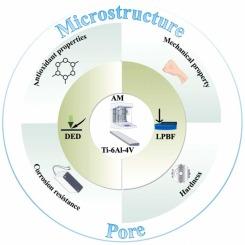
Additive manufacturing (AM) processes, such as DED and LPBF, involve melting metal powders with lasers or electron beams to produce unique microstructures and outstanding performance. This review summarizes the advantages and disadvantages, microstructure, pore defect formation mechanism, and their impact on performance of these 3 AM methods. At the same time, the mechanical properties, hardness, wear, corrosion, and oxidation resistance of Ti-6Al-4V alloy produced by AM are summarized, providing insights for the future development of high-performance titanium alloy manufacturing.
期刊介绍:
The Journal of Alloys and Compounds is intended to serve as an international medium for the publication of work on solid materials comprising compounds as well as alloys. Its great strength lies in the diversity of discipline which it encompasses, drawing together results from materials science, solid-state chemistry and physics.



 京公网安备 11010802042870号
京ICP备2023020795号-1
京公网安备 11010802042870号
京ICP备2023020795号-1

 分享
分享
 求助内容:
求助内容: 应助结果提醒方式:
 扫码关注我们
