Andrea Brattelli , Maria Chiara Sportelli , Rosaria Anna Picca , Nicola Cioffi , Mara Pasqualicchio , Ornella Incerti , Simona Marianna Sanzani , Luigi Gentile
{"title":"Tetrabutylammonium hydroxide and zinc salts in cellulose-based colloidal systems enhance fruit shelf life","authors":"Andrea Brattelli , Maria Chiara Sportelli , Rosaria Anna Picca , Nicola Cioffi , Mara Pasqualicchio , Ornella Incerti , Simona Marianna Sanzani , Luigi Gentile","doi":"10.1016/j.foodchem.2025.144494","DOIUrl":null,"url":null,"abstract":"<div><div>This study explores the development of cellulose-based active colloidal systems to enhance the antimicrobial properties of absorbent food pads and prolong the shelf life of cherry tomatoes. Food pads impregnated with colloidal systems made of microcrystalline cellulose dissolved in tetrabutylammonium hydroxide (TBAH) with zinc salts (ZnCl<sub>2</sub> and ZnSO<sub>4</sub>) were tested for their antifungal efficacy. <em>In vitro</em> results revealed complete fungal suppression by TBAH alone and in combination with ZnCl<sub>2</sub>. The interaction between TBAH and ZnSO<sub>4</sub> exhibited synergistic antifungal activity, while an additive effect was observed with ZnCl<sub>2</sub>. <em>In vivo</em> tests showed a significant reduction in fruit rot, with ZnCl₂-treated pads reducing rot by 91 % after 14 days. TBAH was partially bound to cellulose chains, minimizing the risk of fruit contamination, as confirmed by <sup>1</sup>H nuclear magnetic resonance.</div></div>","PeriodicalId":318,"journal":{"name":"Food Chemistry","volume":"484 ","pages":"Article 144494"},"PeriodicalIF":9.8000,"publicationDate":"2025-08-30","publicationTypes":"Journal Article","fieldsOfStudy":null,"isOpenAccess":false,"openAccessPdf":"","citationCount":"0","resultStr":null,"platform":"Semanticscholar","paperid":null,"PeriodicalName":"Food Chemistry","FirstCategoryId":"97","ListUrlMain":"https://www.sciencedirect.com/science/article/pii/S0308814625017455","RegionNum":1,"RegionCategory":"农林科学","ArticlePicture":[],"TitleCN":null,"AbstractTextCN":null,"PMCID":null,"EPubDate":"2025/4/22 0:00:00","PubModel":"Epub","JCR":"Q1","JCRName":"CHEMISTRY, APPLIED","Score":null,"Total":0}
引用次数: 0
Abstract
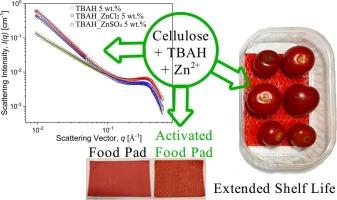
This study explores the development of cellulose-based active colloidal systems to enhance the antimicrobial properties of absorbent food pads and prolong the shelf life of cherry tomatoes. Food pads impregnated with colloidal systems made of microcrystalline cellulose dissolved in tetrabutylammonium hydroxide (TBAH) with zinc salts (ZnCl2 and ZnSO4) were tested for their antifungal efficacy. In vitro results revealed complete fungal suppression by TBAH alone and in combination with ZnCl2. The interaction between TBAH and ZnSO4 exhibited synergistic antifungal activity, while an additive effect was observed with ZnCl2. In vivo tests showed a significant reduction in fruit rot, with ZnCl₂-treated pads reducing rot by 91 % after 14 days. TBAH was partially bound to cellulose chains, minimizing the risk of fruit contamination, as confirmed by 1H nuclear magnetic resonance.
期刊介绍:
Food Chemistry publishes original research papers dealing with the advancement of the chemistry and biochemistry of foods or the analytical methods/ approach used. All papers should focus on the novelty of the research carried out.




 京公网安备 11010802042870号
京ICP备2023020795号-1
京公网安备 11010802042870号
京ICP备2023020795号-1

 分享
分享
 求助内容:
求助内容: 应助结果提醒方式:
 扫码关注我们
