Kaiyue Huang , Kaiyuan Huang , Tongyuan Bai , Xiaofeng Xue , Ping He , Baojun Xu
{"title":"Discrimination on potential adulteration of honey by differential scanning calorimetry (DSC) and graph-based semi-supervised learning (GSSL)","authors":"Kaiyue Huang , Kaiyuan Huang , Tongyuan Bai , Xiaofeng Xue , Ping He , Baojun Xu","doi":"10.1016/j.foodchem.2025.144490","DOIUrl":null,"url":null,"abstract":"<div><div>Honey is a valuable natural food product, prized for its nutritional and therapeutic properties. However, the widespread issue of honey adulteration, often involving the addition of plant-based syrups, poses significant challenges to global markets. This study utilized differential scanning calorimetry (DSC), a thermal-analytical technique, to characterize the thermal profiles of 43 honey samples, including both authentic and adulterated samples with high-fructose corn syrup (HFCS) and varying syrup concentrations. Principal component analysis (PCA) and graph-based semi-supervised learning (GSSL) were applied to classify the samples, achieving high accuracy. Results indicated that increasing adulteration levels led to higher water content and decreased glass transition temperature (Tg) and heat capacity difference (ΔCp). Furthermore, the established K-Nearest Neighbor (KNN) graph and Kullback-Leibler (KL) divergence effectively visualized relationships among samples. The integration of DSC with GSSL presents a cost-efficient and resource-effective approach for detecting honey adulteration with minimal experimental effort while maintaining high classification accuracy. This method holds promise for addressing honey adulteration in the food industry.</div></div>","PeriodicalId":318,"journal":{"name":"Food Chemistry","volume":"485 ","pages":"Article 144490"},"PeriodicalIF":9.8000,"publicationDate":"2025-09-01","publicationTypes":"Journal Article","fieldsOfStudy":null,"isOpenAccess":false,"openAccessPdf":"","citationCount":"0","resultStr":null,"platform":"Semanticscholar","paperid":null,"PeriodicalName":"Food Chemistry","FirstCategoryId":"97","ListUrlMain":"https://www.sciencedirect.com/science/article/pii/S0308814625017418","RegionNum":1,"RegionCategory":"农林科学","ArticlePicture":[],"TitleCN":null,"AbstractTextCN":null,"PMCID":null,"EPubDate":"2025/4/22 0:00:00","PubModel":"Epub","JCR":"Q1","JCRName":"CHEMISTRY, APPLIED","Score":null,"Total":0}
引用次数: 0
Abstract
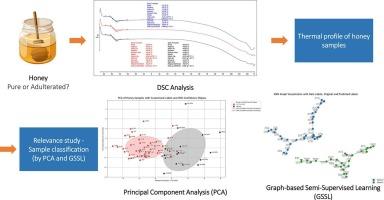
Honey is a valuable natural food product, prized for its nutritional and therapeutic properties. However, the widespread issue of honey adulteration, often involving the addition of plant-based syrups, poses significant challenges to global markets. This study utilized differential scanning calorimetry (DSC), a thermal-analytical technique, to characterize the thermal profiles of 43 honey samples, including both authentic and adulterated samples with high-fructose corn syrup (HFCS) and varying syrup concentrations. Principal component analysis (PCA) and graph-based semi-supervised learning (GSSL) were applied to classify the samples, achieving high accuracy. Results indicated that increasing adulteration levels led to higher water content and decreased glass transition temperature (Tg) and heat capacity difference (ΔCp). Furthermore, the established K-Nearest Neighbor (KNN) graph and Kullback-Leibler (KL) divergence effectively visualized relationships among samples. The integration of DSC with GSSL presents a cost-efficient and resource-effective approach for detecting honey adulteration with minimal experimental effort while maintaining high classification accuracy. This method holds promise for addressing honey adulteration in the food industry.
期刊介绍:
Food Chemistry publishes original research papers dealing with the advancement of the chemistry and biochemistry of foods or the analytical methods/ approach used. All papers should focus on the novelty of the research carried out.




 京公网安备 11010802042870号
京ICP备2023020795号-1
京公网安备 11010802042870号
京ICP备2023020795号-1

 分享
分享
 求助内容:
求助内容: 应助结果提醒方式:
 扫码关注我们
