Electronic nose technology for the detection of ergot alkaloid in soft wheat and identification of the relevant volatile compounds by solid phase microextraction/gas chromatography-high resolution Orbitrap-mass spectrometry coupled to chemometrics
{"title":"Electronic nose technology for the detection of ergot alkaloid in soft wheat and identification of the relevant volatile compounds by solid phase microextraction/gas chromatography-high resolution Orbitrap-mass spectrometry coupled to chemometrics","authors":"Maurizio Piergiovanni , Chiara Giliberti , Cristian Maffezzoni , Davide Errico , Massimo Blandino , Chiara Dall'Asta , Monica Mattarozzi , Federica Bianchi , Marco Giannetto , Maria Careri","doi":"10.1016/j.foodchem.2025.144455","DOIUrl":null,"url":null,"abstract":"<div><div>Ergot alkaloids (EA) are mycotoxins produced by <em>Claviceps purpurea</em> which commonly infects various cereal species, compromising food safety. This study evaluates the potential of the electronic nose to reliably predict EA contamination in wheat, demonstrating as a proof-of-concept the ability of this technology combined with supervised techniques to distinguish samples contaminated at levels of interest from compliant samples. In particular, the average value of samples correctly classified using PLS-DA was 95.5 %. Furthermore, a volatilomics approach based on HS-SPME/GC–Orbitrap HRMS and chemometrics was successfully applied for the first time to characterize the volatile compound pattern of wheat samples based on the level of EA contamination paying attention to the secondary volatile metabolites. Overall, a high confidence in compound identification was achieved with sub-1 ppm mass accuracy. Unsupervised PCA was used for discrimination purposes, revealing 19 differential compounds (markers), some of which are released during the growth of <em>Claviceps Purpurea</em> fungi.</div></div>","PeriodicalId":318,"journal":{"name":"Food Chemistry","volume":"484 ","pages":"Article 144455"},"PeriodicalIF":9.8000,"publicationDate":"2025-08-30","publicationTypes":"Journal Article","fieldsOfStudy":null,"isOpenAccess":false,"openAccessPdf":"","citationCount":"0","resultStr":null,"platform":"Semanticscholar","paperid":null,"PeriodicalName":"Food Chemistry","FirstCategoryId":"97","ListUrlMain":"https://www.sciencedirect.com/science/article/pii/S0308814625017066","RegionNum":1,"RegionCategory":"农林科学","ArticlePicture":[],"TitleCN":null,"AbstractTextCN":null,"PMCID":null,"EPubDate":"2025/4/22 0:00:00","PubModel":"Epub","JCR":"Q1","JCRName":"CHEMISTRY, APPLIED","Score":null,"Total":0}
引用次数: 0
Abstract
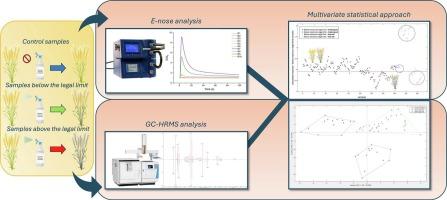
Ergot alkaloids (EA) are mycotoxins produced by Claviceps purpurea which commonly infects various cereal species, compromising food safety. This study evaluates the potential of the electronic nose to reliably predict EA contamination in wheat, demonstrating as a proof-of-concept the ability of this technology combined with supervised techniques to distinguish samples contaminated at levels of interest from compliant samples. In particular, the average value of samples correctly classified using PLS-DA was 95.5 %. Furthermore, a volatilomics approach based on HS-SPME/GC–Orbitrap HRMS and chemometrics was successfully applied for the first time to characterize the volatile compound pattern of wheat samples based on the level of EA contamination paying attention to the secondary volatile metabolites. Overall, a high confidence in compound identification was achieved with sub-1 ppm mass accuracy. Unsupervised PCA was used for discrimination purposes, revealing 19 differential compounds (markers), some of which are released during the growth of Claviceps Purpurea fungi.
期刊介绍:
Food Chemistry publishes original research papers dealing with the advancement of the chemistry and biochemistry of foods or the analytical methods/ approach used. All papers should focus on the novelty of the research carried out.




 京公网安备 11010802042870号
京ICP备2023020795号-1
京公网安备 11010802042870号
京ICP备2023020795号-1

 分享
分享
 求助内容:
求助内容: 应助结果提醒方式:
 扫码关注我们
